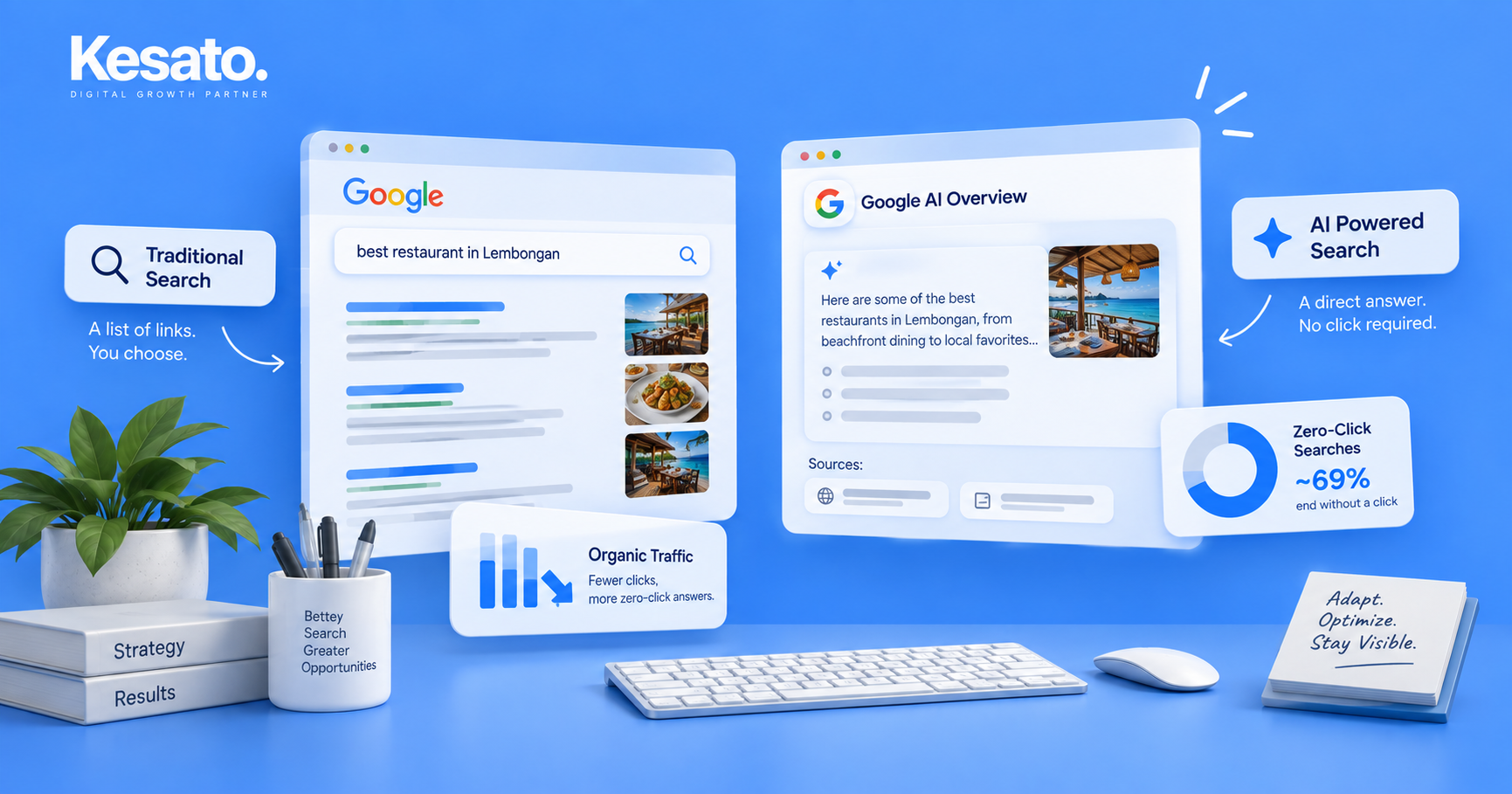
Type a question into Google today and you’ll often see two very different outcomes. Sometimes you still get ten blue links to choose from, other times an AI Overview answers you directly, no click required. This split, traditional search vs AI powered search, is reshaping how organic traffic behaves across every industry. The shift isn’t hypothetical, real data shows fewer clicks, more zero-click answers, and a growing gap between brands that adapt and brands that don’t. If your traffic has been sliding and you’re not sure why, working with an experienced SEO agency in Bali can help you read the signs correctly before it gets worse.
How Traditional Search vs AI Powered Search Actually Work
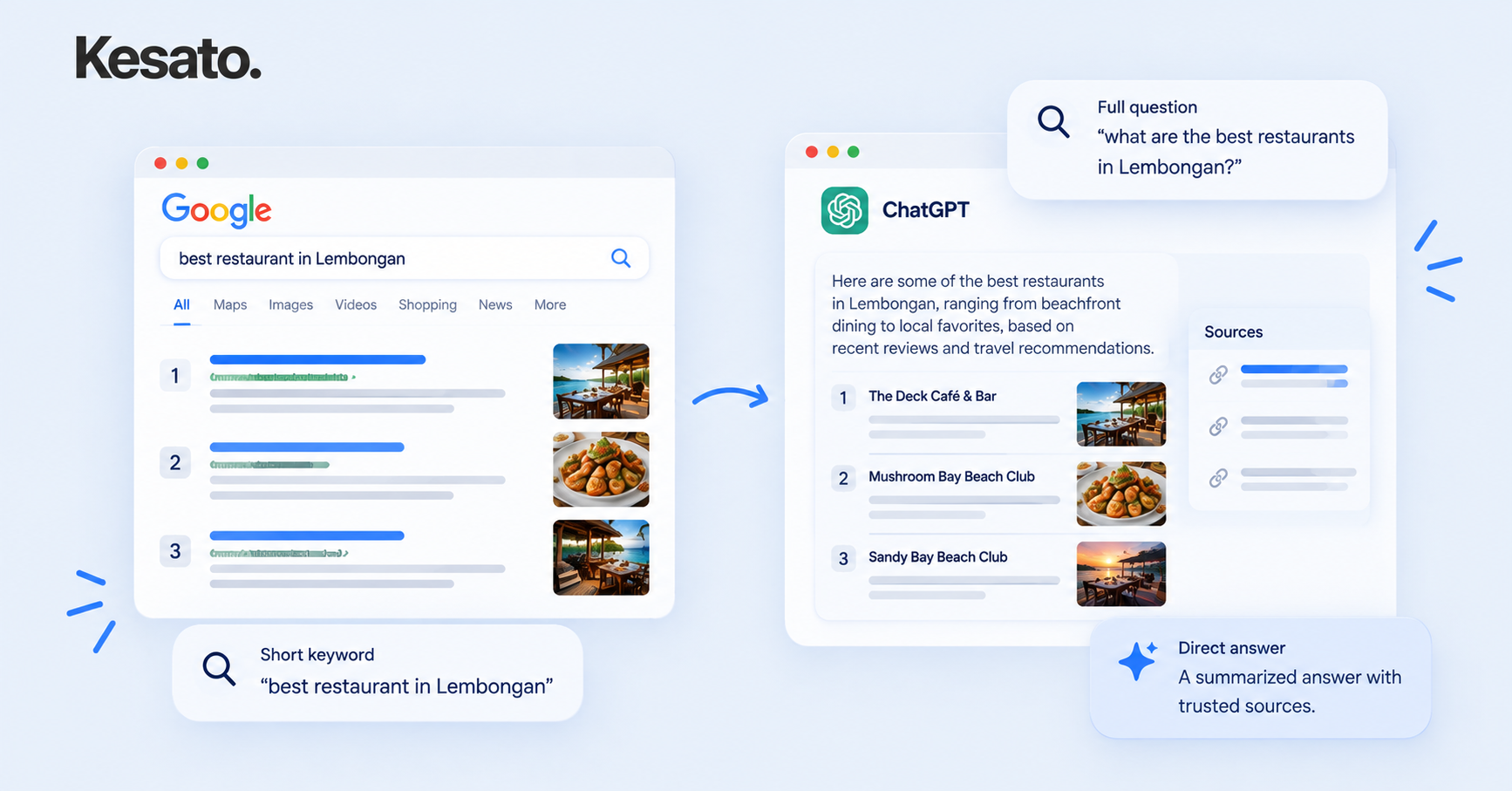
The difference starts with how people phrase a search. In traditional search, someone types a short keyword, like “best restaurant in Lembongan,” and scans a page of ranked links. In AI powered search, the same person is more likely to ask a full question, “what are the best restaurants in Lembongan,” and expect one direct answer instead of a list to sort through themselves.
The ranking logic behind the scenes is different too, and this is the part most people miss. Traditional search rewards position: being link number one is what earns the click. AI powered search rewards being the source the AI trusts enough to summarize and cite, regardless of where that page would have ranked on a traditional results page. A site can be a strong AI source without ever cracking the top three traditional rankings, and vice versa.
That’s the real shift: from competing for a spot on the page, to competing for a spot inside the answer itself.
The Real Impact on Organic Traffic
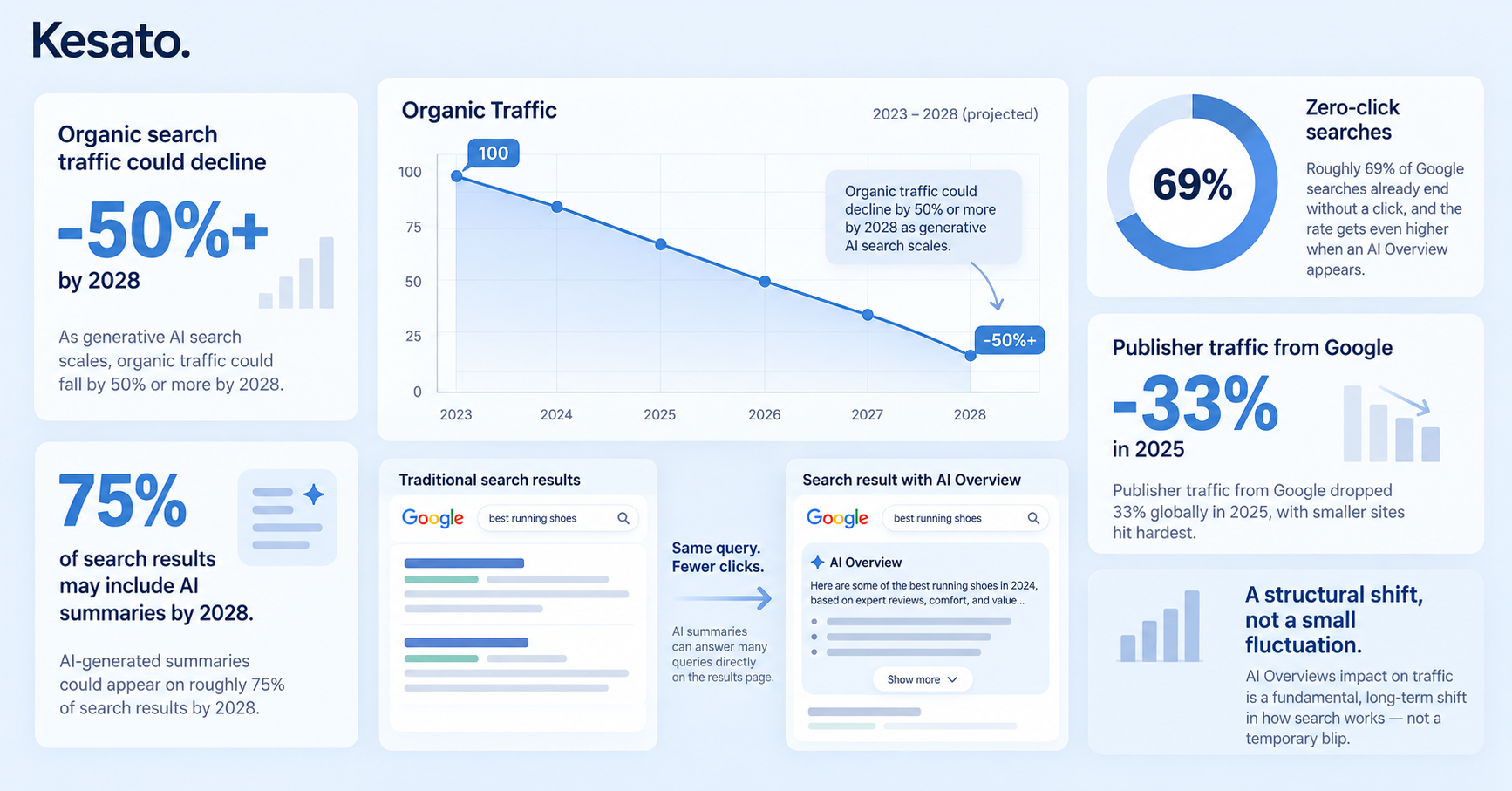
Significantly, and the numbers back it up. Gartner projects organic search traffic could fall by 50% or more by 2028 as generative AI search scales, and McKinsey research expects AI-generated summaries to appear on roughly 75% of search results by that same year, meaning most queries will pass through some kind of AI layer before a user ever reaches your site.
Separately, Similarweb data shows roughly 69% of Google searches already end without a click, climbing even higher once an AI Overview appears on the page. This is often described simply as the Google AI Overviews traffic drop, and the scale is bigger than many site owners expected. This is at the heart of organic traffic decline AI search conversations happening across the industry right now.
Publisher-level data tells a similar story: the same report found that Google traffic to publishers dropped 33% globally in 2025 alone, with smaller sites hit hardest. The pattern is clear: AI Overviews impact on traffic isn’t a rounding error, it’s a structural shift in where clicks go, or don’t go, at all.
Is AI Killing SEO?
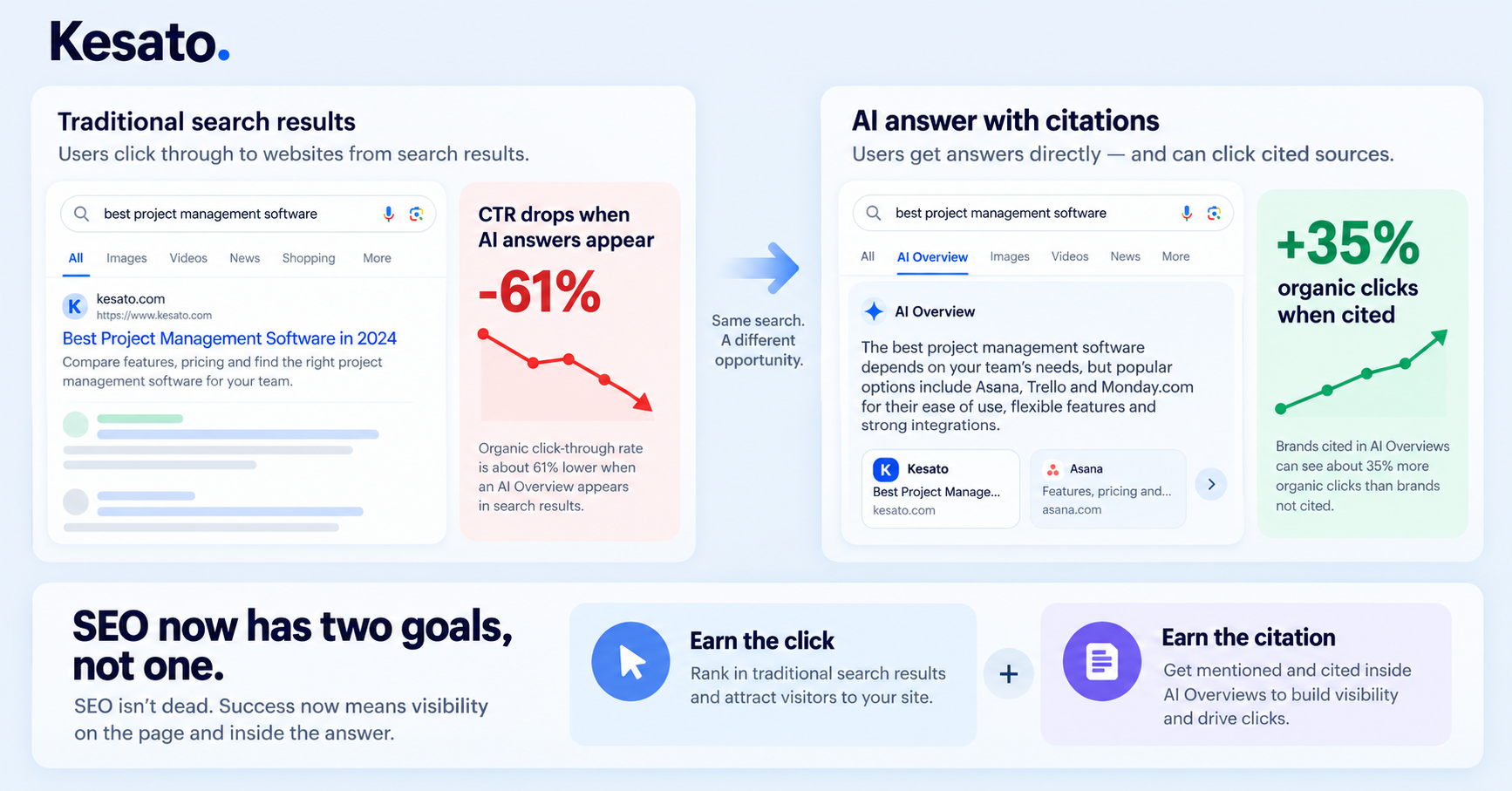
Not exactly, but it is redefining what success looks like. Is AI killing SEO is the wrong question if it assumes rankings and clicks are the only outcomes that matter. A more accurate read: AI is killing the assumption that a top ranking automatically means a visit.
Seer Interactive’s research found that when an AI Overview appears, organic click-through rate drops by roughly 61%, and paid click-through rate drops even further. That’s a real hit. But the same research found brands that get cited directly inside an AI Overview see roughly 35% more organic clicks than brands left out entirely, so visibility inside the answer can offset some of what’s lost outside it.
So SEO isn’t dying, it’s splitting into two goals: still earning the click when possible, and now also earning the citation when it isn’t.
AI Search Behavior Statistics You Should Know
Here’s a quick snapshot of the AI search behavior statistics worth tracking as you plan your own strategy:
- Zero click search: roughly 69% of Google searches end without a click, rising even higher when an AI Overview is present.
- Click-through rate impact: organic click through rate AI search data shows a drop of around 61% on queries where an AI Overview appears.
- Publisher traffic: global publisher traffic from Google fell 33% in 2025 alone, with smaller sites losing the most.
- AI features on the page: AI-generated summaries are projected to appear on roughly 75% of search results by 2028.
- Long-term projection: organic search traffic could decline by 50% or more by 2028 as generative AI search scales further.
- Citation payoff: brands cited directly inside an AI Overview see roughly 35% more organic clicks than brands that aren’t.
- AI referral conversion: traffic referred from AI tools converts at around 14.2% in early data, notably higher than typical organic traffic conversion rates.
These aren’t reasons to panic, they’re reasons to plan around real numbers instead of guessing.
How to Adapt Your Content for Both Types of Search
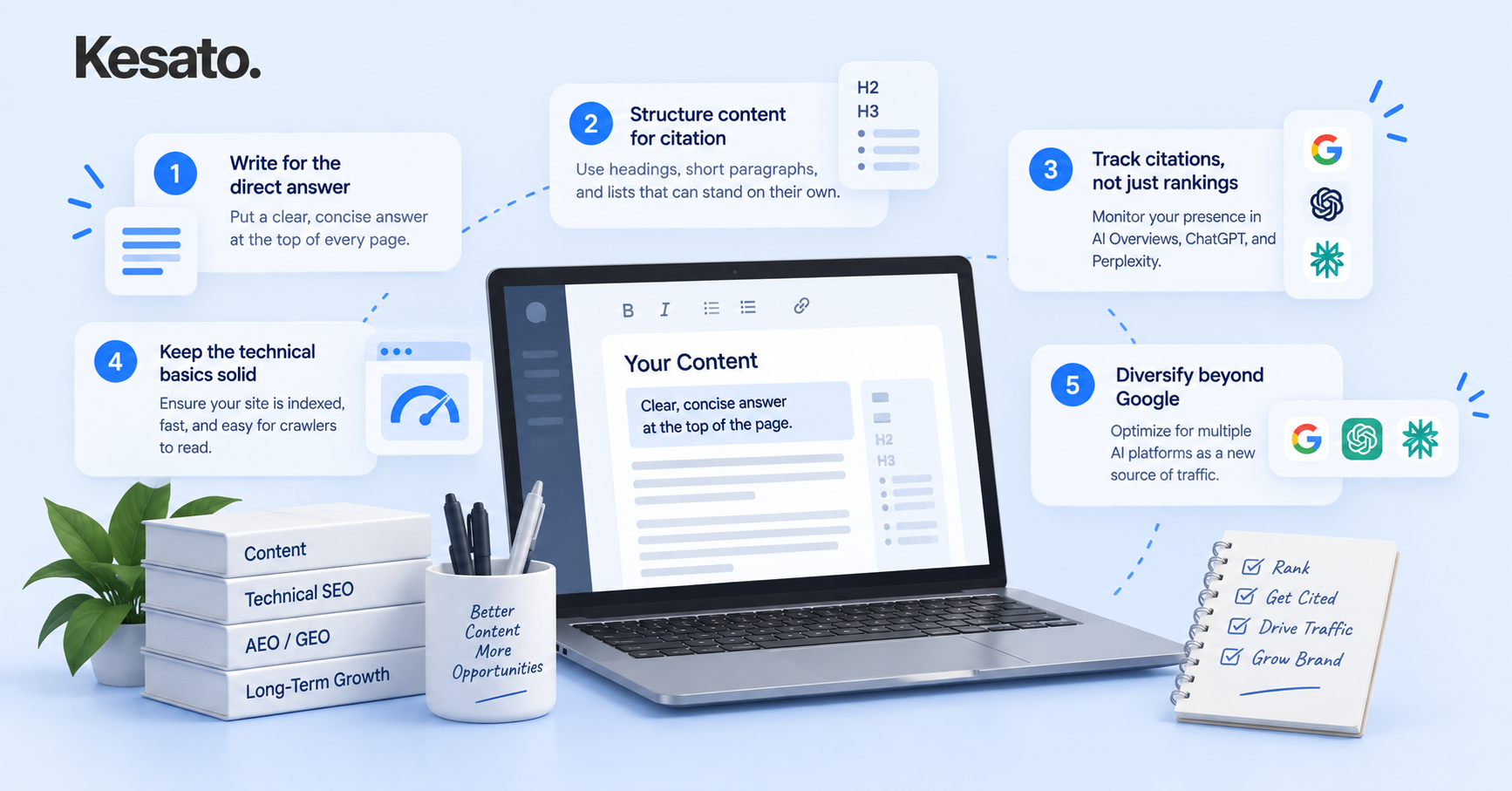
Adapting your content for both traditional and AI-powered search starts with the basics:
- Write for the direct answer, not just the ranking: Put a clear, concise answer near the top of every page so both traditional search and AI tools can use it.
- Structure content for citation: Use headings, short paragraphs, and lists that can stand on their own if an AI pulls just one section.
- Track citations, not just rankings: Start monitoring whether your brand shows up inside AI Overviews, ChatGPT, or Perplexity answers, not only your position on page one.
- Keep the technical basics solid: None of this works if your site isn’t indexed, fast, and easy for crawlers to read. Our SEO and GEO checklist walks through exactly what to check.
- Diversify beyond Google: With AI referral traffic growing across multiple platforms, showing up in ChatGPT or Perplexity answers is becoming its own channel worth optimizing for.
If you want a deeper look at how to prioritize this work based on how established your website already is, that’s exactly what we cover in SEO in the age of AI, our broader look at building an SEO strategy that holds up as AI search keeps growing.
Frequently Asked Questions About AI Powered Search
Is Traditional Search Going Away Completely?
No. Most queries, especially transactional or local ones, still rely on a traditional results page with links. Traditional search vs AI powered search isn’t a full replacement, it’s a split where AI increasingly handles broad, informational questions while traditional search still handles the rest.
How Long Does It Take to See Results From Adapting to AI Powered Search?
There’s no fixed timeline, but most brands start seeing early signals, like appearing in AI Overviews or getting cited by AI tools, within a few months of improving content structure, technical SEO, and topical authority together.
Does This Affect Every Industry the Same Way?
No. Informational and research-heavy industries feel the organic traffic decline AI search trend the most, since AI can summarize answers easily. Highly transactional or local searches, like booking a service or finding a nearby business, are affected less for now.
Should I Stop Investing in Traditional SEO?
No. Traditional SEO fundamentals, technical health, quality content, and backlinks, are the same signals AI systems use to decide what’s trustworthy enough to cite. Dropping traditional SEO doesn’t help you show up in AI answers either, it just means you lose ground on both fronts at once.
What Should I Track to Measure the Impact of AI Powered Search?
Beyond rankings and clicks, track impressions and citations inside AI Overviews, ChatGPT, or Perplexity answers, along with any referral traffic coming from those platforms. Most analytics tools are still catching up, so manual spot-checks with your own brand and product queries are worth doing regularly.
Do I Need to Optimize for Platforms Other Than Google?
Increasingly, yes. As AI Overviews impact on traffic grows on Google, users are also turning directly to tools like ChatGPT and Perplexity to research and compare options, so visibility across multiple AI platforms is becoming its own consideration, not just an extension of Google SEO.