Try searching your business name on Google. Your website almost certainly comes up first. Now search your category along with your location, the way someone who’s never heard of you would. That’s usually where your website disappears and a competitor shows up instead. Closing the gap between those two results is what SEO has always been about. Some businesses have a problem one step further along, where the visits are there and the numbers look fine in reports, but none of it turns into an inquiry or a booking.
Recently a third layer has appeared. More people now ask ChatGPT or Gemini directly for recommendations, and the answers already come back naming specific businesses. All three trace back to the same thing: how machines read and judge your website. This article covers what needs to be in place, and how to check each of it yourself.
How SEO and GEO Work and Why They Depend on Each Other
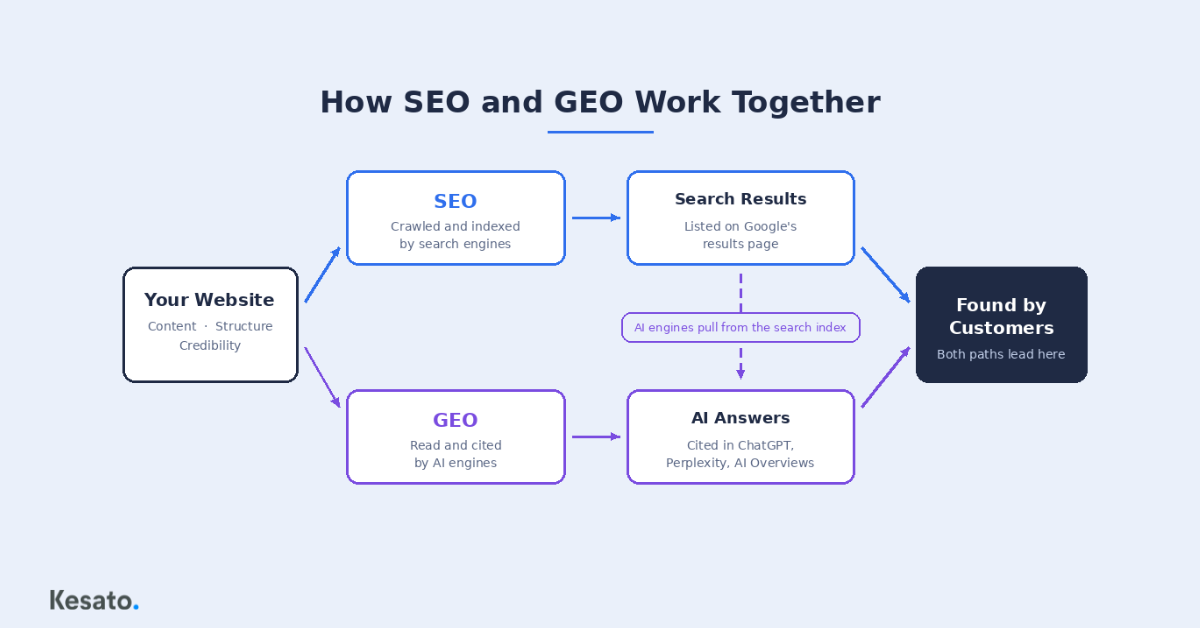
For years, being found online meant one thing, showing up on Google’s first page. The work of getting there is what we’ve long called SEO, short for Search Engine Optimization.
Now there’s a second path. People ask an AI engine a question and get an answer straight away, without ever opening a single link. The work of getting your business named in that answer is called GEO, short for Generative Engine Optimization. Here’s the part that matters: the two don’t operate independently. AI engines don’t crawl the internet from scratch every time they answer. Most of what they pull comes from the existing search index. So a website Google can’t read has almost no chance of appearing in an AI answer, no matter how good the content is.
| SEO | GEO | |
| What it means | Making your website easy to find in search engines | Making your website get cited in AI-generated answers |
| How it works | Pages are crawled, stored in an index, then shown when a relevant search happens | Answers are assembled from multiple sources at once, most of them drawn from the search index |
| What you get | A list of links on a results page | A short answer that names its sources |
| What’s judged | Keyword relevance, domain authority, user experience | Structural clarity, how easily content can be quoted, source credibility |
| Strengths | Measurable, mature tooling, results trackable per keyword | Reaches people who no longer open a results page at all |
| Limitations | Takes time, heavy competition on popular keywords | No standard measurement yet, results shift between conversations |
| How to measure | Search Console, keyword rankings, organic traffic | Regular prompt testing, referrals in analytics, brand mentions |
The Basics That Need to Work Before SEO and GEO Matter
Most problems people assume are SEO issues actually stop at a much earlier layer. If the items below aren’t sorted, nothing built on top of them will produce results.
- Your website is indexed by Google. Type site:yourdomain.com into Google. If nothing comes back at all, no SEO or GEO work can begin
- Page load speed. Slow pages lose visitors before the content ever gets read
- How it looks on a phone. Most visitors arrive on small screens, and Google evaluates the mobile version first
- A security certificate. Your address should start with https, not http
- Clean page addresses. URLs that are readable to people are easier for machines to interpret too
- Clear navigation. Every important page should be reachable within two or three clicks from the homepage
- Content that isn’t loaded entirely through JavaScript. Text that only appears after a script runs often isn’t picked up by crawlers
- Complete business information. Name, address, contact details, and opening hours written plainly on a page that’s easy to find
None of these raise your rankings on their own. Their job is to make sure nothing is standing in the way before the real work starts.
What Determines Whether Search Engines Find Your Website
Keywords that match how people actually search
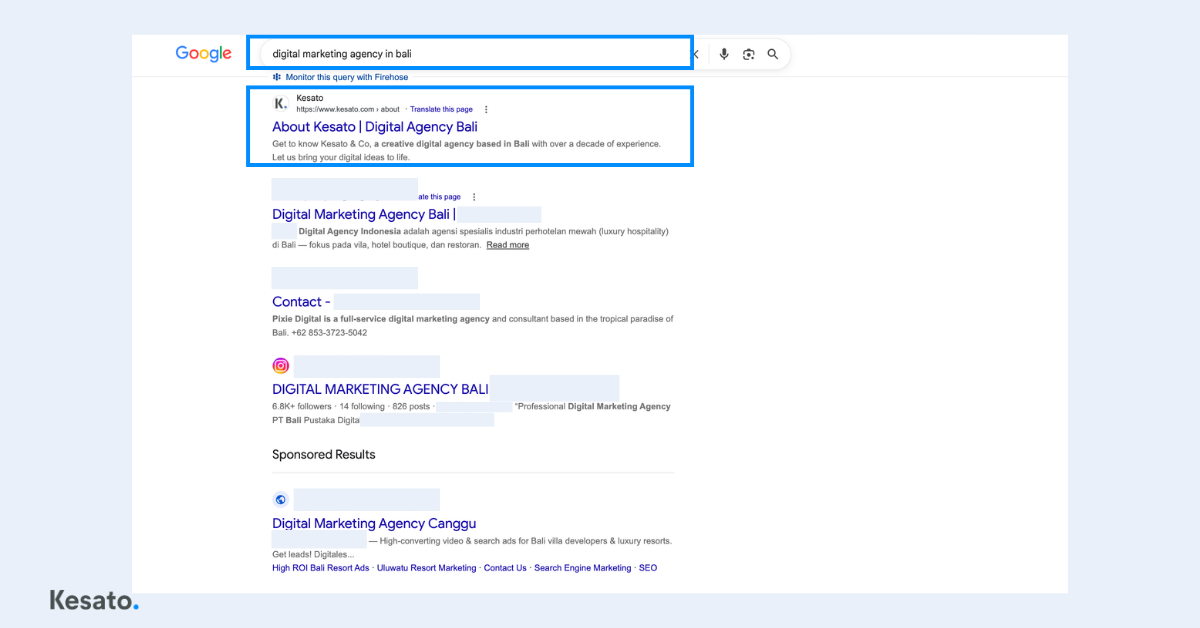
The words you use aren’t necessarily the words your customers type. People inside an industry lean on technical terms, while buyers use everyday language.
Type your main keyword into Google, then look at the related searches at the bottom of the page and the autocomplete suggestions as you type. Both show you how people are really searching.
Page titles and descriptions
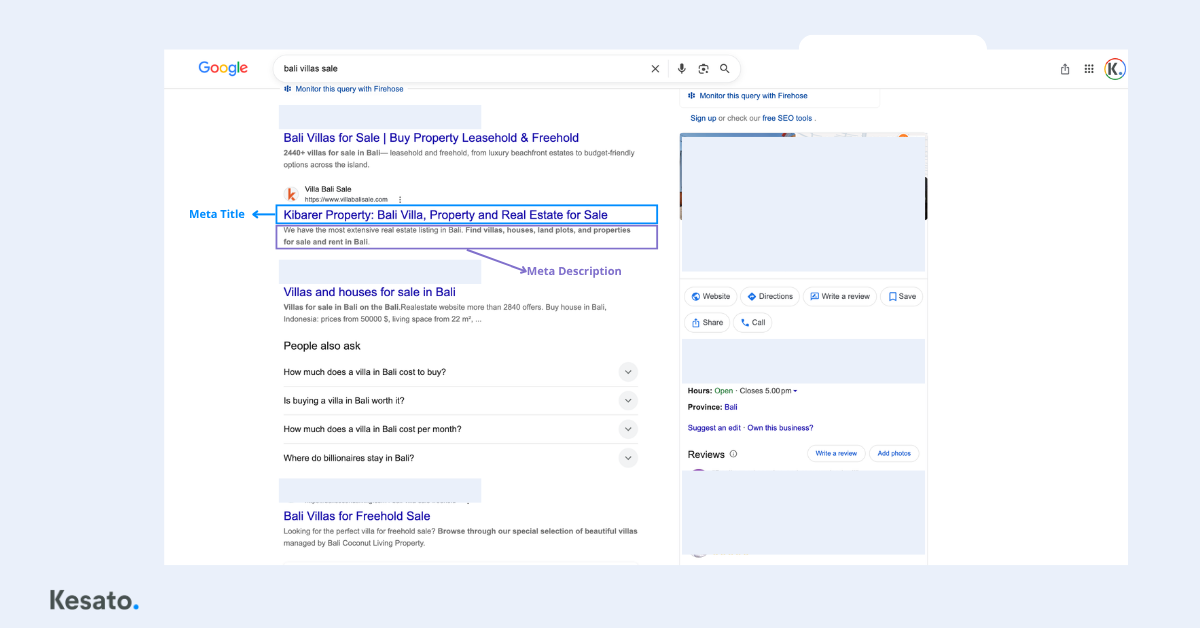
The page title is the blue text that appears in search results, and the description is the two lines beneath it. Together they decide whether someone clicks or scrolls past, and both get cut off when they run too long.
Google’s display limit on desktop is 600 pixels. When a page title runs longer than that, Google generally shows only the first 600 pixels, which works out to roughly 60 characters. Source: Zyppy SEO, The Ideal Title Tag Length for SEO
For descriptions, a safe range is 120 to 155 characters so the text stays intact on both phone and desktop screens.
Search for your page on Google and look at how it appears there. A truncated title means it’s too long, and a description that looks randomly pulled from the page body means the field was never filled in.
Heading structure
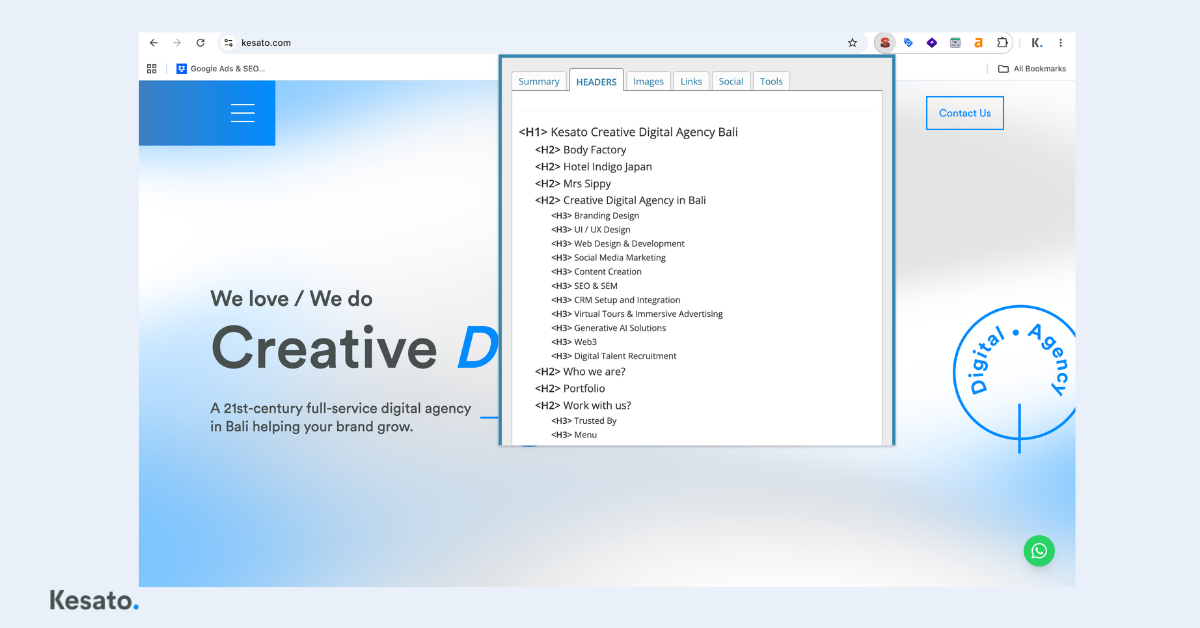
Headings are the markers for titles and subheadings within a page, running from H1 down to H6. The levels tell machines which sections are primary and which sit inside them.
Install the free Detailed SEO Extension for Chrome, then open your page and view its heading list in a single panel. What you’re looking for is any page with more than one H1, or levels that skip a step.
Content that matches search intent
Pages that rank well usually aren’t the longest ones. They’re the ones that most directly answer the intent behind the search. Someone looking for prices needs a pricing page, not a long article about your company history.
Open the top five results for your target keyword and pay attention to the page type. If they’re all product pages while you’ve been preparing an article, your page type doesn’t match what people are looking for.
Links between your pages
Pages within your site should connect to one another rather than sit in isolation. Internal links help machines understand which pages matter most. Open your most important page and count how many other pages link to it. If the only way there is through the menu, it isn’t well connected yet.
Images and alt text
Machines don’t see images, they only read the descriptions attached to them. Descriptive file names and alt text help your images surface in search too. Right-click an image on your site, choose inspect, and check whether the alt attribute is filled in. File names like IMG_2381 are worth replacing with something that describes the content.
Your business profile for local search
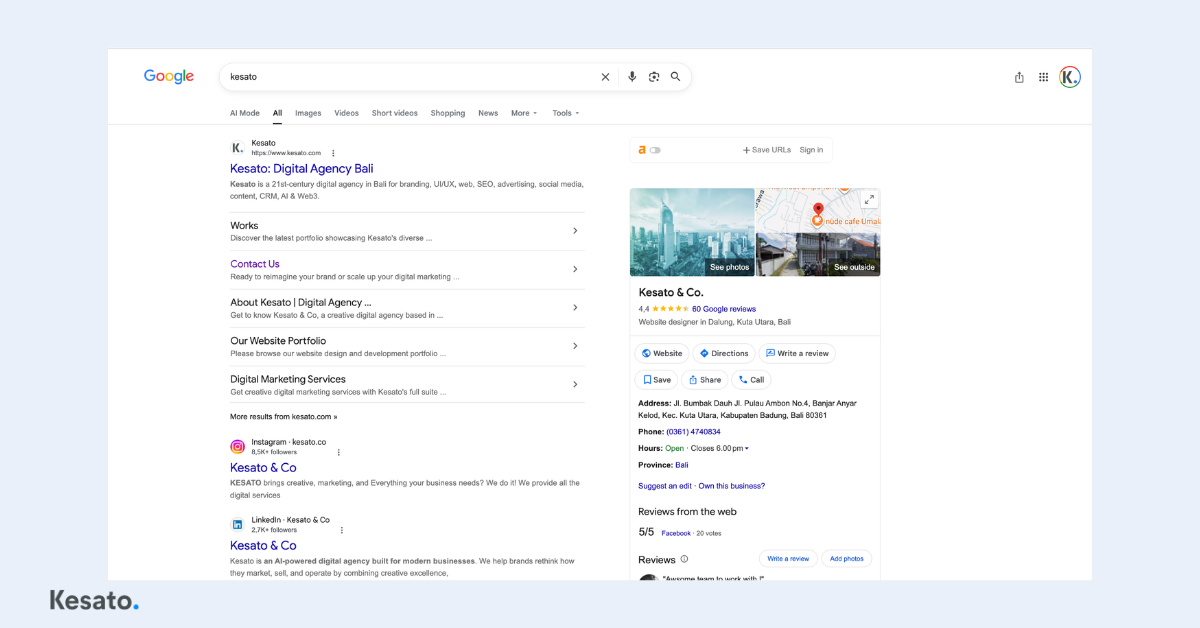
For businesses serving a specific area, a Google business profile often carries more weight than the website itself, especially for searches made on a phone. Look up your business name on Google Maps and check whether the category, opening hours, photos, and reviews are complete and current.
Mentions and links from elsewhere
A website recommended by other websites is treated as more trustworthy. For local businesses, mentions in directories, local media, and review platforms are worth as much as conventional links.
Type your business name in quotation marks into Google and see where the name appears outside your own site.
Does running Google Ads improve your organic rankings?
No. Ads and organic results are evaluated by entirely separate systems, and paying for ads gives you no advantage in the natural rankings. The two can run alongside each other, but one doesn’t substitute for the other.
Blog Articles Are Where SEO and GEO Meet
Service pages answer people who already know what they’re looking for. Blog articles reach the people still figuring it out, and that group is far larger.
Blogs are also the one asset that works both sides at once. A well-structured article can rank in search and get cited by AI engines, because both are judging similar things: clear structure, answers that land, and credible sourcing.
- One article answers one main question, rather than mixing several topics into a single page
- Section headings written as questions, since that’s closest to how people search and ask
- A short answer at the start of each section, two or three sentences, before the longer explanation
- Lists and bullets for anything sequential, since they’re easier to lift whole as a quotation
- Short paragraphs, two to four lines, so the text stays readable on a phone
- An author name and an update date, signaling the content is still current
- A link to the relevant service page, so interested readers have a next step
An article built this way doesn’t need two versions. One well-structured piece already works for both paths.
Are articles written with AI safe for SEO?
Yes, as long as the content is accurate, brings its own perspective, and gets reviewed by a person before it goes live. Search engines judge the quality and usefulness of the writing, not the tool used to produce it.
What Determines Whether AI Engines Cite Your Website
Access for AI crawlers
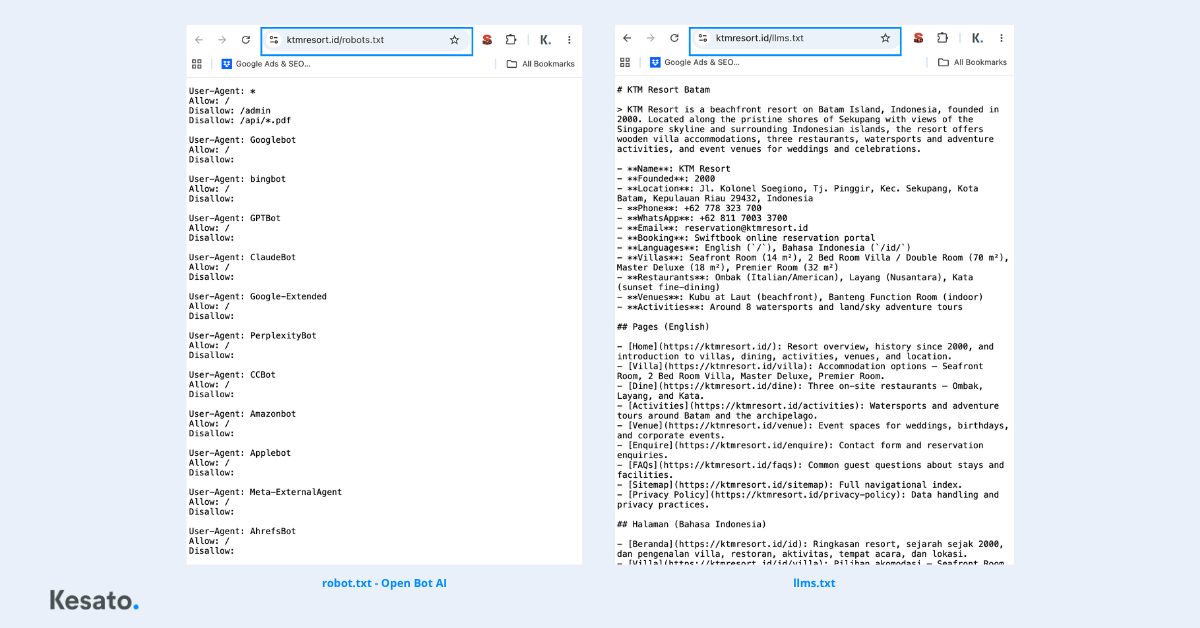
AI engines use their own crawlers, which can be allowed or blocked through your website settings. Some hosting providers block them by default without telling the site owner.
Open yourdomain.com/robots.txt in a browser and check for any line blocking crawlers like GPTBot, ClaudeBot, or PerplexityBot.
At that same root address, another file called llms.txt comes up often. It holds a summary of your site and a list of its most important pages, meant as a guide for AI engines. It’s still a community proposal rather than an official standard.
Google has stated in its own documentation that it neither needs nor uses llms.txt to surface a website in Search or in AI features like AI Overviews. Source: Greadme, Is llms.txt Worth It for AI Search
Creating one is cheap and harmless, so treating it as an experiment is reasonable. Treating it as a priority over content structure and structured data is not.
Content structured to be quotable
AI engines cite passages that stand on their own. A page that flows without clear divisions is hard to use as a source, because there’s no section that can be lifted intact.
Three things decide this:
- Each section covers one thing: rather than mixing several topics into the same paragraph
- Avoid sentences that lean on other sections: like “as explained above,” since the meaning disappears the moment that passage is separated
- Name the key terms in full: instead of substituting “this” or “it,” so the passage stays clear about its subject even when read alone
Take one section of your page and read it apart from the rest. If it still makes sense without the preceding context, the structure is working.
A direct answer at the start of each section
Sections that open with a concise answer stand a better chance of being cited than ones that build toward the point slowly. Two or three sentences is enough, with the explanation following after.
Open your page and read only the first sentence of each section. If that sequence alone answers the core question, your page is easy to cite.
How people phrase questions to AI engines
In a search engine, people type fragments. In an AI engine, they write full questions with the context included. Pages built only around short keywords often don’t line up with that longer form.
Collect the questions your customers genuinely ask over messages or calls, then check whether any page on your site answers them directly.
Structured data
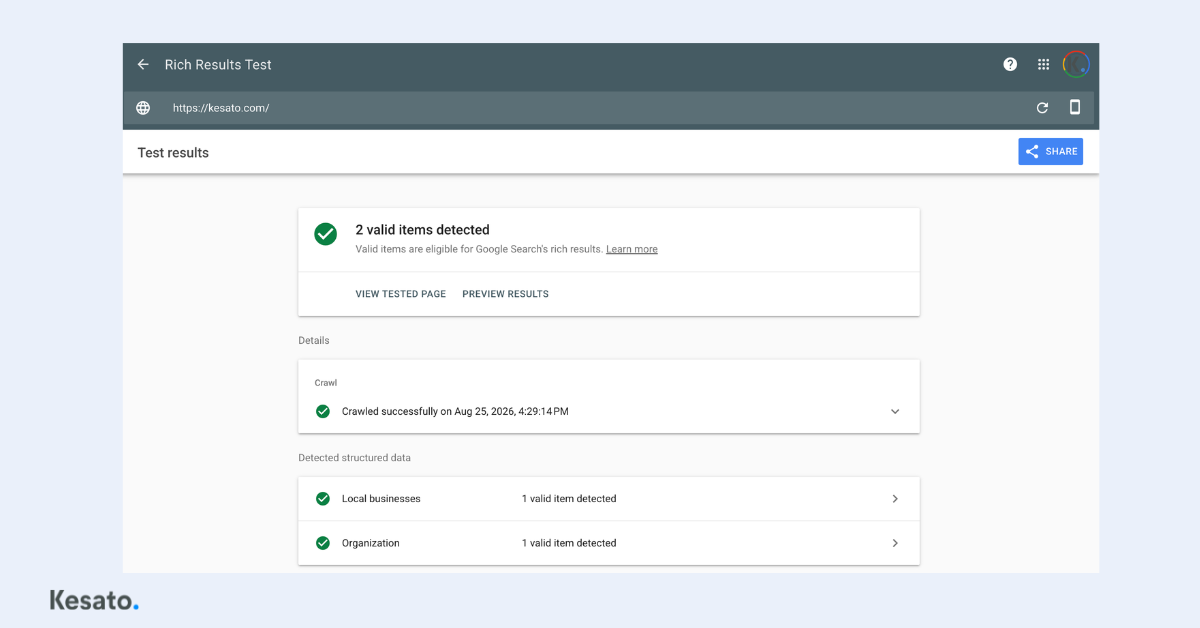
Structured data is additional information behind a page that tells machines what the page contains, whether that’s an article, a product, a set of questions, or a business profile.
The type you use depends on the page. A business with a physical location needs a business profile markup covering address, hours, and service area. Pages with questions and answers need FAQ markup. Blog articles use article markup with an author name and publication date. Offer pages use product or service markup.
Run your page address through Google’s Rich Results Test. The tool shows which structured data types it can read along with any errors that need fixing. If the results come back empty while your page clearly falls into one of the categories above, the markup simply isn’t there.
Authorship and credibility signals
AI engines lean toward sources that make clear who wrote the content and what it’s based on. An author name, their expertise, an update date, and references to trustworthy sources all play a part.
The difference from search engines is in how the selection happens. A search engine shows many results at once and leaves the judgment to the reader. An AI engine has to pick a handful of sources and assemble them into one answer. When two pages are equally good, the one with a clear identity almost always beats the anonymous page with no author and no date.
Open your most important page and look for those four things. If none of them are there, your page loses to any source that includes them.
Consistent information beyond your website
AI engines build answers from many sources, not just your site. A name, address, or business type written differently in different places makes it harder for a machine to be sure they all refer to the same business.
Compare how your business name and address are written on your website, Google Maps, social media, and booking platforms. Make them match right down to the punctuation.
Whether your business is already being named
This is the check that shows your current position most directly.
Write ten questions your customers might realistically ask, not your brand name. Run them through ChatGPT and Gemini in incognito mode, then note which brands and sources come up. Repeat monthly, because what matters is the pattern rather than a single attempt.
One thing worth accepting early: GEO doesn’t have measurement as settled as SEO. Results can differ between conversations even for the same question, and no official report separates AI-driven visits cleanly. It’s better read as a trend across months than as a precise weekly number.
Start at the Bottom Layer, Not the Newest One
If working through the list above turned up a lot that isn’t in place, the order you tackle it matters more than the total. Fix the basics first, then the SEO side, then GEO. Working on GEO over a website that isn’t indexed is like putting up a sign on a road that doesn’t exist yet.
Some businesses work through this gradually on their own, others hand it to a team that does it every day. Both are valid. What matters is not skipping the bottom layer.
If you’d like to see your website assessed from both sides, that’s usually where our team starts.
FAQ
Does GEO replace SEO?
No. GEO extends your reach into new territory, but it stands on the same groundwork. A website search engine can’t read won’t suddenly appear in AI answers just because its structure was tidied up.
How long before SEO and GEO results show?
Technical and structural fixes are usually picked up by machines within weeks. Changes in rankings and in how often you’re named in AI answers generally start showing after three to six months of consistent work.
Do small businesses need to do both at once?
Yes, though not simultaneously. Most foundational work like content structure and structured data benefits both sides at the same time, so building the foundation already covers a good part of each.