A traveller opens ChatGPT and types: “Find me a quiet boutique hotel in Uluwatu for a honeymoon, under $250 a night.” Seconds later, the answer names three or four properties. If yours is not one of them, that guest may never see your website, your OTA listing or your booking engine.
To get your hotel recommended by ChatGPT, make your property easy for AI to find, understand and trust: let AI crawlers read your website, state clearly who your hotel is for, keep every listing consistent, collect detailed reviews and earn mentions on sites AI already relies on. This practice is called generative engine optimization (GEO), and it builds on SEO rather than replacing it.
Key takeaways
- AI assistants recommend hotels that clearly match the traveller’s exact request: location, guest type, budget and atmosphere.
- Blocked AI crawlers are one of the fastest problems to fix and one of the most damaging to ignore.
- Consistent facts across your website, Google Business Profile and OTAs give AI the confidence to name you.
- Among similar properties, reviews and third-party mentions decide who gets recommended.
Why does AI visibility matter for hotels now?
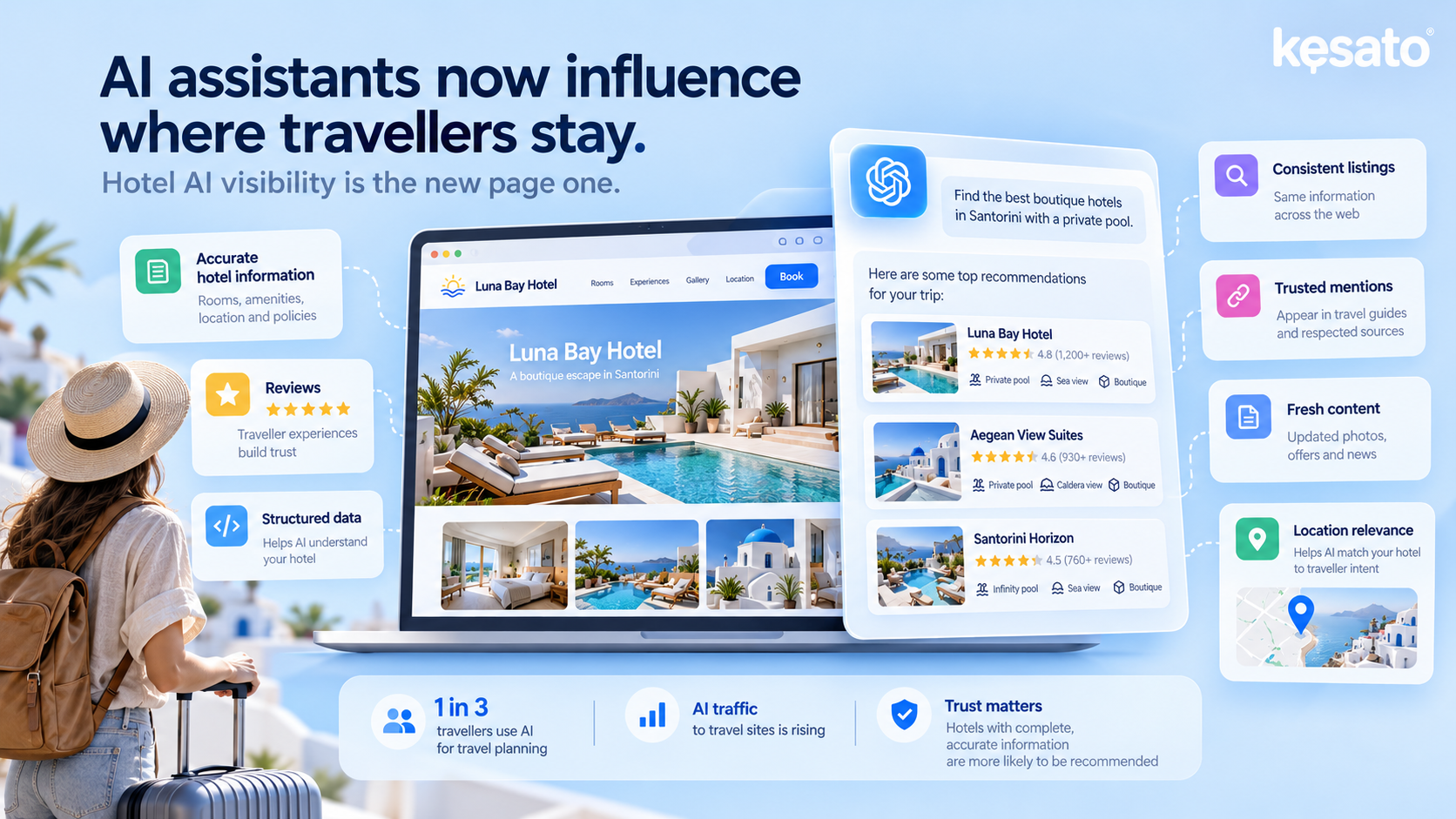
Travellers already use AI to decide where to stay. Phocuswright found that more than half of US travellers have tried generative AI, and one in three use it for travel. Adobe recorded a 3,500% year-on-year rise in traffic from generative AI sources to US travel websites in July 2025, and those visitors were 15% more engaged than visitors from other channels. Adoption is even higher outside the US: the Global Rescue Fall 2025 survey found that 30% of non-US travellers had already used generative AI to plan a trip.
Trust is the deciding factor. The same Phocuswright research found that only about a third of travellers fully trust AI answers, which is why assistants favour hotels whose details are confirmed by several reliable sources.
Hotel AI visibility is how often, and how accurately, assistants such as ChatGPT, Gemini, Perplexity and Google AI Overviews name your property when travellers ask for recommendations. An AI answer usually names only a handful of hotels. Being one of them is the new page one.
How does ChatGPT choose which hotels to recommend?
ChatGPT recommends the hotels that best match the request and have the strongest evidence behind them. With search enabled, it runs web searches, reads the pages it finds and summarises the options, using OpenAI’s own crawler, OAI-SearchBot, to surface content. Without search, it relies on what the model learned during training, which is often outdated for hotels.
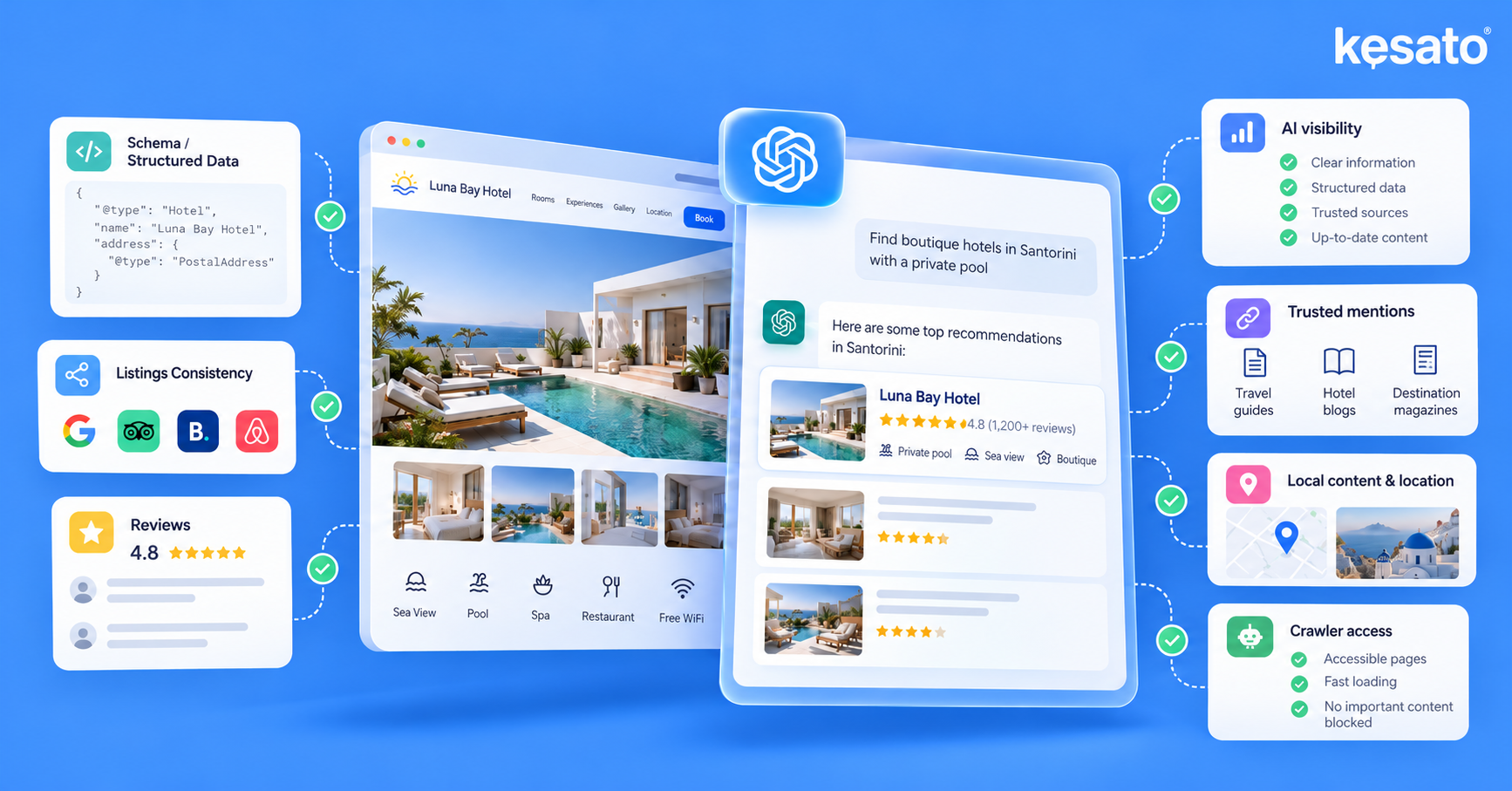
Gemini, Google AI Overviews and Perplexity work in similar ways, drawing on search indexes, local data such as Google Business Profile and cited sources. Across all of them, five signals decide which hotels get named:
| Signal | What AI looks for | What you control |
| Relevance | Location, guest type, budget and atmosphere stated in plain text | Room pages, FAQs, About page |
| Consistency | The same name, address and facts everywhere | Website, Google Business Profile, OTA listings |
| Reputation | Rating, volume and wording of recent reviews | Review requests and replies |
| Authority | Mentions on independent travel sites | PR, local guides, creator partnerships |
| Accessibility | Pages that crawlers can read | robots.txt, CDN and firewall settings |
For the wider shift behind this, see our guide to traditional search vs AI-powered search.
What steps get a hotel into AI answers?
1. Let AI crawlers read your website
Check your robots.txt file and your firewall or CDN bot settings. If they block OAI-SearchBot, PerplexityBot or Googlebot, those assistants cannot read your pages. It takes five minutes to check and is one of the most common problems on hotel websites.
2. Write facts AI can quote
AI extracts sentences that make sense on their own, and it reads text, not images. Write key facts as complete statements, for example: “Villa Ombak is a 12-villa, adults-only retreat in Pererenan, a five-minute walk from the beach.” Research on generative engine optimization found that adding statistics, quotations and cited sources can raise a page’s visibility in AI answers by up to 40%, so support your claims with real numbers wherever you can.
3. Add hotel schema markup
Structured data tells search engines and AI exactly what your property is. Use the Hotel or LodgingBusiness type with your address, geo coordinates, star rating, price range, amenities and check-in times, plus FAQPage schema for your FAQs.
Does schema markup guarantee my hotel appears in ChatGPT? No. Schema makes your information clearer and easier to verify, but AI still weighs relevance, reviews and outside mentions. Treat it as a foundation, not a shortcut.
4. Keep every listing consistent
Use the same property name, address, phone number and core description on your website, Google Business Profile, OTA listings and social profiles. If one listing says “Villa Ombak” and another says “Ombak Villas Canggu,” AI may treat them as two properties, or trust neither.
5. Build reviews that describe specifics
A review that mentions “quiet, great for remote work, fast Wi-Fi” gives AI attributes it can match to a guest’s request. Ask happy guests to say what they enjoyed, and reply in a way that reinforces your strengths.
6. Earn mentions on sites AI trusts
AI assistants lean heavily on independent sources. Pitch your property to travel writers, local guide sites and curated “where to stay” lists. Each credible mention makes your hotel a safer recommendation.
7. Publish local expertise, not just room pages
Articles that answer questions such as “how to get from the airport to Canggu” or “the best time to visit Nusa Lembongan” show that your hotel knows its destination.
What we check first in a hotel AI visibility audit
When we audit a hotel’s AI visibility at Kesato, we start with four checks:
- Crawler access: Can OAI-SearchBot, PerplexityBot and Googlebot reach the website, including room pages behind the booking engine?
- The one-sentence test: Could an AI describe the hotel accurately in one sentence using only the homepage? If not, the positioning is unclear, and that usually starts with hospitality branding, not SEO.
- Listing consistency: Do the website, Google Business Profile and OTAs agree on name, location and core facts?
- Competitor sources: Which websites do AI answers cite for competing properties, and is the hotel present on them?
Why is my hotel not showing up in ChatGPT?
When a hotel never appears in AI answers, the cause is usually one of these:
- AI crawlers are blocked by robots.txt or bot protection
- The website relies on images and a booking widget, with little readable text
- The property name or address varies between listings
- Reviews are few, old or vague
- No independent site has written about the property
- The website does not say clearly where the hotel is and who it is for
How can you measure your hotel’s AI visibility?
Measure AI visibility by testing the questions your ideal guests actually ask. Write down 10 to 20 prompts, such as “best family resort in Nusa Dua with a kids’ club” or “romantic villa in Ubud with a jungle view.” Run each one in ChatGPT, Gemini, Perplexity and Google, and record four things:
- Mention rate: how many answers name your hotel
- Position: where you appear among the options
- Accuracy: whether the facts about your hotel are correct
- Cited sources: which websites the AI relies on
Repeat the same prompts every month. The competitors and sources that keep appearing show you exactly where to focus. Our article on SEO and GEO for business websites explains how this fits into a wider search strategy.
What this means for hotels and villas in Bali
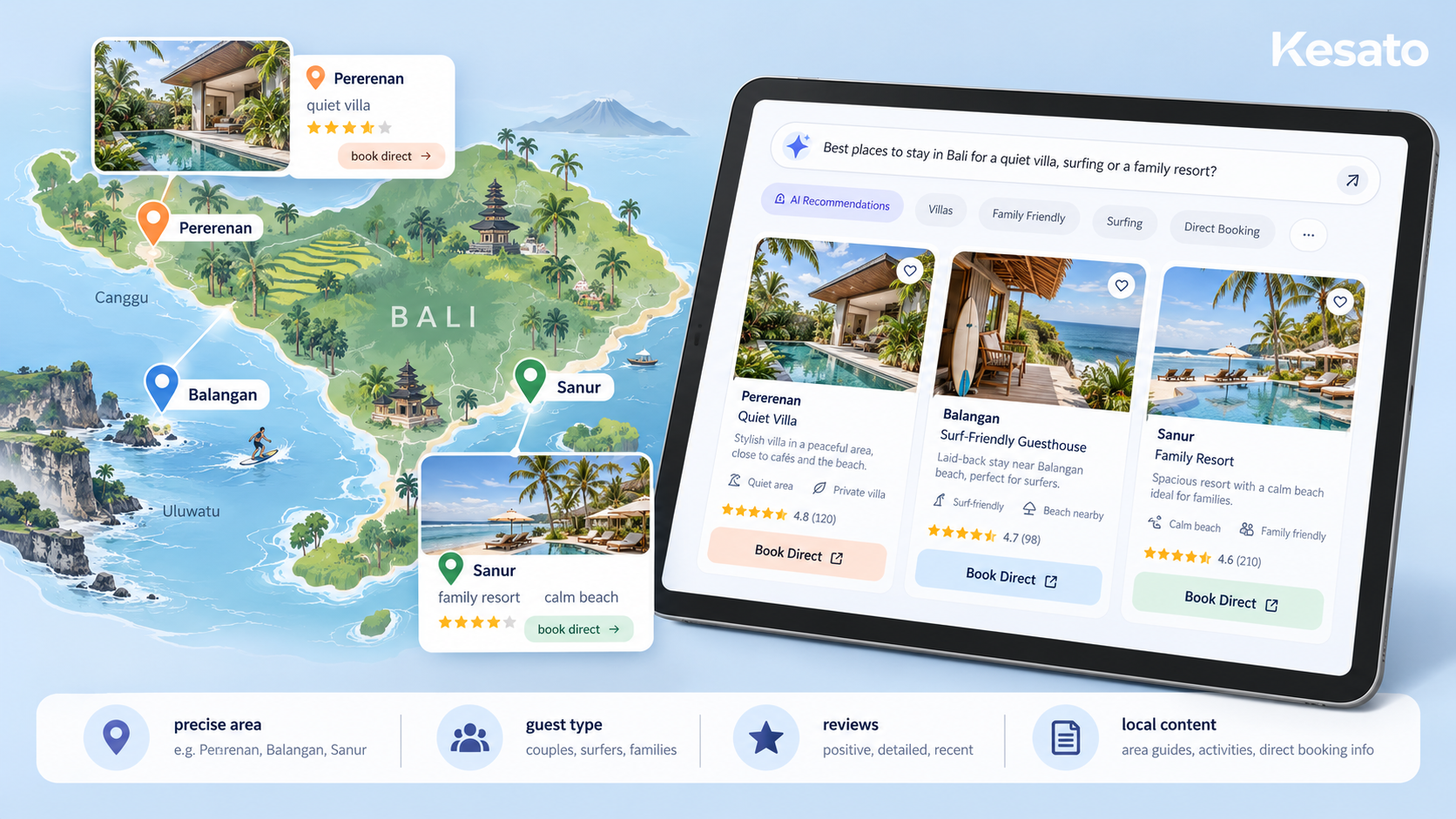
Bali travellers ask AI very specific questions. They ask for a quiet villa in Pererenan, a surf-friendly guesthouse near Balangan or a family resort in Sanur with a calm beach. Properties that describe their exact area, setting and guest type in clear English are far more likely to match these prompts.
State your precise area consistently, because neighbourhoods like Canggu, Berawa and Pererenan blur together. And since OTAs dominate Bali search results, a well-structured website with its own reviews and local content gives AI a reason to send guests to you directly.
How Kesato helps hotels get recommended by AI
At Kesato, we help hotels, resorts and villas across Bali build that visibility through SEO and GEO, schema markup, website development and AI solutions, all under one roof. Want to know what ChatGPT says about your property today? Contact our team for an AI visibility check.
Frequently Asked Questions
How long does it take for a hotel to appear in AI answers?
Fixes to your website and listings can show up in search-enabled assistants within a few weeks, once pages are recrawled. Building the reviews and third-party mentions behind consistent recommendations usually takes several months of steady work.
Is SEO still important for hotels in the age of AI?
Yes. AI assistants often find hotels through search engines, so strong SEO remains the foundation of AI visibility. We explain why SEO in the age of AI still matters.
Do hotel reviews affect AI recommendations?
Yes. AI uses reviews to judge quality and to understand what a property is good for. Detailed, recent reviews that mention specific features give AI more reasons to match your hotel with the right guest.