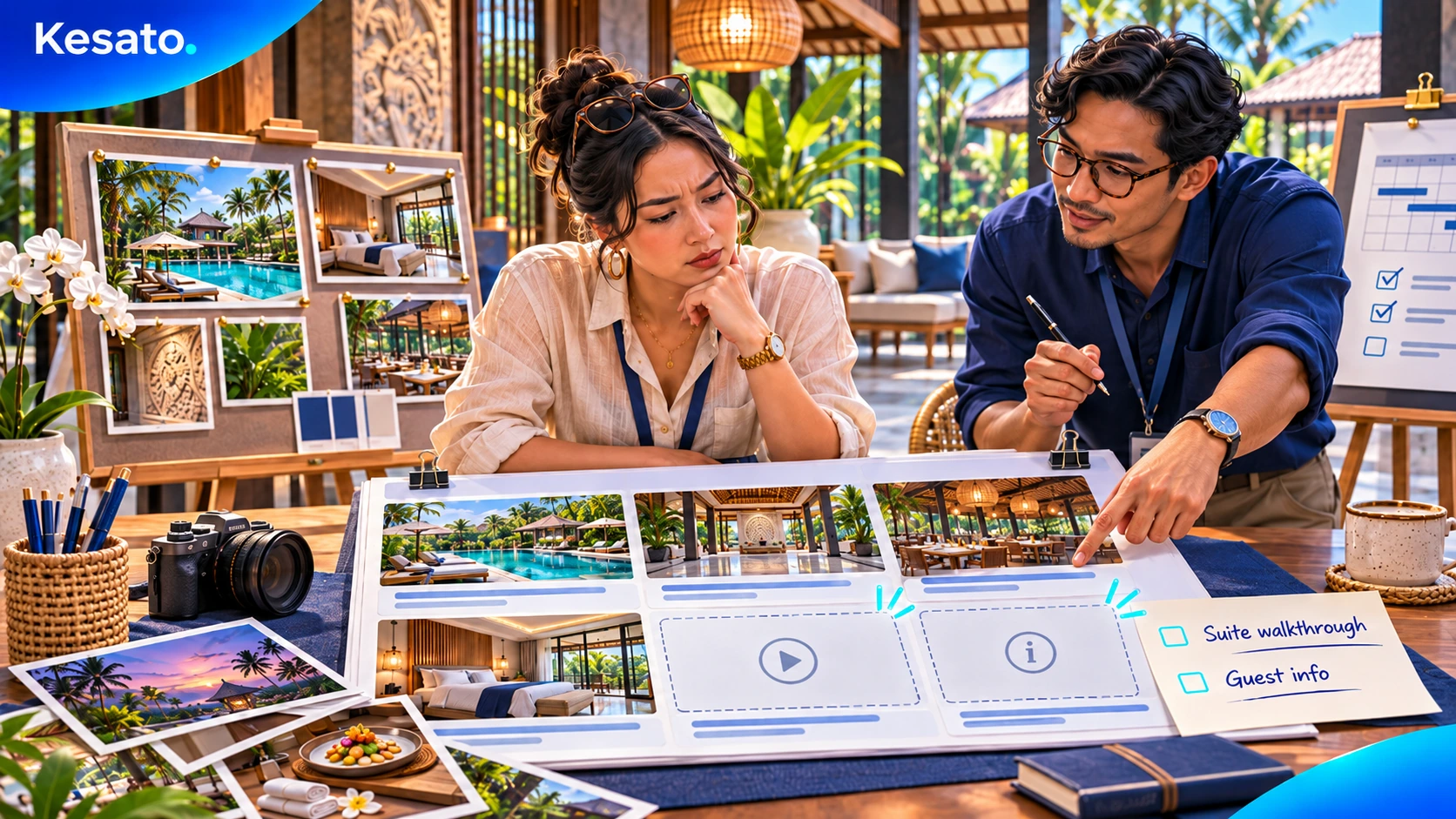
Your hotel has beautiful photos and videos. Yet when your marketing team needs content for a renovated suite or a new offer, the right assets may still be missing.
Perhaps the footage shows the wrong room, uses the wrong format, or lacks approval for advertising. Often, the problem starts before the shoot: the team has not linked the work to a clear marketing goal.
A hotel social media production brief connects that goal to the shots, formats, rights, and approvals your team needs. This guide shows you how to plan, review, and hand over useful content.
Throughout the guide, we use a fictional Bali hotel launching a renovated suite. This example does not describe a Kesato client or actual campaign results.
Key Takeaways
- Start with your marketing goals and existing content gaps before planning a shoot.
- Agree on shots, deliverables, permissions, and approvals before production.
- Check final assets and give your social media team everything it needs to use them.
Table of Contents
- Why Hotel Content Production Should Start With Marketing Goals
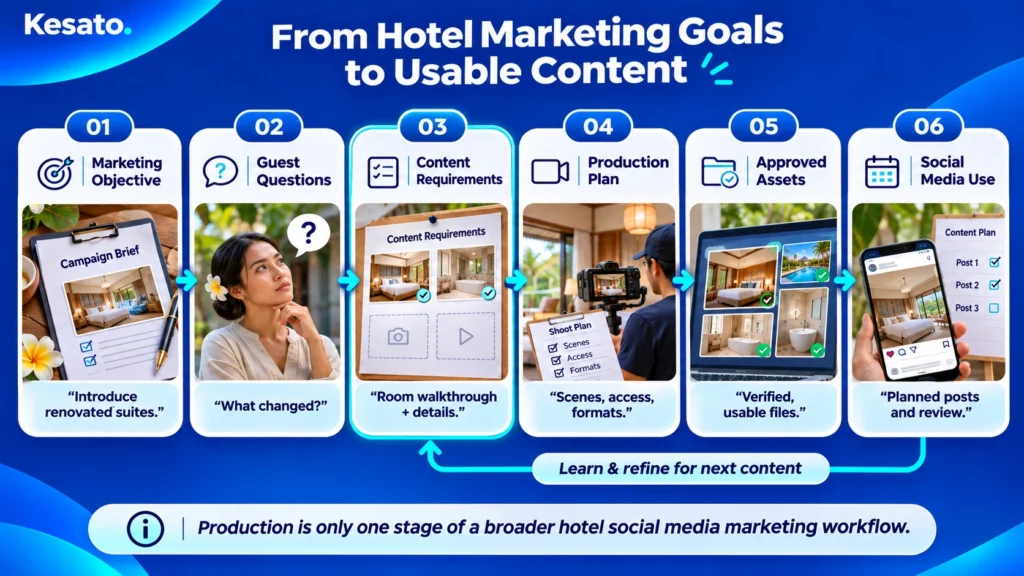
- Translate Marketing Objectives Into Content Requirements
- Audit Existing Content Before Booking Another Shoot
- Build a Marketing-Led Hotel Social Media Production Brief
- Turn the Brief Into a Prioritized Hotel Shot List
- Prepare Hotel Operations Before the Production Team Arrives
- Agree on Deliverables and Content Formats Before Shooting
- Manage Shoot-Day Coverage and Unexpected Changes
- Confirm Content Usage Rights and Permissions
- Set Approval Gates, Final QA, and Asset Handover
- Connect Approved Assets to Social Media Management and the Next Production Cycle
- Frequently Asked Questions About Hotel Social Media Production
1. Why Hotel Content Production Should Start With Marketing Goals
A hotel photoshoot creates visual content. Social media marketing, however, has a broader purpose. It helps your hotel reach the right audience, share useful information, and support specific business goals.
When hotels separate these activities, they may receive attractive photos and videos that do not meet their marketing needs.
For example, imagine a Bali hotel that has just renovated one of its suite categories. The hotel already has beautiful property photos. However, guests comparing room options still need to understand what has changed and what makes the renovated suites different.
Another general lifestyle shoot may not answer those questions. Instead, the marketing team should first identify the information that guests need.
What Makes a Production Asset Useful for Hotel Marketing?
Before approving a shoot, connect four important decisions:
- Marketing objective: What business or communication goal should this content support?
- Target audience: Who needs the information or experience you want to show?
- Customer question: What should guests understand after viewing the content?
- Intended placement: Where will you use the asset, and what should viewers do next?
For the renovated-suite campaign, the hotel may want to introduce the updated category and explain its features. Therefore, a clear room walkthrough and selected detail shots may offer more value than another general hotel video.
Decision for the hotel: Write a short marketing objective before discussing filming days, equipment, or asset quantities. If your team cannot explain why it needs a particular scene, review its priority.
2. Translate Marketing Objectives Into Content Requirements
A marketing goal gives your team direction. However, the production crew needs specific instructions to turn that goal into useful content.
For example, “promote our renovated suites” describes a campaign. It does not explain which features matter, what viewers need to see, or how the hotel plans to use the footage.
Therefore, your next step is to turn the marketing goal into clear content requirements.
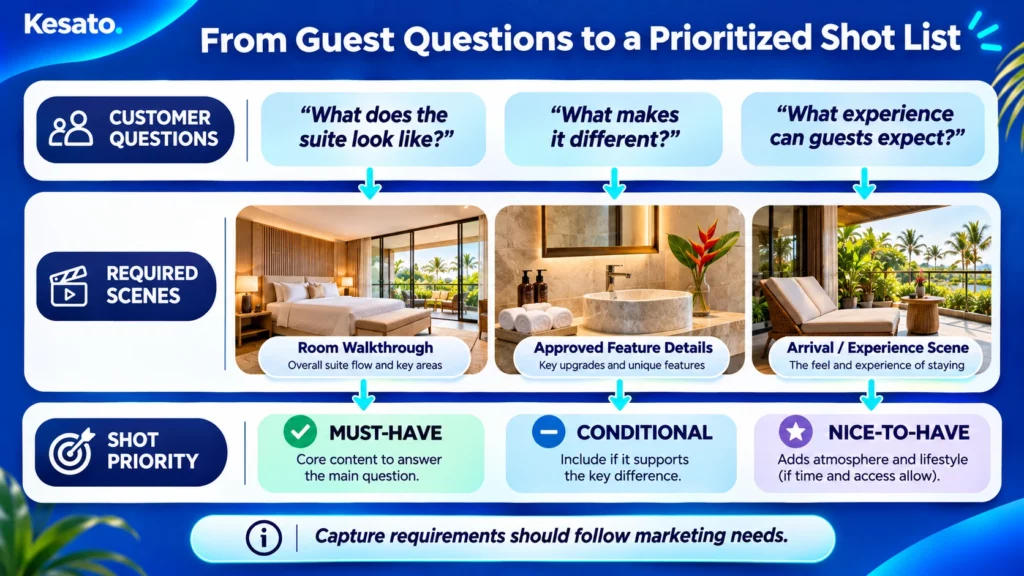
Map Customer Questions to the Content You Need
Start with questions that your reservations, front office, or marketing teams often receive. Then, confirm the answers with the relevant hotel staff.
Once you understand what guests need to know, decide which photos or videos can explain those details.
| Guest Question | Content Requirement | Intended Use |
|---|---|---|
| What does the renovated suite look like? | A room walkthrough that shows the agreed spaces accurately. | Short-form social video. |
| How does this room category differ? | Clear visuals of confirmed features that make the category different. | Informational social post. |
| What experience can guests expect? | Relevant scenes that reflect the experience the hotel can offer. | Social storytelling. |
| Where can I learn more? | A clear next step that directs viewers to accurate room information. | Publishing brief and caption handoff. |
This is an illustrative example. Always confirm actual room features, descriptions, and availability with the hotel.
Separate Essential Content From Optional Content
Every shoot has limits. For example, weather, room access, or staff schedules may change during production.
To prepare for these situations, divide your requirements into three groups:
- Must-have: Content your campaign needs to meet its main purpose.
- Conditional: Useful scenes that depend on access, timing, or other requirements.
- Nice-to-have: Extra content that the team can capture after completing essential shots.
In our suite example, the room walkthrough may be essential. Meanwhile, extra decorative close-ups may be optional.
Decision for the hotel: Approve an objective-to-asset map before creating the technical shot list. As a result, your production team can protect essential scenes when plans change.
3. Audit Existing Content Before Booking Another Shoot
Before paying for another photoshoot, check the content your hotel already has.
Your existing library may contain useful photos and videos. However, the team might struggle to find them, need different formats, or lack the rights to use them for a new campaign.
As a result, a new shoot may not always be necessary. Start by comparing your existing assets with the content requirements you identified earlier.
What Content Is Missing, Outdated, or Unusable?
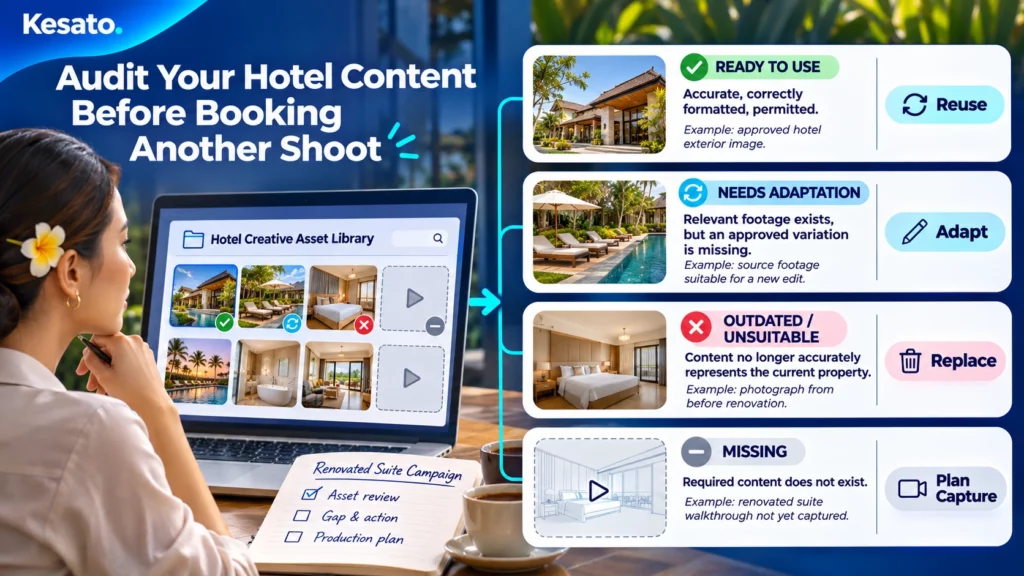
Review each relevant asset and place it into one of four groups:
| Asset Condition | What to Check | Potential Action |
|---|---|---|
| Ready to use | The asset is accurate, has the right format, meets quality needs, and allows the planned use. | Reuse. |
| Needs adaptation | Useful footage exists, but the team needs another approved edit or version. | Adapt. |
| Outdated or unsuitable | The content no longer shows the property accurately or does not meet campaign needs. | Replace or capture again. |
| Missing | The hotel does not have a suitable asset for this requirement. | Plan new production. |
For example, older suite photographs may no longer show the renovated room accurately. However, the hotel might still use approved exterior footage to support the new campaign.
Decide What to Reuse, Adapt, or Capture
Look at the actual files rather than relying only on their names. Check the content, quality, current accuracy, and usage rights.
For instance, a landscape video may not have enough space around the subject for a vertical crop. Similarly, a photograph may show a guest whose permission does not cover the new advertising campaign.
Simply changing the file format will not solve either issue.
Decision for the hotel: Create a content gap inventory before booking another shoot. Then, focus new production on the assets you cannot reasonably obtain from your existing library.
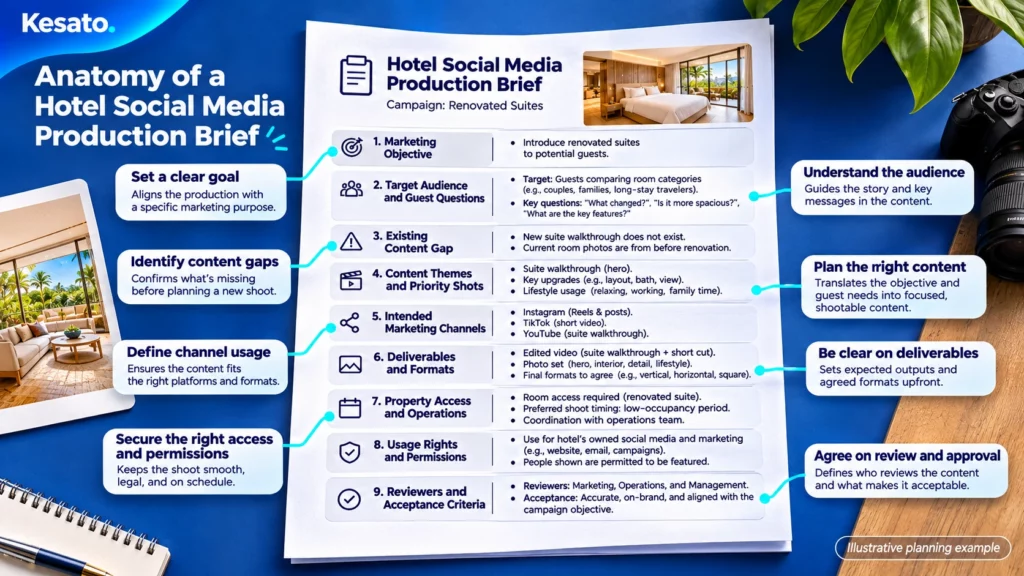
4. Build a Marketing-Led Hotel Social Media Production Brief
A production brief gives the hotel, marketing team, and content agency one clear reference for the project.
It should explain what the business needs and what the production team must deliver. However, it does not need to describe every camera movement or editing technique.
Depending on the agreement, the agency may use the hotel’s marketing requirements to develop the creative approach and technical shot list.
What Should Be Included in the Production Brief?
The following example shows how a hotel could prepare a social media production brief for a renovated-suite campaign.
| Brief Field | Illustrative Requirement |
|---|---|
| Marketing objective | Introduce the renovated suite category and explain its confirmed differences. |
| Audience | Prospective guests comparing accommodation options. |
| Customer questions | What does the suite look like? What makes it different? Where can guests find accurate details? |
| Existing content gap | Current photos do not clearly show the renovated category. |
| Content direction | Room walkthrough, confirmed feature details, and relevant experience scenes. |
| Priority | Capture the walkthrough and key features first. Add supporting lifestyle scenes if possible. |
| Planned placement | Organic social content. Include website or advertising use only if the agreement covers it. |
| Deliverables | Agree on asset types, quantities, dimensions, versions, formats, and delivery dates. |
| Property preparation | Confirm room access, housekeeping readiness, on-site contacts, and filming rules. |
| Permissions | Check people, music, third-party assets, and intended usage channels. |
| Approvers | Name the hotel marketing representative and agency contact who can approve decisions. |
| Acceptance criteria | Check required scenes, accurate property details, agreed formats, and usable final files. |
This is a sample planning brief, not an official Kesato production package or mandatory industry standard.
In addition, the brief should cover approved brand references, content restrictions, the target campaign date, budget limits, and decisions that need further approval.
Who Should Prepare the Brief: Hotel or Agency?
The hotel should explain its marketing priorities, guest information needs, and property limits. It should also identify the people who can approve important decisions.
The agency can then help develop the creative direction, shooting plan, and technical requirements. However, the exact responsibilities depend on the agreed scope.
For example, the hotel may not need to prepare every camera angle. Nevertheless, it should confirm that the proposed scenes will meet the campaign’s needs.
If your hotel needs professional production support, explore Kesato’s content creation services.
Decision for the hotel: Do not approve a shoot based only on a moodboard and an estimated number of photos. Instead, confirm what the content must explain, which assets the agency will deliver, and how you will check the results.
5. Turn the Brief Into a Prioritized Hotel Shot List
After approving the brief, the next step is to create a shot list.
A shot list turns content requirements into specific scenes that the production team can plan and capture.
However, listing hotel locations alone is not enough. For example, “photograph the suite” does not explain which details guests need to see or what makes the scene important.
Prioritize Shots by Marketing Need, Not Just Hotel Location
A useful shot list connects each scene to its marketing purpose, preparation needs, and completion check.
| Priority & Scene | Marketing Purpose | Preparation & Check |
|---|---|---|
| Must-have: Suite walkthrough | Help viewers understand the room arrangement. | Confirm access and capture the agreed sequence of room areas. |
| Must-have: Approved suite features | Explain confirmed details that make the category different. | Check the details with the hotel and capture them clearly. |
| Conditional: Arrival sequence | Show the arrival atmosphere. | Coordinate the relevant area and staff if the scope includes this scene. |
| Conditional: Guest-style experience | Show how guests may experience the property. | Confirm talent, styling, and permissions. |
| Nice-to-have: Additional details | Provide extra content for future use. | Capture these shots if time and access allow. |
The production team can choose suitable camera movements and framing. Meanwhile, the hotel’s marketing team should check whether the scenes answer the agreed customer questions.
Plan Alternative Shots When Conditions Change
Hotel operations can change quickly. For example, guests may occupy a public area, a room may become unavailable, or bad weather may interrupt an outdoor shoot.
Therefore, prepare suitable alternatives before production begins.
If rain prevents an important outdoor scene, the team might adjust the schedule. Alternatively, it may suggest another approved scene that meets the same purpose.
However, the team should not replace an essential shot with unrelated footage simply to fill the schedule.
Decision for the hotel: Complete must-have shots first. If the team needs to change an important scene, record the reason and obtain approval before accepting the alternative.
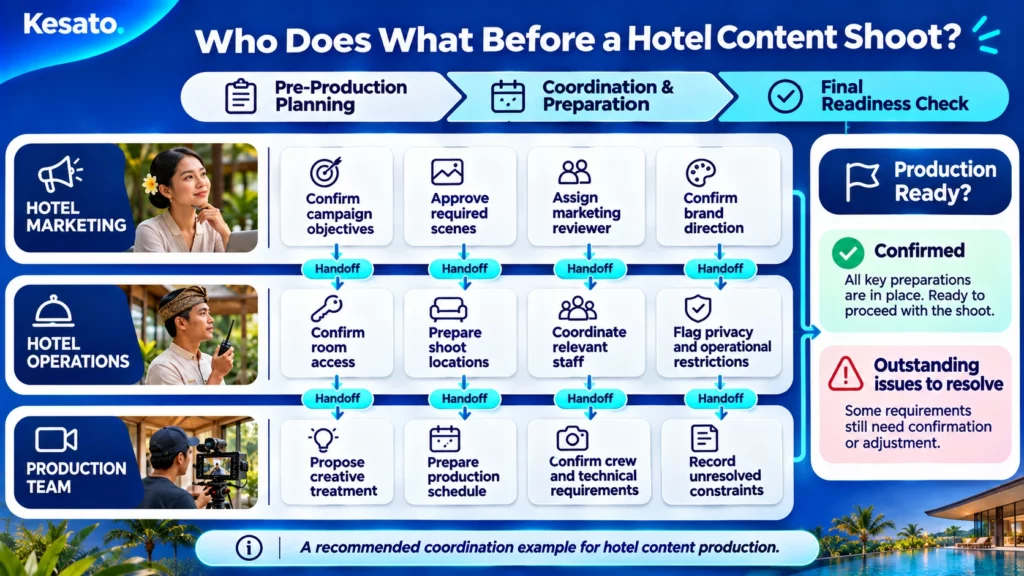
6. Prepare Hotel Operations Before the Production Team Arrives
A good production plan can still face problems if the hotel is not ready for the crew.
For example, the team may arrive while housekeeping is still preparing the suite. Or the hotel may not have arranged access to the restaurant, pool, or another required location.
These delays can affect the shoot schedule. Therefore, hotel preparation should involve the relevant operational teams, not only marketing.
What Should Hotel Departments Prepare?
| Function | Preparation to Confirm |
|---|---|
| Marketing | Confirm the brief, shot priorities, brand references, and decision-maker. |
| Front Office | Coordinate guest movement, relevant room access, and privacy needs. |
| Housekeeping | Prepare the room, confirm styling, and protect the agreed shooting window. |
| Food & Beverage | Arrange outlet access, approved dishes, plating times, and required staff. |
| Operations / Security | Confirm restricted areas, equipment movement, safety, and permissions. |
| Production team | Confirm the schedule, crew, equipment, creative plan, and backup options. |
Of course, smaller hotels may combine several of these responsibilities. The goal is to give each task a clear owner, not to create extra departments.
Confirm Talent, Property Access, and Shoot-Day Restrictions
Before filming, confirm whether scenes include staff, hired models, or guests.
Also, identify restricted areas, privacy concerns, equipment requirements, and any extra permissions.
Remember that hotel public areas still serve guests. Therefore, your production plan should protect their comfort, privacy, and safety.
Industry guidance from Hotels Filmed also highlights room preparation, department coordination, and the need for a reliable on-property contact.
Who Makes Decisions When the Schedule Changes?
Assign a contact who can solve routine access issues during the shoot.
For larger changes, identify who can approve extra costs, new scenes, or changes to the agreed work.
Otherwise, the crew may lose time waiting for decisions from several departments.
Decision for the hotel: Hold a final readiness check before the shoot. Confirm locations, staff, permissions, timing, equipment access, and backup plans. If an essential requirement remains unresolved, raise it before filming starts.
7. Agree on Deliverables and Content Formats Before Shooting
“We need some photos and videos” is not a complete production request.
Before the shoot, the hotel and agency should agree on the assets they need, where they will use them, and what the final files must include.
As a result, both teams can make better decisions during filming and editing.
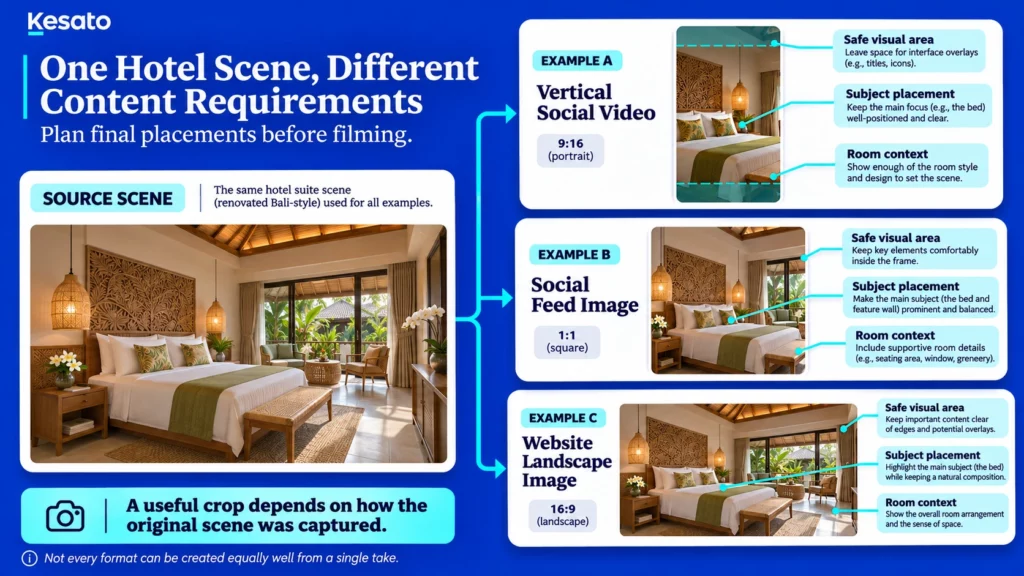
Define Assets by Their Intended Placement
A vertical social video, a social feed image, and a landscape website banner may show the same room. However, each format can require different framing and editing.
For example, TikTok for Business recommends vertical 9:16 video and safe areas for important text in TikTok ads.
That recommendation applies to a specific platform. It does not mean every hotel photo or video should use the same format.
Similarly, you cannot always turn a landscape video into a useful vertical version. Cropping may remove important room details or make the subject difficult to see.
What Should the Deliverables Agreement Specify?
| Specification | What to Agree |
|---|---|
| Asset types and quantities | List the final photos, videos, and other assets included in the project. |
| Placement | Specify the social platforms, website sections, ads, or other intended uses. |
| Technical formats | Agree on aspect ratio, dimensions, resolution, duration, and file format. |
| Creative treatment | Confirm editing style, color, audio, text, captions, and brand elements. |
| Variations | List additional crops, subtitles, clean versions, or alternative edits if included. |
| Source materials | State whether the agency will provide raw footage or editable project files. |
| Timeline and revisions | Agree on draft delivery, review periods, revision scope, and final delivery. |
| Usage terms | Confirm permitted channels, duration, territory, changes, and third-party restrictions. |
Why One Asset May Need Different Versions
Imagine filming the renovated suite.
First, a vertical video may guide mobile viewers through the room. Next, a landscape image may show the room arrangement on the hotel website. Finally, a social post may focus on one confirmed feature.
Although these assets show the same property, they serve different purposes.
Decision for the hotel: Agree on a deliverables matrix before filming. Do not assume the price includes a fixed number of Reels, unlimited revisions, raw footage, or advertising rights unless your agreement says so.
8. Manage Shoot-Day Coverage and Unexpected Changes
The shot list should guide production throughout the day.
Instead of reviewing it only at the beginning and end, use it to track essential scenes as the team completes them.
This approach helps the hotel and crew find missing shots while they may still have time to fix them.
What Should Be Checked Before Leaving Each Location?
Before moving to another area, review the following points:
- Coverage: Did the crew capture all must-have scenes or record their current status?
- Visible accuracy: Does the footage show the property and its features correctly?
- Technical usability: Has the production team completed its basic quality checks?
- Permissions: Does the team have the relevant approvals for people and restricted areas in the footage?
- Exceptions: Which scenes still need a retake, replacement, or scope decision?
How Should Changes Be Documented?
Use a simple status system that both teams understand:
- Captured: The crew recorded the planned scene and completed an initial check.
- Needs retake: The team found an issue that it may still fix during production.
- Blocked: The crew could not complete the shot under current conditions.
- Scope change: The proposed alternative changes an agreed requirement and needs approval.
However, an initial shoot-day check does not replace final editing and approval.
For example, a scene may look complete on location but still need changes after the team reviews the footage in detail.
Decision for the hotel: Review coverage at key points during production. If an essential shot is missing, discuss the available options before the team leaves the location.
9. Confirm Content Usage Rights and Permissions
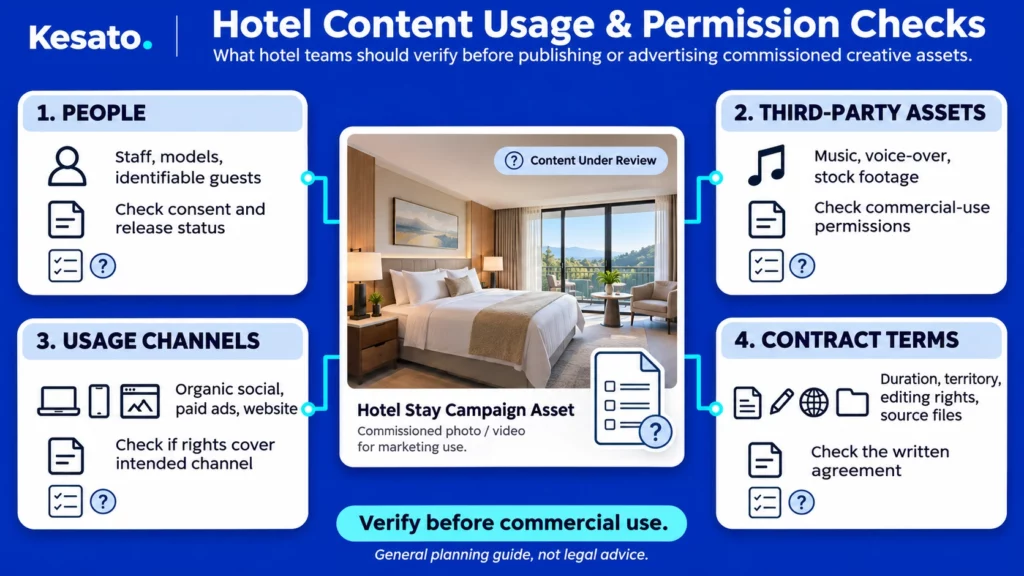
Receiving a photo or video does not automatically give your hotel every right to use it.
For example, an agreement may allow organic Instagram posts but not paid advertising. Another agreement may include finished videos but exclude raw footage or further editing.
Therefore, discuss usage rights and permissions before production begins.
What Rights Should Be Confirmed Before Production?
Your written agreement should explain how the hotel may use the final assets.
Important details include:
- Permission to use content on organic social media and in paid advertising.
- Usage on the hotel website, sales materials, and other agreed channels.
- Any limits on the period or locations where the hotel may use the content.
- Permission to crop, edit, or create additional versions.
- Whether other agencies or vendors can use the assets on the hotel’s behalf.
- Ownership or licensing terms for artwork, raw files, and other materials.
These details depend on the agreement. As a result, hotels should not assume that every production fee includes the same rights.
What About Staff, Guests, Talent, and Music?
Review the permissions for any identifiable people who appear in promotional content. This includes hotel staff, hired models, and guests.
In addition, check licenses for music, voice-overs, stock footage, graphics, and other third-party materials.
In Indonesia, Law No. 28 of 2014 on Copyright, Article 12, sets written-consent requirements for certain commercial advertising uses of portraits. However, the rules that apply to a particular project depend on its actual use and circumstances.
For example, a guest’s presence at the hotel does not automatically mean the hotel can feature that person in an advertisement. Likewise, music available in an editing application may not include the rights needed for every commercial use.
If your hotel works with independent creators who also publish content on their own channels, the agreement may need a different scope. Kesato’s guide to influencer marketing in Bali</a covers these collaborations separately.
Decision for the hotel: Record permitted uses, restrictions, and outstanding permissions before production or publication. If you are unsure about a legal requirement, seek advice from a qualified professional.
10. Set Approval Gates, Final QA, and Asset Handover
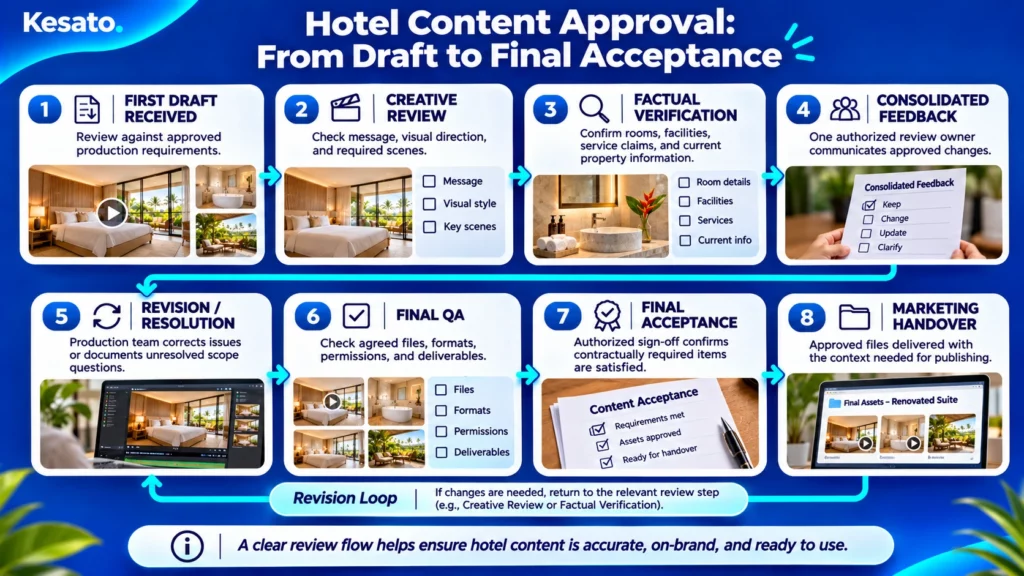
Content approval should not begin with an unexpected request for everyone at the hotel to review the final video.
Instead, agree on the review process before production starts.
First, identify which decisions need approval. Next, assign the people who can approve them. Finally, agree on how the team will handle feedback and missing requirements.
Who Should Approve Content at Each Stage?
| Checkpoint | Review Responsibility | Required Outcome |
|---|---|---|
| Brief approval | Hotel marketing and the authorized production representative. | Both sides agree on objectives, scenes, scope, and deliverables. |
| Shoot readiness | Relevant hotel operations and production leads. | Teams confirm access, schedule, people, and restrictions. |
| Coverage review | On-site contacts and production lead. | Teams record missing or changed priority shots. |
| Creative review | Named hotel marketing approver. | The reviewer approves the draft or sends one combined revision request. |
| Factual review | Hotel staff responsible for checking facilities and service information. | Relevant staff confirm property details and claims. |
| Final acceptance | Designated sign-off owner. | The reviewer checks files, agreed usage terms, and open issues. |
Creative review, factual review, and final acceptance serve different purposes. Therefore, the hotel may assign them to different people.
However, not every department needs to approve every edit. Clear responsibilities can help avoid repeated feedback and unnecessary delays.
What Should the Hotel Check Before Accepting Final Assets?
Use the agreed production brief and deliverables list as your main reference.
Before accepting the final work, confirm that:
- The agency has delivered the agreed asset types and quantities.
- The files cover all required scenes or approved alternatives.
- Room details, facilities, and service claims are accurate.
- Each file meets the agreed format, size, and version requirements.
- The team has reviewed audio, text, subtitles, and brand elements where needed.
- The handover includes the required permissions and usage information.
- File names and folders help the marketing team find the correct versions.
- Both parties have recorded any remaining issues or later deliveries.
What Happens If a Required Asset Is Missing?
First, check whether the missing asset was part of the agreed scope.
Next, identify the issue. Can the team fix it through editing? Can existing footage provide a suitable alternative? Or does the hotel need another shoot?
For example, the editor might create a missing vertical version from suitable source footage. However, editing cannot always replace a required scene that the crew never filmed.
Finally, review the contract before assigning extra work or costs. The agreement and the reason for the issue will help determine the next step.
Decision for the hotel: Collect feedback through the authorized reviewer. Then, confirm that the team has addressed the agreed requirements before you approve the final handover.
11. Connect Approved Assets to Social Media Management and the Next Production Cycle
The content production process does not end when the agency sends a download link.
Your social media team also needs to understand how and where to use the assets.
Without that information, the hotel may receive a complete folder of files but still struggle to prepare its content calendar.
What Does the Social Media Team Need From the Production Handover?
Each approved asset should include the information the marketing team needs for its planned use:
- Content purpose: Which campaign, message, or guest question does this asset support?
- Asset identity: Which filename and version should the team use?
- Channel suitability: Which platforms have suitable, approved versions?
- Factual notes: Which confirmed details or restrictions should inform published copy?
- Usage permissions: What licenses, consent records, or usage limits apply?
- Approval status: Who approved the asset, and are there any open issues?
- Next action: Is the asset ready for scheduling, or does it still need copy or other work?
Remember that content production and publishing are different responsibilities. Unless the agreement includes both, the production team does not automatically manage the hotel’s social media accounts.
For more information about ongoing posting and account operations, read Kesato’s guide to social media management for businesses.
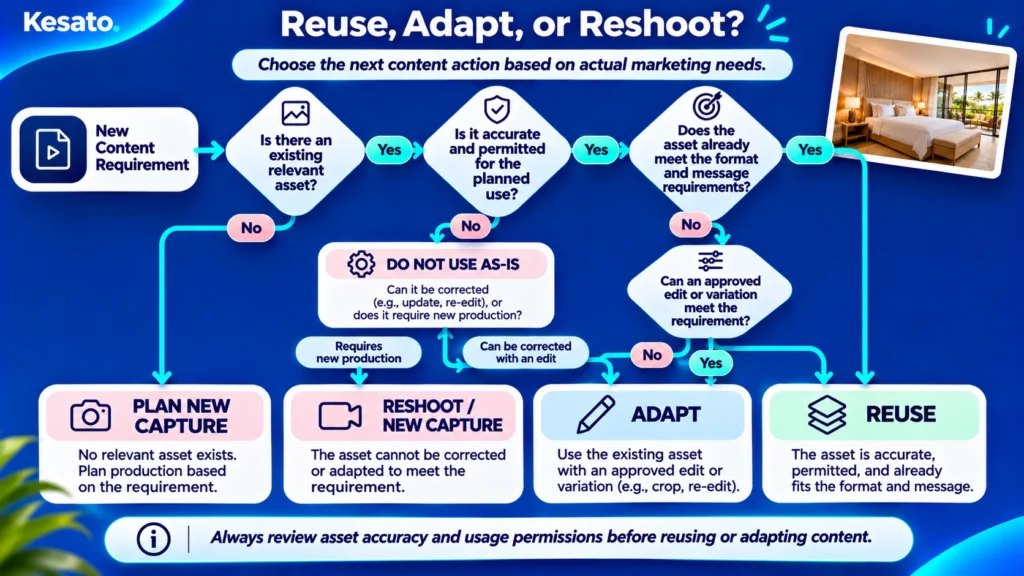
How Should Hotels Decide What to Produce Next?
Before planning another shoot, compare your content library with upcoming marketing needs.
- Reuse: Keep using an existing asset when it remains accurate, relevant, suitable, and permitted for the new purpose.
- Adapt: Create an approved crop, edit, or new version when existing content can meet the requirement.
- Reshoot: Plan new filming when essential scenes are missing or existing footage cannot meet the need.
Next, review how your marketing team used the assets from the previous shoot.
For example, did the campaign receive the correct formats? Did the team need content that the original brief missed? Are guests still asking questions that the posts do not answer?
These findings can guide your next production brief. However, completing a content shoot does not automatically prove that your hotel gained more enquiries or bookings. You need separate measurement to evaluate those results.
Final decision for the hotel: Treat content production as part of social media marketing. Start with a clear need, produce the right assets, check their quality, and use what you learn to plan future content.
If your hotel needs help connecting marketing goals with content planning and production, Kesato’s social media marketing services offer a starting point. Together, we can discuss the planning, production, and ongoing management support that fits your business needs.
Frequently Asked Questions About Hotel Social Media Production
Who should write a hotel’s social media production brief?
The hotel should explain its marketing goals, audience needs, property details, and operational limits. The agency can then help develop the creative approach and technical shot list. However, both parties should agree on their responsibilities before the project begins.
How far in advance should a hotel prepare for a content shoot?
Start early enough to confirm locations, room access, staff, talent, permissions, and the creative plan. For example, a simple room shoot may need less preparation than a project involving several departments and locations. Therefore, agree on a realistic schedule with the production team rather than using one fixed timeline for every project.
Can one hotel shoot provide content for social media, a website, and paid ads?
Yes, one shoot can support several channels if the team plans for them in advance. However, each channel may need different framing, formats, or usage rights. Therefore, include those requirements in the brief before filming starts.
Should raw footage and editable files be included in the deliverables?
Only if the agreement includes them. For example, a final edited video does not automatically include its raw footage or editable project files. Before production, confirm which source materials the agency will provide and what rights the hotel will receive.
What if the agency misses a required shot or the hotel rejects a deliverable?
First, compare the issue with the approved brief and deliverables agreement. Then, check whether the team can fix it through an agreed revision, suitable alternative, or additional filming. Finally, review the contract before deciding who should handle extra work or costs.