

Key takeaways
- A memorable hotel or villa brand gives guests a clear reason to recognise and remember it.
- Check what potential guests know about your property before assuming your brand is familiar.
- Make sure your website, booking platforms and actual guest experience communicate the same promise.
- Fix verified problems before investing in a complete rebrand.
Hotel branding is not simply about having a beautiful logo or professional photographs. It is about giving people a clear understanding of your property and reinforcing that understanding through the experience you deliver. The same principle applies to villa branding.
However, a property that looks consistent online is not necessarily well known. And a hotel with a familiar name does not automatically provide a memorable stay.
This guide explains how to recognise the difference, find out what guests actually remember, identify inconsistent messages and decide what to improve before spending money on a rebrand.
Table of contents
- Why Do Some Hotels and Villas Stay in Guests’ Minds?
- Who Do You Want Guests to Remember You For?
- What Makes Your Hotel or Villa Different From the Alternatives?
- Do People Actually Recognize or Remember Your Property?
- Does Your Hotel Look and Sound Like the Same Brand Everywhere?
- Does the Guest Experience Live Up to What You Promise?
- What Do Guest Reviews Reveal About Your Hotel’s Brand?
- What Should You Improve First—and Do You Need to Rebrand?
- How Can You Tell Whether Your Brand Is Becoming More Recognizable?
- Final Takeaway: Give Guests Something Real to Remember
- Frequently Asked Questions
Why Do Some Hotels and Villas Stay in Guests’ Minds?
A hotel or villa is more likely to leave a clear impression when guests understand what makes it distinctive and experience what the property promised. But recognition, memory and satisfaction are different things, and each needs to be evaluated separately.
For example, a traveller may recognise a well-known resort name without ever staying there. Another guest may remember an excellent villa experience but struggle to recall the property’s name.
These situations call for different solutions.
If people do not recognise the brand, the property may need clearer identity and more relevant exposure. If guests remember the stay but not the name, the hotel may need to connect its distinctive experiences more consistently to the property identity.
If guests recognise the name but are disappointed by the experience, the immediate priority may be operational rather than visual.
Hospitality branding involves three connected elements:
- Recognition: Can people identify the hotel or villa?
- Differentiation: Can they explain why it is worth considering?
- Experience: Does the actual stay support the expectations created before booking?
A memorable brand does not require every property to be luxurious, expensive or unusual.
A small villa may become known for a thoughtfully designed family stay. A boutique hotel may be recognised for its location, architecture or attentive service. The important point is that the difference should be meaningful to the right guests and supported by reality.
The next step is to understand which guests the property actually wants to reach.
Who Do You Want Guests to Remember You For?
Before deciding how your property should look or sound, consider who it is designed to serve.
A family looking for convenient accommodation may value different things from a couple planning a quiet retreat. A guest staying for work may judge the property differently from someone visiting Bali for a special celebration.
Trying to communicate every possible benefit can leave potential guests unsure what the property is best suited for.
Understand the Guests You Want to Attract
Start with the business you want to operate, not just the audience you hope will notice your social media posts.
Ask:
- Which guests are the property best equipped to serve?
- What type of stay are they planning?
- What problems or concerns do they have when choosing accommodation?
- Which facilities and experiences genuinely matter to them?
- What would make them choose this property over a comparable alternative?
For example, a villa intended for families should be honest about its sleeping arrangements, pool safety considerations, accessibility and available services. Calling it “family-friendly” without explaining why provides little useful information.
Likewise, a boutique property marketed as a peaceful nature retreat should communicate what that experience involves, including relevant limitations.
For operators managing multiple villas, also decide whether guests should recognise one shared brand or each property independently. Kesato’s guide to scaling a villa or resort business in Bali explores the importance of connected systems as property portfolios grow.
Find Out What Your Existing Guests Actually Value
Your intended audience may be different from the guests who currently book.
Review reservation patterns, enquiry questions and guest feedback. Where your records allow it, look for differences between guest groups rather than assuming everyone values the same experience.
Ask previous guests questions such as:
- What made you choose this property?
- What part of your stay stood out?
- Was anything different from what you expected?
- How would you describe this hotel or villa to a friend?
Open-ended answers are especially useful because they allow guests to describe the experience in their own words.
Do not automatically treat the most commonly praised feature as your only brand identity. A great breakfast may be appreciated by many guests, but it may not be the main reason your target audience chooses the property.
Use the feedback alongside operational knowledge and your business priorities. The goal is to identify differences that the hotel can reliably deliver and that guests genuinely value.
What Makes Your Hotel or Villa Different From the Alternatives?
Many hotels use similar descriptions: luxury accommodation, unforgettable experiences, personalised hospitality and tropical paradise.
These statements are not necessarily wrong. The problem is that they often fail to explain what the guest will actually receive.
A useful difference should be specific, relevant and credible.
Find a Difference That Matters to Guests
Begin with the alternatives a prospective guest might realistically compare.
A villa in Ubud should not automatically compare itself with every luxury hotel in Bali. It may be more useful to review properties serving similar guests, offering comparable accommodation or competing in the same location and price category.
Look at how each property describes:
- Its main accommodation experience.
- The types of guests it serves.
- Its most distinctive facilities or services.
- Its setting and nearby activities.
- The reasons guests mention when recommending it.
Then ask what your property can honestly offer that is important to your audience.
A distinctive identity might be connected to thoughtful family arrangements, a carefully designed wellness experience, the architecture, or a particular style of hospitality.
It does not have to be something no other hotel has ever offered. But it should be clear enough that guests can understand what to expect and why it is relevant to them.
Check Whether Your Promise Matches the Property
Consider an illustrative villa in Ubud that describes itself as a “peaceful private nature retreat.”
Before making that the main brand message, the owner should ask:
- How private is the property in practice?
- Can guests regularly experience the tranquillity being promised?
- Does the photography reflect the actual surroundings?
- Are there nearby activities or conditions that guests should know about?
- Do guest comments support or challenge the promise?
If some rooms experience road noise or the villa shares facilities with other guests, the property should explain those details accurately rather than promise complete privacy.
A brand promise should be something the business can consistently support, not simply an attractive phrase.
This distinction is important because changing the wording is often easier than changing the actual experience. Sometimes the better solution is clearer communication. In other cases, the operation itself needs attention.
Do People Actually Recognize or Remember Your Property?
Owners often evaluate brand awareness through Instagram followers, online engagement or website traffic.
Those figures may show attention, but they cannot independently tell you whether prospective guests recognise your hotel’s name or remember it when choosing accommodation.
To answer that question, distinguish between two types of awareness.
Brand recall means someone can name a property without being shown its name or logo. Brand recognition means someone identifies the property after receiving a prompt, such as a list of names or visual identities.
Guest memory is related but different: it concerns what someone remembers about an experience after staying at the property.
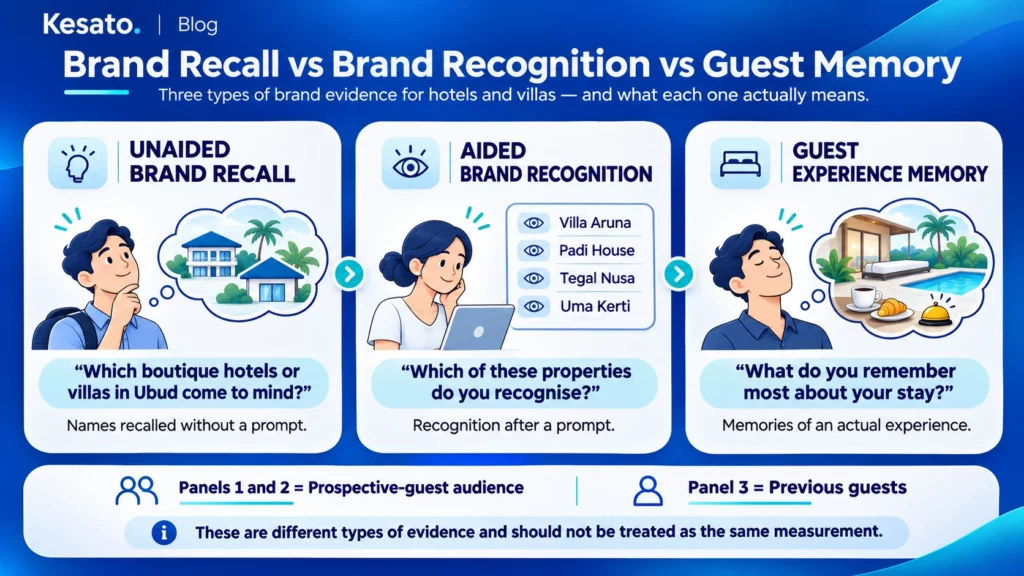
Test What People Remember Without Prompting Them
If you want to know whether your brand comes to mind naturally, start with an open-ended question to people who match your target audience.
For example:
“When you think of boutique hotels or private villas in Ubud, which properties come to mind?”
Do not mention your hotel’s name before asking this question.
Record the properties named. If the respondent mentions yours without assistance, that is an example of unaided recall.
Then, after the unaided question, you can show a balanced list of relevant property names and ask which ones the person recognises.
That provides a separate indication of aided recognition.
SurveyMonkey’s guide to measuring brand awareness explains why unaided questions should be asked before showing respondents a brand name or logo.
The choice of respondents matters as much as the wording.
Surveying only people who already stayed at the property will not tell you how widely your hotel is recognised by prospective guests. To understand market awareness, include relevant people who have never booked.
For a small initial exercise, treat the results as exploratory findings. Do not present them as representative market percentages unless the sample, screening and survey method justify that claim.
Check Recognition and Supporting Search Signals
Use this practical guide to decide which evidence answers your question.
| What you want to know | How to check | What it tells you |
|---|---|---|
| Do people remember the property name? | Ask relevant potential guests to name properties without a prompt | Unaided brand recall |
| Do people recognise the brand? | Show a balanced list of property names after the unaided question | Aided brand recognition |
| Do people understand what the property offers? | Ask what type of stay they associate with it | Brand perception |
| Are people searching for the property name? | Review branded queries in Google Search Console | Search interest, not total awareness |
| What do previous guests remember? | Ask an open-ended post-stay question | Memorable guest experience attributes |
Google Search Console can provide supporting evidence through branded search queries. On eligible properties, its branded and non-branded query filter separates search performance by query type.
However, this filter may not be available to every website, and Google’s classification can sometimes be incorrect. See the official Search Console explanation.
A rise in branded searches can indicate changing search interest, but it is not a direct measure of how many people know the brand. Search behaviour may also be affected by advertising, seasonality and other events.
Use surveys to assess recognition and recall. Use search data to support the wider picture.
Does Your Hotel Look and Sound Like the Same Brand Everywhere?
Before booking, guests may encounter your property through Google, an OTA, Instagram, the official website or a recommendation.
These places do not need to look identical. But they should provide a consistent understanding of the hotel’s identity and experience.
For example, imagine that the same Ubud villa promotes a peaceful nature retreat on its website but regularly publishes nightlife-focused imagery on social media.
The photographs may all be genuine, but they could create different expectations about the property.
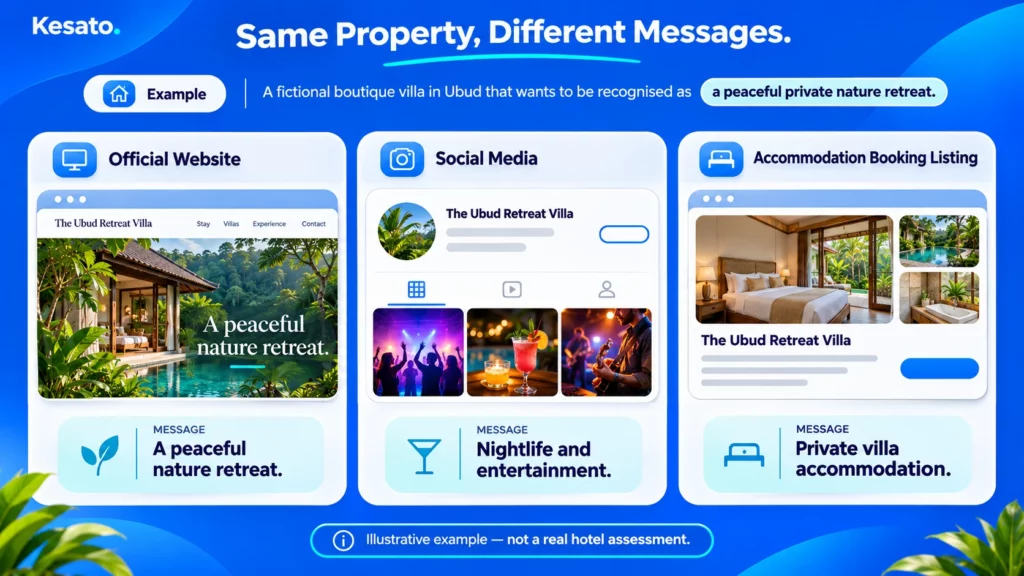
Compare Your Website, OTA Listings and Social Media
Open your main guest-facing channels side by side.
Check:
- Property identity: Are the hotel or villa name, location and important contact details consistent?
- Main message: Do the descriptions communicate the same type of stay?
- Photography: Are the images accurate, current and consistent with what guests can expect?
- Room descriptions: Do room names, facilities and capacity match across platforms?
- Service promises: Are claims such as privacy, wellness, family suitability or personalised service supported?
- Visual identity: Are approved logos, colours and other recognisable elements used correctly?
Include important physical materials where appropriate, such as arrival signage, welcome information, menus and guest communication.
The objective is not to make every platform use the same photograph or sentence. It is to prevent guests from receiving conflicting information.
For more on the wider role of websites, search and social channels, Kesato’s guide to digital marketing in Bali explains how these touchpoints work together.
Check Names, Images, Descriptions and Guest Promises
Make a simple inventory of the materials used across your channels.
Record the location of each item, the current version and whether it accurately reflects the property.
For a villa brand, pay particular attention to naming. If the same property appears under different names on different platforms, guests may struggle to recognise it when searching later.
For multi-property operators, check whether the relationship between the overall brand and individual villas is clear.
Then identify who is responsible for updating each channel. A correct website description will not solve a conflicting OTA listing if nobody owns the correction.
Prioritise factual inconsistencies and misleading promises before cosmetic details.
Does the Guest Experience Live Up to What You Promise?
A brand promise becomes meaningful when guests encounter the real property.
They may have chosen a hotel because it described itself as peaceful, family-friendly, intimate or strongly connected to local culture. The experience needs to support that description.
The review should begin before arrival and continue after checkout.
Review the Journey From Booking to Checkout
Consider the following stages:
- Before booking: Are the property description, rooms and conditions accurate?
- Before arrival: Do confirmation messages explain essential information and prepare guests for the stay?
- On arrival: Does the reception, greeting and first impression match the expectations created online?
- During the stay: Are the rooms, service, facilities and atmosphere consistent with the promise?
- After checkout: What do guests remember, appreciate or question about the experience?
For the illustrative Ubud villa, a peaceful atmosphere should not be judged solely by the website photography. The team should review actual guest feedback and operating conditions.
That might include noise, privacy between spaces, arrival procedures and the way the property communicates its surroundings.
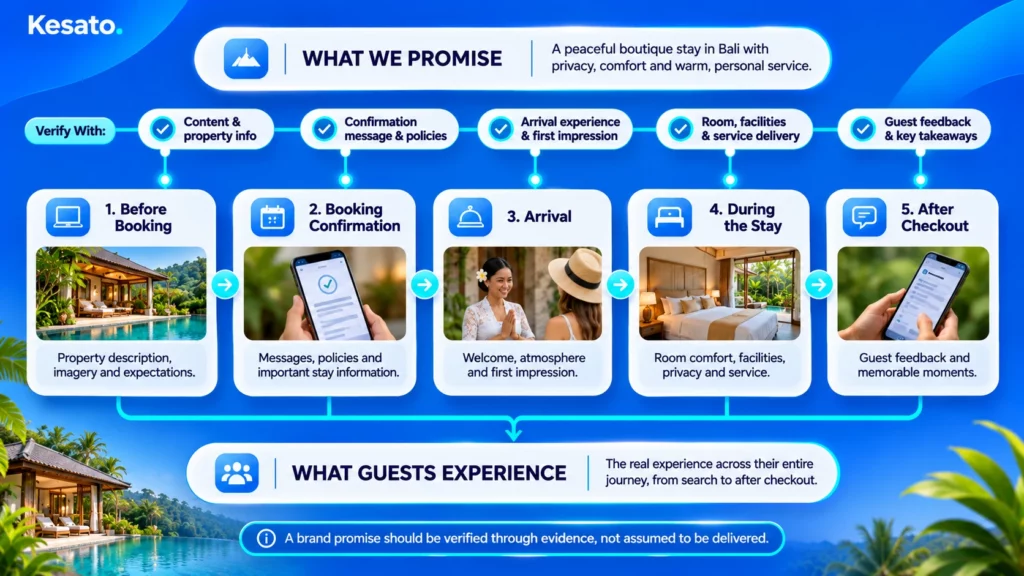
Compare Brand Promises With Actual Guest Feedback
Use a simple comparison to identify where more investigation is needed.
| Brand promise | Where guests see it | What to verify | Possible next step |
|---|---|---|---|
| Peaceful private retreat | Website, OTA and social media | Feedback about privacy, noise and atmosphere | Review the claim and actual conditions |
| Family-friendly stay | Room and property descriptions | Capacity, facilities and suitability for families | Clarify information or improve facilities |
| Personalised hospitality | Guest messages and promotional content | Arrival and service experiences | Review service procedures |
| Authentic local experience | Website and activity descriptions | What the property actually provides | Make the promise more specific and accurate |
These examples are hypothetical. They are not findings from a Kesato client or evidence that a particular hotel failed to deliver its promise.
A single negative review should trigger investigation, not an automatic conclusion.
Cornell hospitality research examining more than 95,000 reviews of independent high-end hotels and resorts found that consistent service and room quality were important in guest evaluations. The study was not conducted specifically in Bali, and it does not establish a universal measure of brand recognition.
Its practical lesson is that the experience guests receive deserves as much attention as the words used to promote the property. The Cornell research summary provides additional context.
What Do Guest Reviews Reveal About Your Hotel’s Brand?
Guest reviews can show which aspects of a stay people notice, value or find disappointing.
However, star ratings alone rarely explain what guests remember.
Look for Repeated Themes, Not Just Star Ratings
Read a collection of recent reviews from relevant sources. Look for repeated themes rather than individual dramatic comments.
Group the feedback into subjects such as:
- Room condition and comfort.
- Staff behaviour and service.
- Privacy, atmosphere and noise.
- Facilities and overall value.
- Accuracy of descriptions and expectations.
- Distinctive experiences that guests mention voluntarily.
Compare positive and negative feedback within each theme. A repeated concern deserves investigation, but its seriousness should be considered alongside context and available operational evidence.
For example, repeated references to exceptionally attentive staff may indicate an experience guests value. But it does not prove that people outside the guest base recognise the brand.
Similarly, strong ratings do not guarantee that prospective guests can recall the property’s name.
Separate Guest Experience Problems From Messaging Problems
Suppose guests frequently report that a villa is less private than expected.
There are at least two questions to investigate:
- Does the property’s website promise a level of privacy it cannot consistently provide?
- Are there operational conditions that could reasonably be improved?
If the experience is accurate but poorly described, improve the communication.
If the actual service or facility falls short of a reasonable promise, involve the relevant operations team.
Sometimes both need attention.
Review evidence before deciding which. A branding exercise cannot replace operational improvements, just as an operational repair does not automatically make a property’s identity recognisable.
For a broader review of website, distribution and marketing issues, see Kesato’s 360-degree digital marketing audit for hospitality brands.
What Should You Improve First—and Do You Need to Rebrand?
Not every branding problem requires a new name, logo or visual identity.
Before committing to a redesign, identify which part of the business is failing to communicate or deliver the intended experience.
Fix Inconsistencies Before Changing Everything
Begin with improvements supported by clear evidence.
If the hotel’s location information is inconsistent, correct it. If the same room has conflicting descriptions, standardise the information. If staff do not know about a promised service, investigate the process before producing more promotional materials.
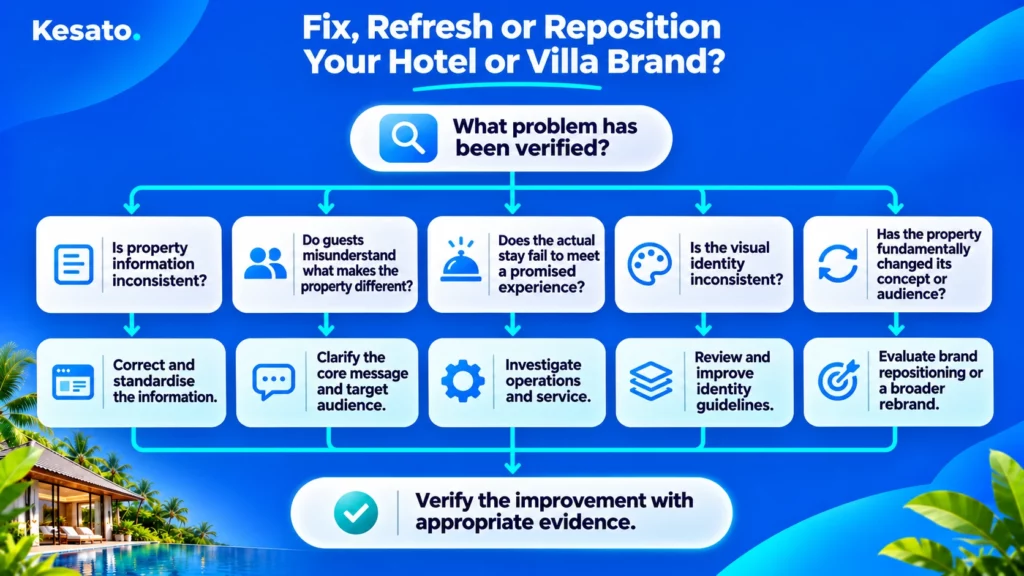
Use the following decision guide.
| Verified problem | Recommended first action | Who should be involved |
|---|---|---|
| Property name or descriptions differ across platforms | Correct and standardise the information | Marketing and reservations |
| Guests do not understand what makes the property different | Clarify the target audience and core message | Owner and brand team |
| Website and booking-platform images create different expectations | Review approved imagery and descriptions | Marketing and content team |
| Guest feedback repeatedly conflicts with a core promise | Investigate the service or property conditions | Operations and general manager |
| Visual identity is inconsistent across important touchpoints | Review and apply clear identity guidelines | Designer and brand team |
| The property has changed its concept or target guests | Evaluate repositioning or a broader rebrand | Owner, leadership and relevant specialists |
A useful priority record should explain the problem, evidence, affected guest touchpoints, responsible team and how the fix will be checked.
For example, an outdated property description can be checked after it has been updated. A service improvement may require repeated observation and guest feedback to verify that it is consistently delivered.
Know When a Brand Refresh or Repositioning May Be Needed
A brand refresh may be appropriate when the business still serves the same audience and offers essentially the same experience, but its identity or communications no longer represent it well.
Repositioning is a larger decision. It may be relevant when the property changes its concept, target audience, service level or core offer.
Consider an established villa that has undergone extensive renovations and now serves a different type of guest. Its earlier identity may no longer describe the experience accurately.
Even then, start by reviewing the business direction and what guests currently recognise. Changing a name without understanding its existing recognition could remove something valuable.
If you need professional support, Kesato’s existing guide to choosing a hospitality branding agency explains what to consider when evaluating a branding partner.
The important decision is not whether the brand could look more modern. It is whether the proposed change resolves a meaningful problem.
How Can You Tell Whether Your Brand Is Becoming More Recognizable?
After making changes, owners need a way to evaluate whether the business is moving in the intended direction.
Start by deciding what improvement you want to observe.
If the goal is broader brand recognition, use a consistent awareness measurement approach. If the goal is clearer positioning, assess what potential guests believe the property offers. If the goal is a more reliable guest experience, review operational checks and guest feedback.
Establish a Baseline You Can Repeat
Before changing important brand elements, document the existing situation.
For awareness research, record:
- The target guest group and how respondents were recruited.
- The exact unaided and aided questions used.
- The location or market covered.
- The number of valid responses.
- The findings and limitations of the sample.
When you repeat the research, use a comparable method and audience. Changing the questions or respondent group can make the results difficult to interpret.
If your hotel has insufficient data for a representative market survey, begin with a small exploratory study and report the results accordingly.
For guest experience, record recurring feedback themes and the specific operational standards you intend to improve.
There is no need to create a complex dashboard before the property has agreed on what it wants to learn.
Review Recognition, Guest Feedback and Business Signals Separately
Review three types of evidence without combining them into one unverified brand score.
- Awareness: Unaided recall and aided recognition among relevant prospective guests.
- Experience: Guest feedback, repeated review themes and evidence that promised services are delivered.
- Business signals: Branded search activity, enquiries, repeat reservations and direct-booking trends where reliable records are available.
Business indicators may change for reasons unrelated to brand improvements. Seasonality, rates, advertising, distribution and property availability can all affect results.
For instance, an increase in branded searches following a campaign does not prove that guests are more satisfied. Likewise, an increase in repeat bookings does not demonstrate that a new visual identity caused the change.
Instead, connect each action to the outcome it was intended to address.
If you corrected conflicting room descriptions, check whether the information is now consistent. If you improved a promised service, verify that guests actually receive it. If you aimed to increase recognition, use a repeatable recognition study.
That gives the owner a more useful view than relying on followers, impressions or a single revenue metric.
And if guests recognise the property but struggle to complete reservations, the next problem may be the booking experience rather than branding. Kesato’s hotel website conversion checklist provides a separate guide to investigating those issues.
Final Takeaway: Give Guests Something Real to Remember
Building a memorable hotel or villa brand begins with understanding who the property serves, what makes it worth choosing and whether the real experience supports that promise.
Ask whether potential guests recognise the name. Check what previous guests remember. Compare the messages on your website, booking platforms and social media with what the hotel actually delivers.
Then fix the gaps you can verify.
Some improvements require clearer information or more consistent visual identity. Others require better service, stronger communication or a serious review of how the property is positioned.
A new logo is not always the answer. Give guests a clear, credible reason to remember the property first.
If you are exploring how a stronger hotel or villa identity could work across your property and guest communications, you can browse Kesato’s selected work for examples of its creative projects and approach to visual storytelling.
Frequently Asked Questions
How Can I Make My Hotel or Villa More Memorable?
Start by understanding which guests the property serves and what they genuinely value. Communicate a clear, credible difference, use a recognisable identity and deliver the promised experience consistently. Check what potential guests recognise and what previous guests remember rather than relying only on social media engagement.
How Do I Know Whether Guests Recognize My Hotel Brand?
Survey relevant prospective guests. First ask them to name properties without any prompt, then separately test recognition using names or identities. Keep the audience and questions consistent when repeating the study. Branded searches can provide supporting evidence but do not replace brand-awareness research.
Does a Small Villa Need a Brand Identity?
Yes, a small villa benefits from a clear and consistent identity, but it does not always need an extensive branding project. Begin with an accurate property name, a recognisable visual identity, consistent listings and an understandable guest promise. Expand the system as the business and its needs develop.
What Should I Check if My Branding Looks Different Across Platforms?
Compare the property name, logo, photographs, room information, descriptions and promises across your website, social media, OTAs and guest communications. Correct misleading information first. Different platforms can use different formats while communicating the same property identity.
When Should a Hotel Consider Rebranding?
Consider a broader rebrand when the existing identity no longer reflects the property’s concept, target guests or genuine experience. If the main problem involves inconsistent content, outdated imagery or service delivery, targeted improvements may be more appropriate. Verify the underlying problem before replacing a familiar brand identity.
Editorial note: The checklists and illustrative Ubud villa scenario in this article are educational syntheses prepared with AI-assisted editorial support. They are not property-specific audit results or guarantees of booking, revenue or brand-awareness improvements.