
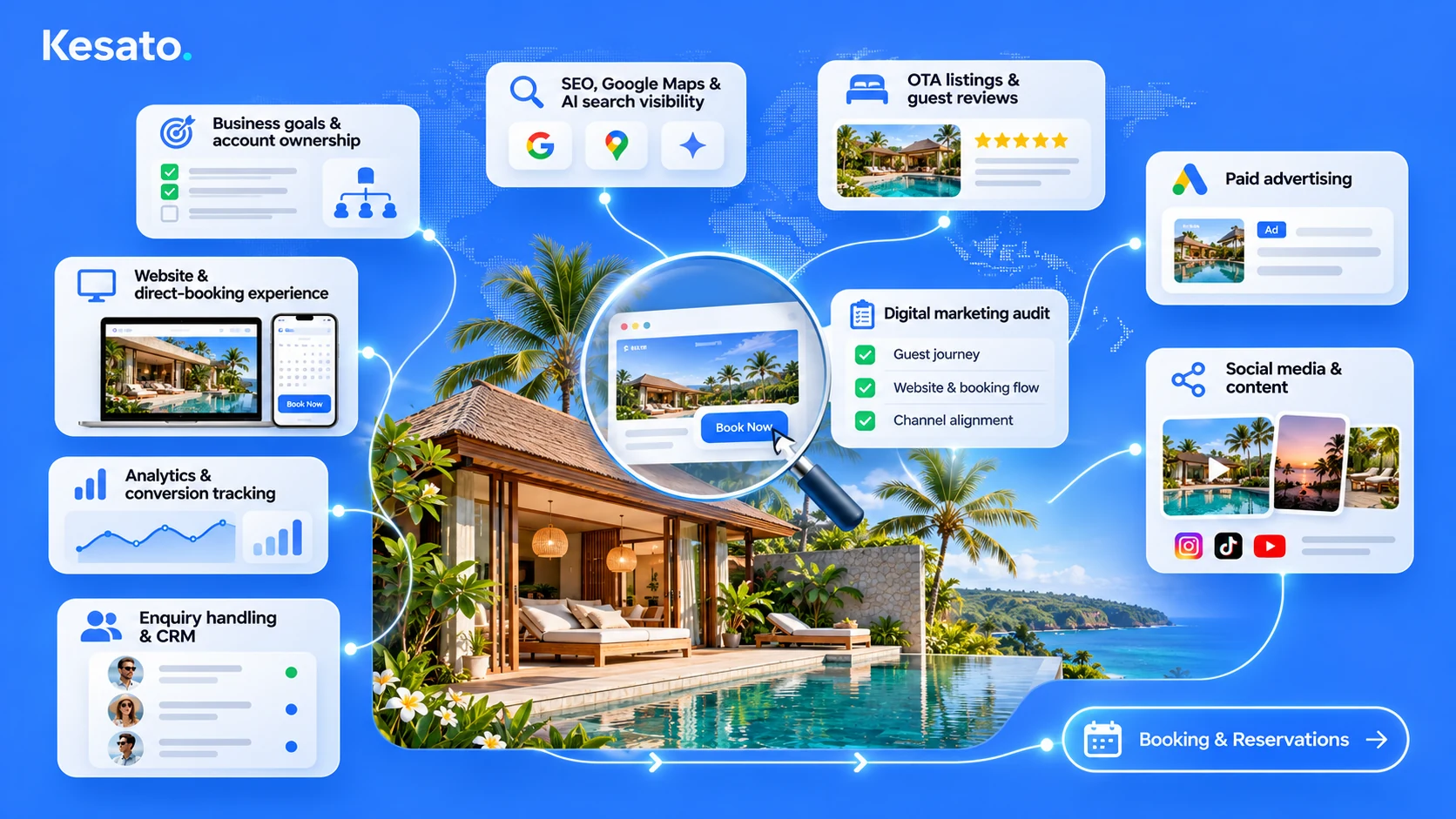
Key takeaways
- Audit the full guest journey, from online discovery to confirmed bookings.
- Review eight areas, including SEO, ads, website performance, OTA listings and analytics.
- Use real evidence to identify problems instead of relying on traffic or engagement numbers alone.
- Fix booking and tracking issues before increasing your marketing budget.
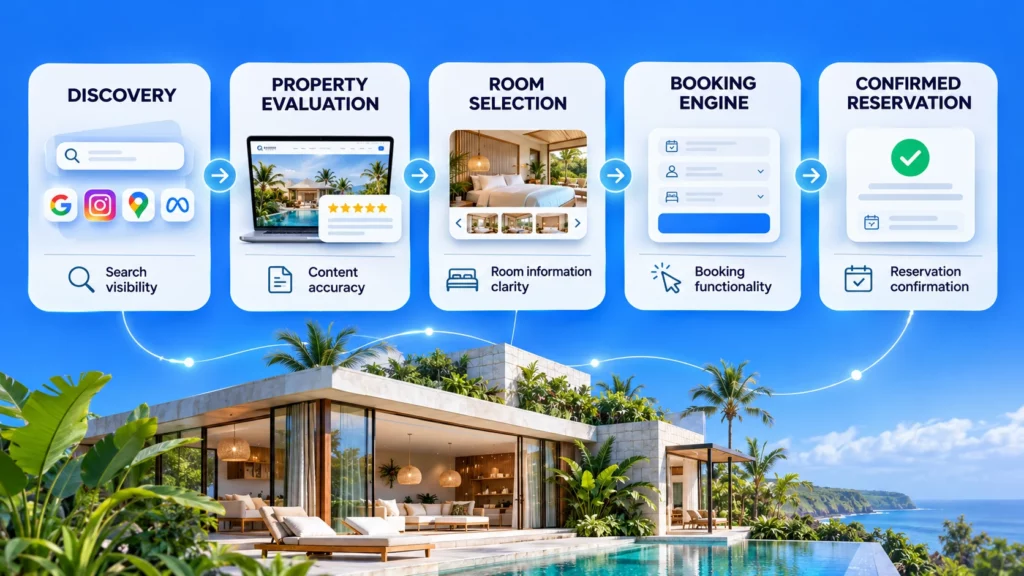
Guests rarely book a hotel after seeing just one advertisement. They might discover a property on Instagram, compare reviews on an OTA, search Google and finally visit the hotel’s website.
But what happens when that journey ends without a reservation?
The problem could be ineffective advertising, unclear room information, a slow booking engine or unanswered enquiries. Without reviewing the full journey, it is difficult to know where to focus.
A digital marketing audit for hotels helps owners and marketing managers find those gaps. It examines how the website, search visibility, advertising, content and reservation processes work together.
For Bali hospitality businesses, the audit should also consider domestic and international guests, OTA distribution and direct-booking opportunities.
This guide explains eight areas to review. It also provides a practical checklist and a simple framework for deciding what to improve first.
Table of contents
- What Is a 360° Digital Marketing Audit for a Hotel?
- Before You Start: Define Goals and Collect Evidence
- The Eight Areas of a Hotel Digital Marketing Audit
- Hotel Digital Marketing Audit Worksheet
- From Evidence to Action
- What Should You Fix Before Hiring a Digital Agency?
- Final Takeaway
- Frequently Asked Questions
What Is a 360° Digital Marketing Audit for a Hotel?
A 360° digital marketing audit reviews how a hotel’s online channels support its business goals. It looks beyond individual campaigns to examine the full guest journey.
A monthly report might show website visits, ad clicks or social media engagement. An audit goes further. It asks whether those activities attract the right guests and lead to meaningful outcomes.
For example, a hotel may attract plenty of organic traffic but receive few direct bookings. That does not automatically mean its SEO strategy is failing.
The website might have unclear room details. The booking engine could be difficult to use. Alternatively, the hotel may not be tracking confirmed reservations correctly.
A useful audit investigates these possibilities before recommending changes.
Hospitality marketing also extends beyond the hotel’s website. OTA listings, online reviews, Google Maps and guest communication all influence booking decisions. The HSMAI hotel online presence checklist provides a wider perspective on these connected channels.
For more context, explore Kesato’s guide to digital marketing in Bali.
Before You Start: Define Goals and Collect Evidence
Start with two questions: What does the hotel want to achieve, and what evidence is available?
Set Business Goals Beyond Clicks and Impressions
Marketing goals should reflect business needs, not just platform metrics.
A boutique hotel in Ubud may want to attract wellness travellers. A family resort in Nusa Dua might focus on school holidays. A villa group may need better visibility across several properties.
Before reviewing any channel, clarify:
- Who are the hotel’s priority guest segments?
- Which source markets matter most?
- Does the hotel want more awareness, enquiries or confirmed bookings?
- Which room types or travel periods need attention?
- Who manages each marketing and reservation channel?
These answers help the team decide which findings matter most.
Gather the Reports, Access and Guest Journey Data
Next, collect the information needed to review the hotel’s digital presence.
Useful sources include:
- Website CMS and booking-engine access.
- Google Search Console and Google Analytics 4.
- Google Ads and Meta Ads reports.
- Google Business Profile and OTA listings.
- Website enquiry and reservation records.
- CRM reports, where available.
Also test the guest journey yourself.
Open the website on a mobile device. Check the room information and booking links. Compare property details across the website and major booking platforms.
Record the device, date and conditions of each test. Do not complete a real payment or reservation unless you have permission.
If important data is missing, document the gap. An audit should never invent results to fill missing reports.
The Eight Areas of a Hotel Digital Marketing Audit
A complete audit should cover eight connected areas. Each helps explain where guests discover the property, how they make decisions and what may prevent them from booking.
1. Business Goals and Account Ownership
Start by reviewing who owns the hotel’s marketing accounts and who is responsible for results.
Different teams may manage advertising, the website, social media and reservations. This can create gaps when responsibilities are unclear.
Check: Business objectives, account access, reporting ownership and team responsibilities.
Warning signs: Missing administrator access, inconsistent reports or campaigns without defined goals.
Next step: Confirm account ownership and assign clear responsibilities.
2. Website and Direct Booking Journey
The website should make it easy for guests to evaluate rooms and proceed to booking.
Review navigation, room descriptions, photography, mobile usability and booking-engine links. Check whether guests can understand rates, inclusions and booking conditions.
Check: Mobile booking flow, room information, page usability and booking-engine handover.
Warning signs: Broken buttons, confusing room options, unexpected redirects or a booking engine that fails on mobile.
Next step: Reproduce the issue and involve the website or booking provider.
3. SEO, Google Maps and AI Search Visibility
Can potential guests find the hotel when searching for relevant accommodation?
Use Google Search Console to review search queries, landing pages, impressions and clicks. Compare branded searches with discovery queries that describe the property’s location or guest experience.
Then check Google Business Profile. Confirm the property’s location, amenities, images and contact information.
AI search can also be reviewed. Test relevant travel questions in ChatGPT or other AI assistants. Record the exact prompts, dates and responses.
However, one missing recommendation does not prove a visibility problem.
Google explains that fundamental SEO practices remain important for AI features. No special markup guarantees an AI recommendation.
Check: Search performance, indexability, Maps information and documented AI search observations.
Warning signs: Important pages missing from search, inaccurate hotel information or visibility for irrelevant queries.
Next step: Separate technical issues from content gaps and information inconsistencies.
For more detail, see Kesato’s guide to hotel visibility in ChatGPT.
4. OTA Listings, Reviews and Distribution
Guests often compare a hotel’s website with OTA listings before making a booking decision.
Review property descriptions, room categories, images, amenities and booking policies across relevant platforms.
Guest reviews can also reveal recurring problems. For example, repeated complaints about inaccurate room information may point to a content or operational issue.
Check: OTA content, property details, booking policies and review patterns.
Warning signs: Outdated images, inconsistent information or recurring guest complaints.
Next step: Identify the source of each discrepancy and coordinate corrections.
5. Paid Advertising Performance
Paid advertising should support a clear objective.
An awareness campaign for a new resort needs different success measures from a campaign targeting guests ready to book.
Review targeting, campaign messages, landing pages and conversion tracking.
Most importantly, distinguish between actions. An ad click, enquiry and completed reservation are not the same result.
Check: Campaign objectives, landing-page relevance, reported conversions and available reservation evidence.
Warning signs: Poorly matched landing pages, duplicate conversions or campaigns optimising only for clicks.
Next step: Validate conversion tracking before increasing the budget.
6. Social Media and Content Consistency
Social media should communicate the hotel’s actual guest experience.
Review whether the images, captions and content themes reflect the property’s positioning. Make sure important details remain consistent across platforms.
Also examine what happens after someone engages with the content.
Can guests find the correct website? Are booking links working? Does someone respond to enquiries?
Check: Content themes, brand consistency, profile links and enquiry handling.
Warning signs: Outdated offers, broken links or engagement without a clear next step.
Next step: Identify whether improvements are needed in content, distribution or lead handling.
7. Analytics, Conversion Tracking and Attribution
Reliable measurement helps hotels make better marketing decisions.
Review how Google Analytics 4, Google Tag Manager and advertising platforms track important actions.
Google’s recommended GA4 events distinguish a submitted lead request from a completed purchase.
A booking-button click should not be reported as a confirmed reservation.
If the website sends guests to an external booking engine, review cross-domain measurement. Without suitable configuration, the guest journey may become fragmented in analytics reports.
Check: Event definitions, successful submissions, booking tracking and data consistency.
Warning signs: Duplicate events, missing conversions or reported bookings that cannot be verified.
Next step: Test important events and document what each conversion actually measures.
8. Enquiry Handling and Guest Retention
Marketing does not end when a guest sends an enquiry.
Review how messages from WhatsApp, email, website forms and social media reach the reservations team.
Check whether enquiries have clear owners and whether the hotel records their outcomes.
Check: Enquiry routing, follow-up processes, CRM stages and relevant guest communication records.
Warning signs: Unanswered messages, unclear responsibilities or enquiries counted as bookings before confirmation.
Next step: Improve the handover between marketing and reservations.
Hotel Digital Marketing Audit Worksheet: What to Check
Once the eight areas have been reviewed, summarise the findings in a simple worksheet.
The goal is not to create the longest possible list of problems. It is to identify what has been checked, what evidence exists and which actions are needed.
| Audit area | What to verify | Evidence | Next action |
|---|---|---|---|
| Business goals | Objectives and ownership | Goals and access records | Clarify responsibilities |
| Website | Mobile booking journey | Usability tests | Investigate friction |
| Search visibility | Accurate, discoverable information | GSC and Maps checks | Review visibility gaps |
| Distribution | Consistent OTA listings | Listing comparisons | Correct discrepancies |
| Paid media | Relevant, measured campaigns | Ads and conversion reports | Validate performance |
| Social media | Consistent content and links | Content inventory | Improve consistency |
| Analytics | Accurate conversion events | GA4 and tracking tests | Repair measurement |
| Lead handling | Clear enquiry ownership | Workflow records | Improve follow-up |
For each issue, record the evidence, possible business impact and responsible person.
If the evidence is incomplete, label the finding as unverified. Do not treat a suspicion as a confirmed problem.
From Evidence to Action: How to Prioritize Audit Findings
A successful audit should lead to practical decisions.
Some issues directly interrupt bookings. Others affect content quality or reporting. Not every finding requires an immediate investment.
For this guide, we use a simple Evidence-to-Action approach:
Identify → Verify → Diagnose → Prioritize → Recheck
This approach combines general principles from ISO 19011 auditing guidance, the Five Whys technique and the Plan–Do–Check–Act cycle.
Methodology note: This checklist adapts established auditing and continuous improvement principles to hotel marketing. It was prepared with AI-assisted editorial support and is not a proprietary Kesato framework or a certified audit standard.

Score Each Check Using Verifiable Evidence
Use a simple scoring system to organise the findings:
- 0 — Problem confirmed: The function is missing or failing.
- 1 — Partial or unverified: Evidence is incomplete.
- 2 — Verified: The function works under the documented test conditions.
- N/A: The check does not apply to the property.
These scores help organise an audit. They are not validated industry benchmarks.
A high score does not guarantee strong revenue performance. A low score also does not automatically mean the issue is urgent.
Investigate Root Causes Before Recommending Fixes
Imagine a hotel receiving paid traffic but few confirmed bookings.
Increasing the advertising budget might seem like an easy solution. However, the team should first investigate:
- Are the ads reaching relevant guests?
- Does the landing page match the offer?
- Can visitors understand the room options?
- Does the booking engine work correctly?
- Are completed bookings being tracked?
This example is hypothetical. It illustrates why teams should investigate the guest journey before blaming an individual channel.
Prioritize, Assign Ownership and Recheck
Once the findings are verified, group them into three priorities.
| Priority | When to use | Recommended action |
|---|---|---|
| P1 — Fix first | Confirmed issue affecting booking or essential measurement | Fix and retest |
| P2 — Improve next | Verified weakness affecting experience or efficiency | Plan improvements |
| P3 — Test or monitor | Possible issue without sufficient evidence | Collect data and test |
For example, a booking engine that repeatedly fails on mobile may deserve immediate attention.
Record the affected page, device, observed error and test conditions. Assign the issue to the responsible team, then verify the fix.
Keep the process simple:
Issue → Evidence → Business Impact → Action → Owner → Verification
This turns the audit into a working improvement plan.
What Should You Fix Before Hiring a Digital Agency?
Not every marketing problem requires a new agency.
Hotel teams may be able to correct outdated property information, improve response procedures or organise account access themselves.
Other problems need specialist support. These may include website development, SEO, advertising attribution or complex booking integrations.
Before contacting an agency, prepare:
- Clear business goals and target guest segments.
- A list of marketing accounts and platform owners.
- Verified findings from the audit.
- Known technical and reporting gaps.
- A prioritised list of improvements.
This helps both sides focus on evidence rather than assumptions.
For growing hospitality groups, these challenges often become more complex. Kesato’s guide to scaling a villa or resort business in Bali explains the importance of connected systems.
Hotel teams can also explore Kesato’s portfolio when reviewing agency capabilities.
The goal is to choose the right support for the problems that actually need solving.
Final Takeaway: Audit the Booking Journey, Not Just the Channels
Hotel marketing works as a connected system.
Search helps guests discover a property. Content builds trust. Booking platforms support reservations. Advertising creates opportunities, while analytics and reservations teams help measure outcomes.
When one part fails, the problem may appear somewhere else.
A useful digital marketing audit brings these connections into focus. It helps hotel teams identify real issues, collect evidence and decide what to fix first.
Before launching another campaign, understand what already works and where the guest journey needs improvement.
Frequently Asked Questions
Can a Hotel Conduct a Digital Marketing Audit Without an Agency?
Yes. Hotel teams can review websites, content, listings, campaigns and enquiry processes themselves. Technical issues involving tracking, booking engines or complex integrations may require specialist support.
What Data Should a Hotel Prepare for a Marketing Audit?
Start with business goals, website analytics, search performance, advertising reports, OTA listings and reservation records. Include enquiry workflows and CRM data where available. Document any missing information.
Should an Audit Include OTA Listings and Guest Reviews?
Yes, if these channels are part of the hotel’s guest journey. OTA content and reviews help reveal information gaps, booking expectations and recurring guest concerns.
How Often Should a Hotel Review Its Digital Marketing?
There is no single schedule for every hotel. Review key issues regularly, and conduct a broader audit when business goals, campaigns, systems or distribution arrangements change.