
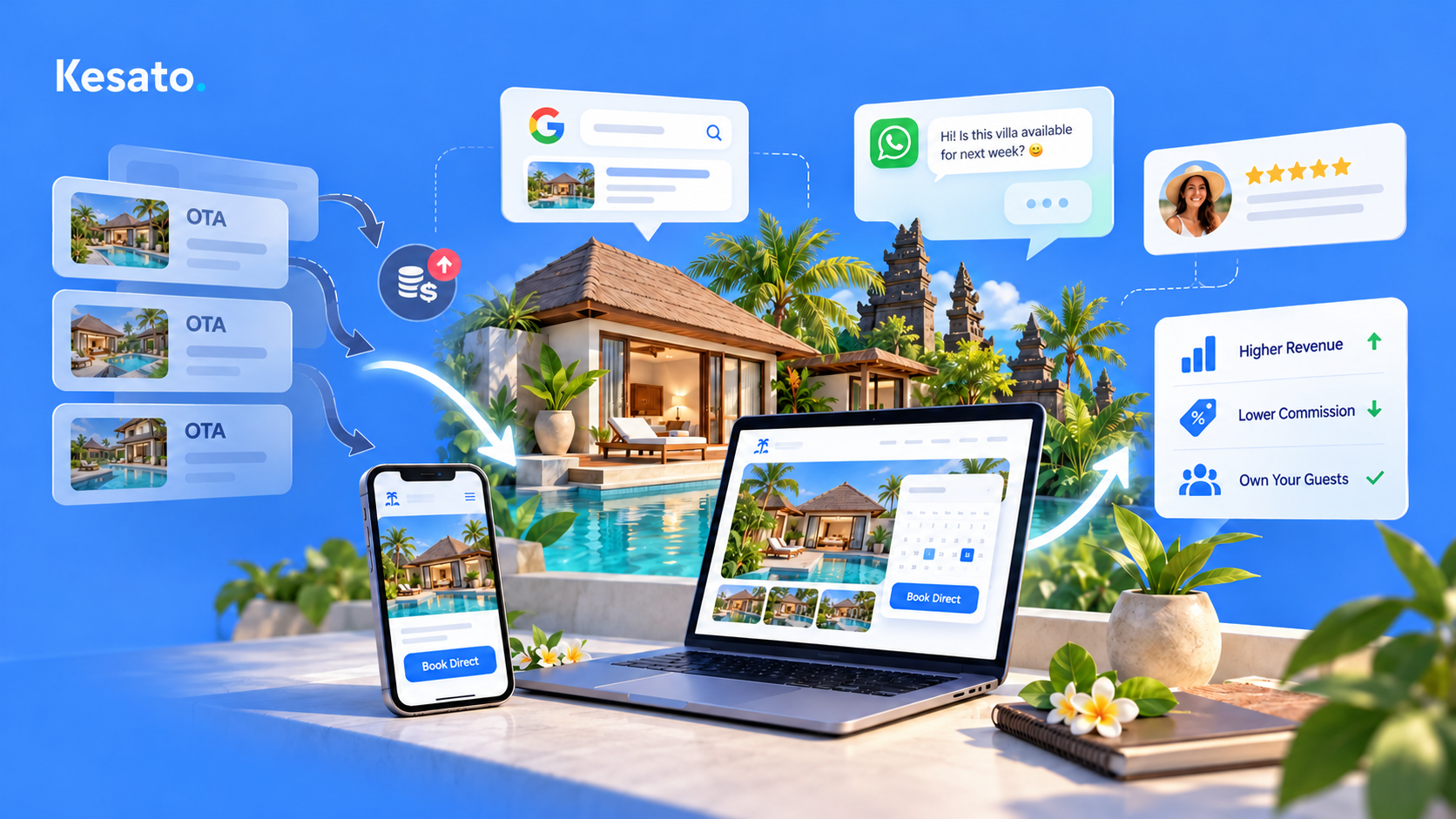
Every Bali villa owner knows the feeling. A five-night stay comes in through Booking.com or Airbnb, and a large share of the revenue is gone in commission before the guest even arrives. OTAs bring visibility, but relying on them for almost every booking makes a villa expensive to run and dependent on someone else’s platform.
Getting more direct bookings for Bali villas means winning the guest at every point where they compare options: a fast website with a real booking engine, a clear reason to book direct, strong visibility on Google and AI assistants, convincing social proof and a way to bring past guests back. A good villa direct booking strategy does not quit OTAs. It stops depending on them.
Key takeaways
- OTA commissions typically take 15% or more of every booking, before hidden costs such as higher cancellation rates.
- Direct bookings tend to be worth more: longer stays, longer booking windows and a guest relationship you own.
- Guests book directly when it is just as easy as an OTA and gives them something extra.
- Past guests are the cheapest source of future direct bookings.
How much do OTAs really cost a Bali villa?
OTA commission is the percentage of each booking that an online travel agency keeps in exchange for listing and selling your villa. According to Smart Order’s guide to OTA commission rates, Booking.com charges around 15%, rising to 18% or more with partner programs, while Expedia Group ranges from about 15% to 30%. On Airbnb, the host-only fee model usually costs hosts around 15.5% per booking, as StayFi explains.
| Platform | Typical cost to the property |
| Booking.com | Around 15%, higher with preferred or visibility programs |
| Expedia Group | Around 15% to 30%, depending on market and property |
| Airbnb (host-only fee) | Usually around 15.5% |
| Direct booking | Booking engine, payment and marketing costs, no commission |
A villa at USD 300 a night booked for five nights earns USD 1,500. At 18% commission, USD 270 of that goes to the OTA.
Commission is not the only cost. Cloudbeds’ 2026 State of Independent Hotels Report, based on 90 million bookings, found OTA cancellation rates of 21.8%, more than double the 10.6% rate for direct bookings. The OTA also keeps the guest relationship, which makes it harder to bring that guest back directly.
Why are direct bookings worth the effort?
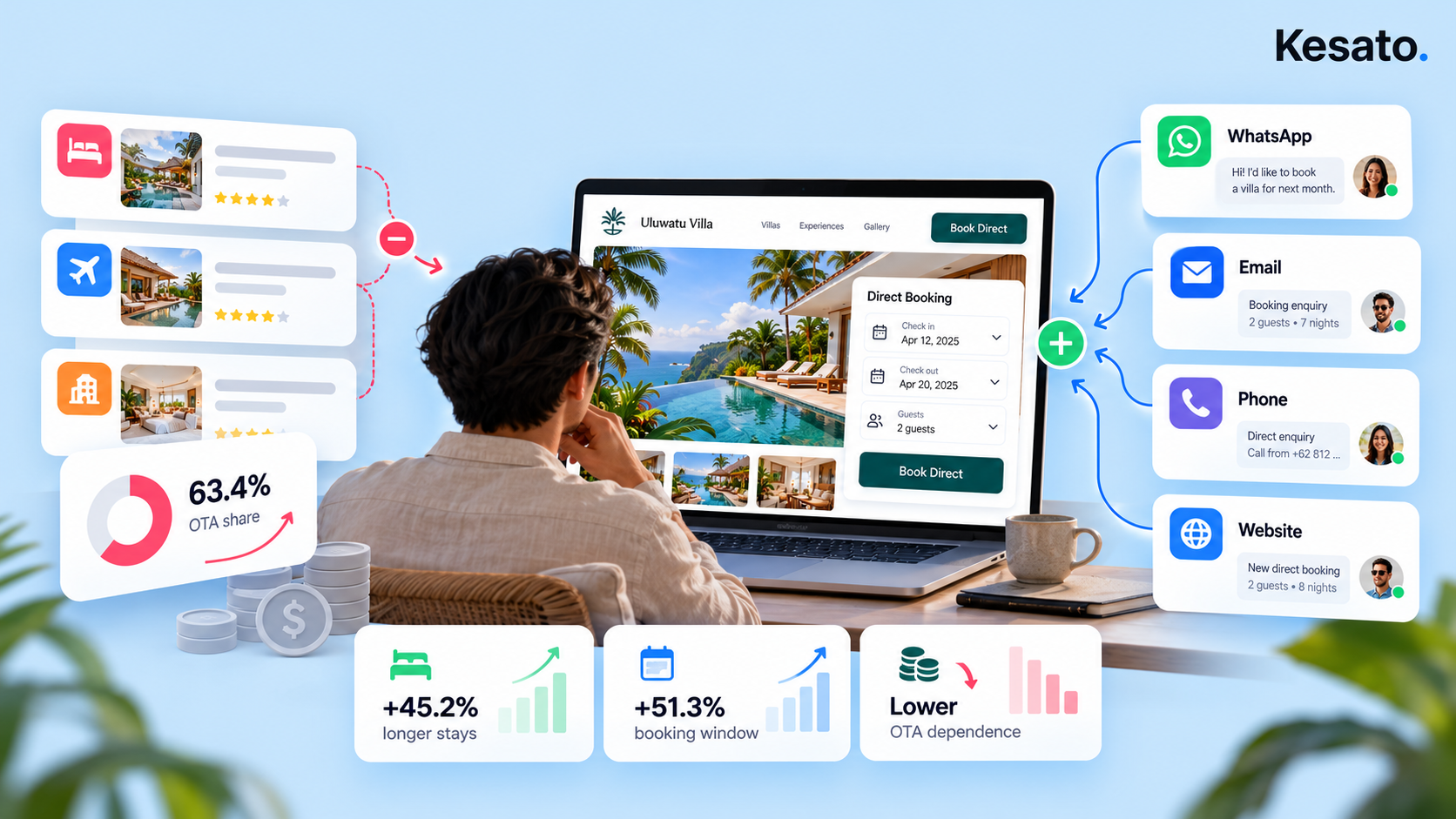
A direct booking is a reservation made through the villa’s own channels, such as its website, WhatsApp, email or phone, with no intermediary taking a commission.
Most large booking studies cover hotels rather than villas, but the pattern holds for both. For vacation rentals, the closest match to the Bali villa model, Lodgify’s 2026 State of the Industry Report analysed over 1.6 million bookings and found that direct bookings produced stays 45.2% longer and booking windows 51.3% longer than OTA bookings.
Yet most independent properties still depend on OTAs. Cloudbeds found that OTAs supplied 63.4% of independent hotel bookings in 2025, approaching 80% in some markets. That gap is the opportunity.
What steps increase direct bookings for Bali villas?
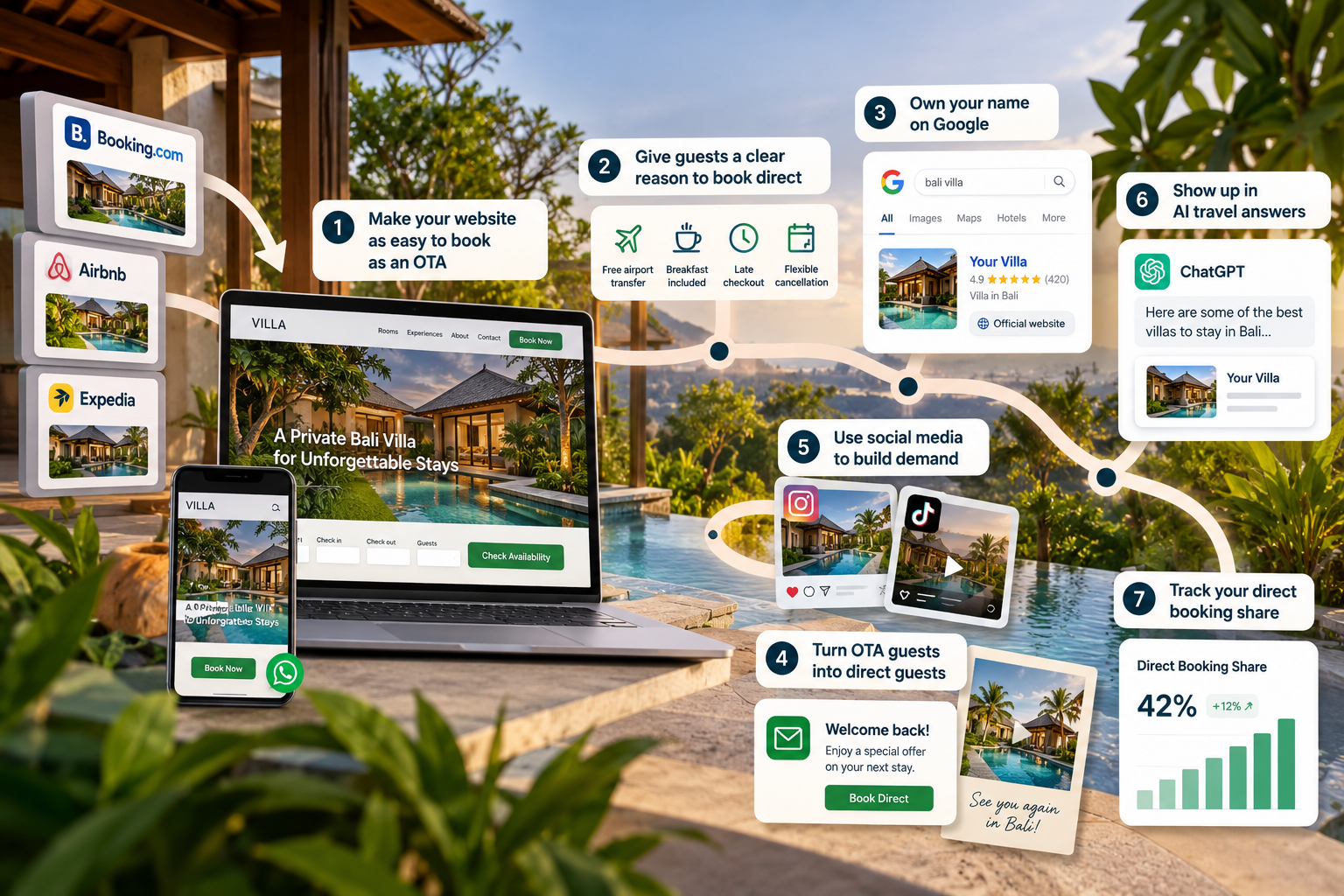
1. Make your website as easy to book as an OTA
Many guests find a villa on an OTA, then check its website before booking. SiteMinder’s 2026 Changing Traveller Report found that 18% of travellers who start their search on an OTA end up booking directly with the hotel. If your website is slow, has no live availability or hides the price, you lose that guest back to the OTA. Choose a booking engine for villas that shows real-time rates and connects to a channel manager, so availability stays in sync with your OTAs. Make the site fast on mobile and add a WhatsApp button, since many guests in Bali prefer to ask a quick question first. Strong website copywriting helps turn those visits into bookings.
2. Give guests a clear reason to book direct
A guest who sees the same price everywhere will usually book where they feel safest. Offer something the OTA cannot, such as a free airport transfer, breakfast, a late checkout or more flexible cancellation, and show it clearly on the homepage and booking page. Before pricing below OTA rates, check your contracts for rate-parity terms. Perks are usually the safer lever.
3. Own your name on Google
Make sure your Google Business Profile is complete, connect your rates to Google Hotels and other metasearch sites through your booking engine where possible, and consider a small brand campaign so OTAs do not capture clicks on your own name. Our guides to Google Ads for business and how much Google Ads costs explain how to budget for this.
Should a villa stop listing on OTAs completely? Usually not. OTAs are still a powerful discovery channel. The aim is to use them for reach while steadily moving repeat and high-value guests to your own channels.
4. Turn OTA guests into direct guests
During the stay, invite guests to join your mailing list or WhatsApp updates with their consent, then follow up after checkout with a return-guest offer. Respect OTA policies and privacy rules when collecting contact details.
5. Use social media to build demand
Instagram and TikTok are where many travellers first discover Bali villas. Share the experience, not just the rooms, and link every profile to your booking page, not to an OTA. Consistent social media management keeps the villa visible between peak seasons.
6. Show up in AI travel answers
More travellers now ask ChatGPT, Gemini or Perplexity where to stay. If AI recommends your villa and links to your website, that guest may never open an OTA. We explain how in how to get your hotel recommended by ChatGPT.
7. Track your direct booking share every month
Measure what share of your bookings comes direct, your website’s booking conversion rate and your cost per direct booking compared with OTA commission.
What we review first in a villa’s direct booking setup
When we review a villa’s direct booking setup at Kesato, we start with four checks:
- The booking test: How many taps does it take to book on mobile, and does the website price match the OTA listing?
- The reason to book directly: Is a clear perk visible on the homepage and booking page, or does the guest have to hunt for it?
- The brand search. When someone searches the villa’s name on Google, is the first click the villa’s website or an OTA?
- The guest database: Are past guests’ contact details collected with consent, and is anyone following up?
These checks usually show where direct bookings are leaking and which fixes will pay back fastest.
How is the Bali villa market different?
Bali’s market is large and international. BPS-Statistics Bali recorded 6,948,754 direct foreign arrivals in 2025, up 9.72% on 2024, with Australia the largest source market at 23.44% of the total. For most villas, that makes Australian travellers the first audience to win directly, with rates they understand, offers timed to Australian school holidays and ads aimed at Australian cities.
Guests also plan around peak periods such as July to August and the year-end holidays, and expect quick replies on WhatsApp. Villas that answer fast, show rates in a familiar currency and describe their exact area, such as Canggu, Uluwatu or Ubud, remove the doubts that send guests back to OTAs.
How Kesato helps villas win more direct bookings
At Kesato, we help villas, hotels and resorts across Bali build direct booking channels that work, from website design and development and SEO and GEO to Google and Meta ads, social media and CRM setup, all under one roof. Want to know how many bookings your villa could move away from OTAs? Contact our team for a direct booking review.
Frequently Asked Questions
What percentage of bookings should be direct?
There is no single target, because location, property type and season all matter. With OTAs supplying 63.4% of independent hotel bookings in 2025, the average independent property is left with well under 40% direct. A practical goal is to grow your direct share every quarter and track it monthly.
Are direct bookings really cheaper than OTA bookings?
Usually, but they are not free. A direct booking still carries costs for the booking engine, payment processing, ads and marketing. For most villas, those costs are lower than a 15% to 25% commission, especially for repeat guests.
How long does it take to increase direct bookings?
Website and Google fixes can show results within weeks. Building a base of repeat guests through email, WhatsApp and social media usually takes one to two seasons of consistent work.


