
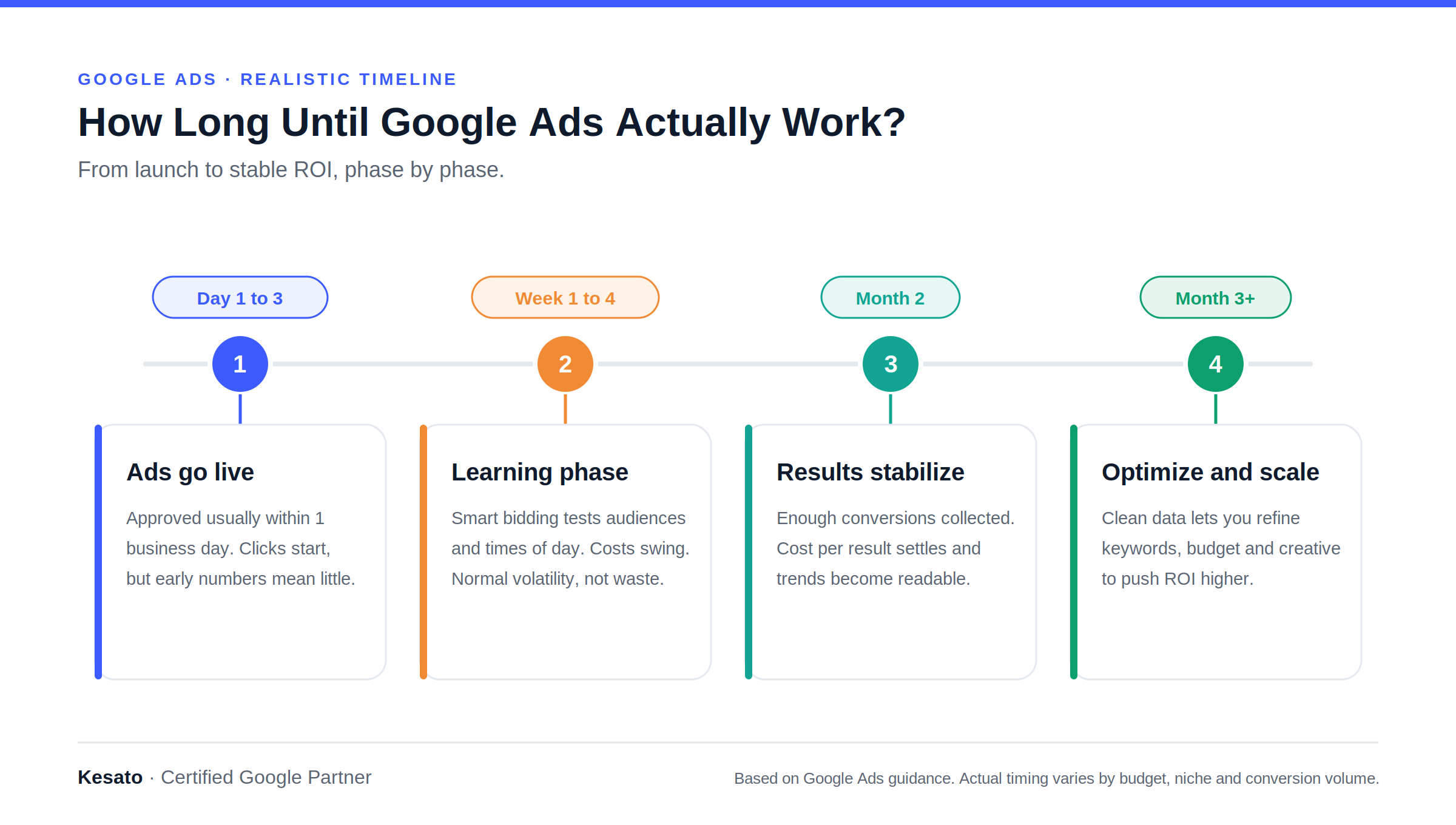
Google Ads can start showing within hours of approval, but meaningful, profitable results usually take 2 to 3 months. Your ads go live once approved (typically within 1 business day), the smart bidding learning phase runs 1 week to 1 month, and stable performance only arrives after enough conversion data has built up.
Below is the realistic timeline, why it works this way, and how to reach results faster.
The Google Ads Timeline, Phase by Phase
Here is what a realistic path from launch to steady returns actually looks like, and what to watch at each stage.
- Day 1 to 3: Ads go live. After approval (usually within 1 business day), impressions and clicks start almost immediately. Watch only for delivery and obvious errors here, not cost per result. Early numbers swing wildly and tell you almost nothing, so resist reading them as a verdict.
- Week 1 to 4: The learning phase. Smart bidding tests placements, audiences, devices, and times of day. Cost per result rises and falls, sometimes sharply. This volatility is the system working, not wasted spend. Your job is to feed it clean conversions and leave the settings alone.
- Month 2: Stabilization. Once the algorithm has collected enough conversions, your cost per acquisition settles into a range and trends become readable with confidence. This is the first point where the data is trustworthy enough to act on.
- Month 3 and beyond: Optimization and scale. With clean history behind you, you refine keywords, add negatives, shift budget to winners, and test new creative to push return on ad spend higher. Growth compounds from here.
A useful rule of thumb: expect your first conversions within days, your first reliable cost per acquisition within a month, and your first confident scaling decision around month 3.
What Is the Google Ads Learning Phase?
The learning phase is the period when an automated bidding campaign gathers conversion data to decide when, where, and to whom your ads should show. It applies to smart bidding strategies such as Target CPA, Target ROAS, and Maximize Conversions. Manual CPC has no learning phase.
How long does it last? Usually 1 week to 1 month, and conversion volume is the single biggest driver. Google recommends at least 15 conversions in 30 days for smart bidding to function, and 30 to 50 conversions per campaign per month for reliable output. Two things quietly stretch the window: a long conversion cycle, where the gap between click and purchase is measured in days or weeks, and thin traffic that starves the algorithm of the signals it needs.
It also resets. Significant edits to budget, bid targets, or campaign structure send the campaign back into learning, which is why disciplined, spaced-out changes matter so much.
Quick FAQ: How many conversions does Google Ads need to exit the learning phase? Google recommends a minimum of 15 conversions within 30 days per campaign. Aim for 30 to 50 per month for stable, dependable performance.
Search vs Performance Max: Which Works Faster?
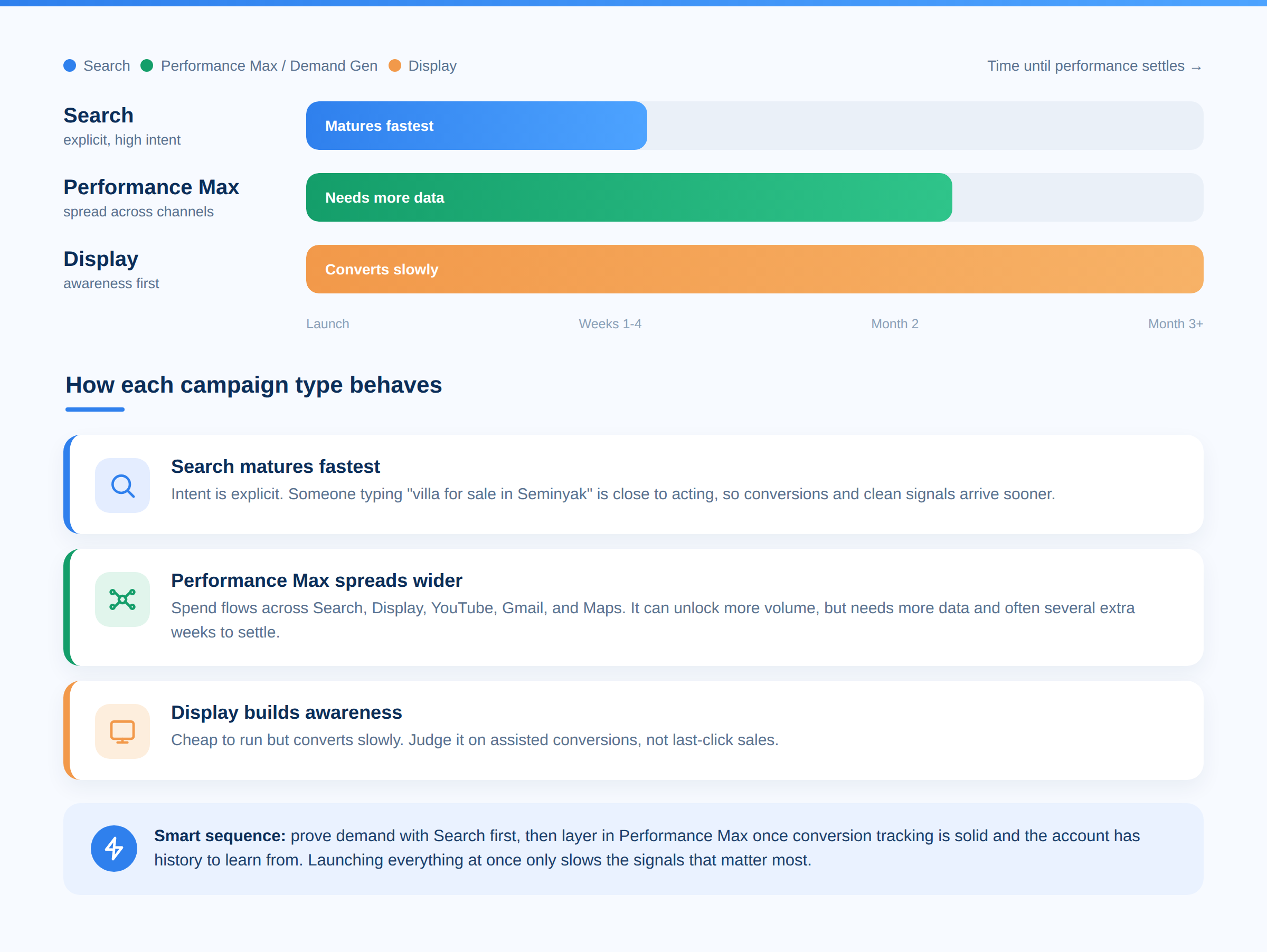
Campaign type changes the timeline as much as budget does, so picking the right one for your goal is half the battle.
- Search matures fastest because intent is explicit. Someone typing “villa for sale in Seminyak” is close to acting, so conversions and clean signals arrive sooner.
- Performance Max and Demand Gen spread spend across Search, Display, YouTube, Gmail, and Maps. They can unlock more volume, but they need more data and often several extra weeks before performance settles.
- Display alone builds awareness cheaply but converts slowly, so judge it on assisted conversions, not last-click sales.
For a fast, measurable start, prove demand with Search first, then layer in Performance Max once conversion tracking is solid and the account has history to learn from. Launching everything at once only slows the signals that matter most.
Why Are My Google Ads Not Working Yet?
If results feel slow, the cause is almost always data or setup, not the platform itself. These are the factors that decide how fast Google Ads work, with the fix for each.
- Budget too low. A budget that cannot fund 15+ conversions a month traps you in permanent learning. Fund the goal, not just the click.
- Too many changes. Every edit to budget, bids, targeting, or creative can reset learning. Give each change 1 to 2 weeks to breathe before the next one.
- Weak conversion tracking. If Google cannot measure conversions accurately, it cannot optimize toward them. Verify tracking and tags before you spend a rupiah or a dollar.
- Poor ad-to-landing-page match. Clicks that never convert usually trace back to a landing page that does not deliver on the ad’s promise. The message match is half the battle.
- Underestimating auction competition. In crowded niches, a low impression share means the system simply cannot buy enough auctions to learn quickly.
- Wrong bid strategy for your volume. Putting a low-volume account on Target ROAS before it has the conversions to support it makes bids thrash and restarts learning. Begin with Maximize Conversions or manual bidding, then graduate to value-based strategies as data accumulates.
- Judging too early. Grading a campaign in week 1 is like scoring an exam after the first question.
Fix these and you often cut the road to profitability from 6 months down to 6 weeks.
Read also: How Much Does Google Ads Cost?
What Google Ads Timelines Look Like in Competitive Markets
Timelines are not universal. In competitive, high-value niches, they run longer, and that has real budget implications.
For the brands Kesato works with in Bali hospitality, villa real estate, liveaboard and yacht charter, and F&B, and for businesses targeting both Indonesia and the United States, the learning phase often sits at the longer end. Luxury and travel keywords carry heavy competition and long decision cycles. A villa booking or property enquiry can take days or weeks to convert after that first click, so reaching 30 to 50 conversions takes more calendar time even with a healthy budget. For sales cycles this long, importing offline conversions, the inquiry that becomes a booking weeks later, lets the algorithm learn from real revenue instead of raw form fills.
Geography matters too. US campaigns often face higher costs per click and denser competition than the same niche in Indonesia, while Indonesian campaigns may need broader targeting to gather enough volume to learn. Seasonality compounds both: launching right before Bali high season behaves very differently from a shoulder-season start.
The answer is not patience alone. It is structured: consolidated conversion actions, seasonally aware budgets, market-specific landing pages, and one bid strategy given room to learn.
Benchmarks prove how much the niche matters. WordStream’s 2026 US data shows real estate carries one of the highest costs per lead at roughly $103, while travel sits near $45, and conversion rates swing widely by category. A realistic Google Ads timeline starts with your category’s true baseline, not a generic average. Check the 2026 Google Ads benchmarks for yours before you set expectations.
Ready to Make Every Ad Dollar Count?
Google Ads reward patience backed by strategy, not guesswork. The slow, expensive version happens when campaigns are launched hopefully and edited nervously. The fast version happens when structure, tracking, and budget are right from day one. In competitive, high-consideration markets like Bali property and hospitality, where a single enquiry can be worth thousands, that early discipline is often the difference between a profitable quarter and a wasted one.
If you would rather skip the costly learning curve, the team at Kesato, a certified Google Partner, builds and manages campaigns engineered to reach stable ROI sooner. Explore our Google Ads and digital marketing services, pair them with SEO and SEM for compounding long-term reach, and lean on conversion-focused content and creative so every click lands somewhere that sells. When you are ready to grow, start at kesato.com.
Frequently Asked Questions
Does Google Ads work immediately?
No. Ads can serve within hours of approval, but reliable results take 2 to 3 months as the campaign gathers conversion data and clears the learning phase.
Can Google Ads work with a small budget?
Yes, if the budget can fund at least 15 conversions a month. Below that threshold the algorithm lacks data, so results stay unstable and slow.
How long should I run Google Ads before deciding if they work?
Give a campaign at least 3 months. That covers approval, the learning phase, and enough post-learning data to judge true ROI fairly.
Are Google Ads worth it for businesses in Indonesia?
Yes. For both local and international demand they deliver fast visibility, though competitive niches like tourism and property need a longer runway to mature.