

Search engines have spent two decades refining one core mission: surface content that genuinely helps the person searching. That mission has only intensified with the rise of AI Overviews, ChatGPT Search, and other large language model (LLM) powered tools that now sit between websites and searchers.
Here’s the uncomfortable part most SEO guides skip: uniqueness isn’t a ranking factor. Google has never scored a page higher simply for being original. But originality is now the practical precondition for everything that is measured, and the gap between those two statements is where most content strategies go wrong.
Why Is Unique Content Important for SEO?
Unique content matters because search engines consolidate near-identical pages into one result and ignore the rest. Original data, firsthand experience, and a distinct angle are what earn the engagement, citations, and links that ranking systems actually measure. Without them, a page competes for visibility it will rarely receive.
What Makes Content “Unique” in the Eyes of Search Engines
Unique content means original writing, data, and perspective: information that doesn’t already exist elsewhere in the same wording, structure, or format. It’s different from duplicate content, which repeats existing material, even a business’s own product descriptions reused across multiple pages, and from plagiarized content, which copies someone else’s work outright.
The distinction matters because search engines treat these three categories very differently:
- Duplicate content is usually filtered or consolidated rather than penalized. Google’s documentation on canonicalization states plainly that some duplicate content on a site is normal and not a violation of its spam policies.
- Plagiarized content carries genuine legal exposure through DMCA takedown requests, and copied pages tend to lose the consolidation contest to the original. There is no dedicated “plagiarism penalty,” but there is no upside either.
- Genuinely unique content sits in a category of its own: it’s rewarded, cited, and remembered.
In practice, uniqueness tends to come from one of four sources:
- Original research or internal data that hasn’t been published anywhere else
- A documented process based on real, firsthand experience rather than general advice
- An informed opinion or angle that adds nuance to a common narrative
- Custom visuals, screenshots, or examples created specifically for that page
A useful test: if a page could disappear without leaving any real information gap on the internet, it likely isn’t unique enough to compete.
Why Do AI Search Engines Reward Original, First-Hand Content?
AI search systems reward original, first-hand content because they run their own retrieval process rather than simply reading Google’s rankings. Pages built on firsthand data, direct experience, or a documented process are easier for these systems to verify, trust, and cite.
The data on this has shifted dramatically, and it’s worth being precise. An updated Ahrefs analysis of 863,000 keyword SERPs and roughly 4 million AI Overview URLs, reported by Search Engine Journal in early 2026, found that only about 38% of URLs cited in AI Overviews also appeared in the top 10 results for the same query. In Ahrefs’ July 2025 study, that figure was roughly 76%. BrightEdge, using a different methodology, put the overlap closer to 17%.
The methodologies aren’t directly comparable and Ahrefs notes its own citation detection improved between studies, so the exact number should be treated with caution. But the direction is consistent across independent datasets: ranking on page one is no longer sufficient for AI visibility, and increasingly isn’t even the main route to it.
Modern AI Overviews and LLM-based search tools look for a specific set of signals before citing a source:
- Clear authorship: named experts with demonstrable experience in the topic
- Structured formatting: question-based headings, short paragraphs, and scannable lists that are easy for machines to parse
- Freshness: recently published or updated pages, especially in fast-moving fields
- Semantic relevance: content that consistently appears near the right topical keywords, reinforcing what a page is actually about
These signals overlap with traditional on-page SEO, but they raise the bar. A page can rank on page one of Google and still get skipped entirely by an AI Overview if it lacks the structural and authorship signals above. Unique, well-organized content is one of the few things that satisfies both systems at once.
Duplicate and Thin Content Quietly Erodes Search Visibility
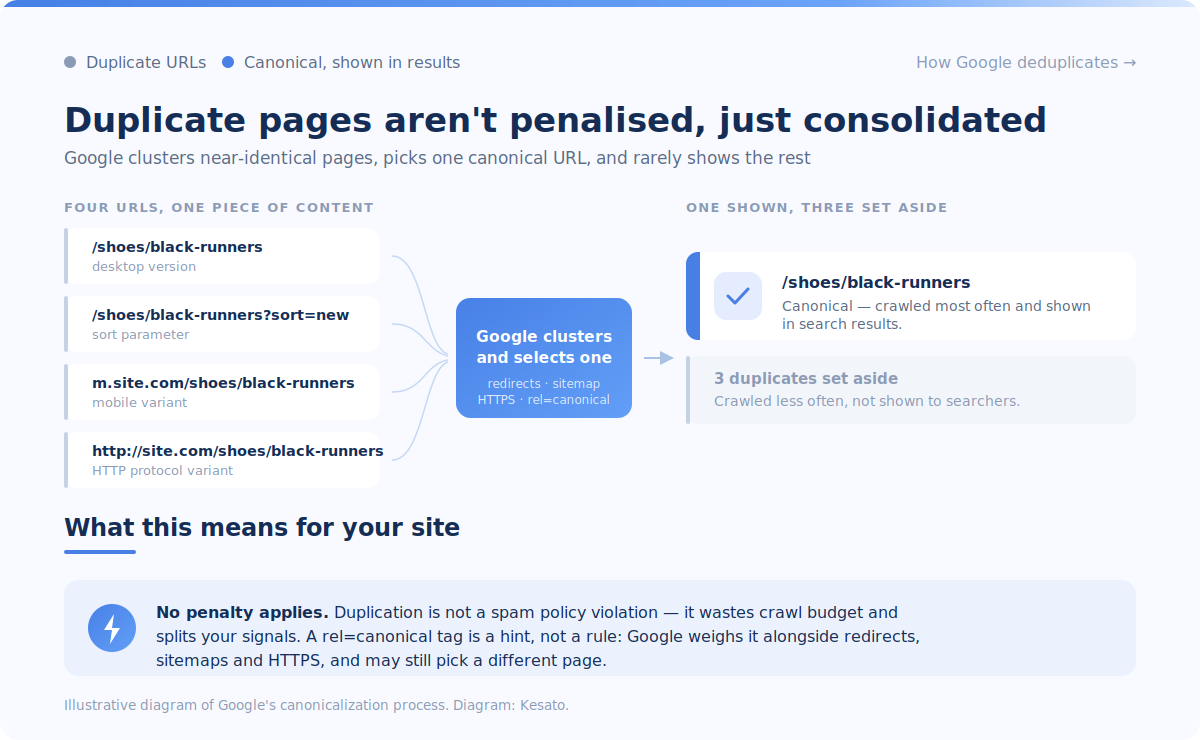
The cost of skipping originality isn’t usually an outright penalty. It’s something quieter: invisibility. When a website publishes pages that closely resemble content already available elsewhere, search engines consolidate ranking signals into whichever version they judge most authoritative, leaving the rest to fade from results.
Over time, this shows up in three measurable ways:
- Stalled organic traffic, as new pages fail to gain independent visibility
- Wasted crawl budget, as bots spend time re-indexing near-identical pages instead of new content
- Keyword cannibalization, where a site’s own pages compete against each other instead of against outside competitors
Does Duplicate Content Always Get Penalized by Google?
Not automatically. Google’s documentation on duplicate content makes clear that most repetition, like a pricing paragraph reused across service pages, isn’t treated as manipulative and won’t trigger a penalty on its own. Google’s Search Advocate John Mueller has similarly clarified that no ranking factor scores a page higher purely for being unique.
What both sources agree on is the underlying requirement: every page still needs to add real, standalone value, or search engines will simply choose not to prioritize it. Consolidation isn’t a punishment. It’s just a decision that your page wasn’t the one worth showing.
How to Audit Your Site for Duplicate and Thin Content

Knowing duplication is a problem is useless without a way to find it. Here’s a practical sequence, from free to thorough:
-
- Start in Search Console: Open Indexing → Pages and look for pages excluded as Duplicate without user-selected canonical or Alternate page with proper canonical tag. This tells you which pages Google has already decided not to show, and it’s the fastest signal you have.
- Run a site query: Search site:yourdomain.com “a distinctive sentence from your page” in Google. If several of your own URLs return, that text is repeated across pages that should be distinct.
- Crawl the site: Screaming Frog’s Content tab flags near-duplicate pages and low word-count pages in one pass. Siteliner offers a lighter free alternative for smaller sites.
- Check for external copying: Copyscape or a simple exact-match search of a unique sentence will show whether other sites have lifted your content, or whether your supplier’s product descriptions appear on fifty other retailers.
- Decide the fix per page: Genuinely duplicate URLs get a canonical tag pointing to the primary version. Thin-but-distinct pages get rewritten or consolidated into one stronger page. Pages that serve no purpose get removed and redirected. Note that a canonical tag is a hint rather than a rule: Google weighs it alongside redirects, sitemaps, and HTTPS status, and may still select a different page as canonical.
Step five is where most audits stall, because the right answer differs page by page. Canonicalizing pages that should have been merged, or merging pages that should have been canonicalized, creates a different problem rather than solving the first one.
Is AI-Generated Content Still Considered Unique?
This is now the most common question in the originality conversation, and Google’s actual position is narrower than the panic around it suggests.
Google does not penalize content for being AI-generated. What its spam policies prohibit is scaled content abuse: generating many pages primarily to manipulate search rankings rather than help users. The policy is explicitly method-agnostic. Mass-produced thin content violates it whether a language model, a scraper, or a room of underpaid writers produced it.
That distinction has practical consequences:
- What’s safe: AI-assisted drafts that are edited, fact-checked, and enriched with firsthand data, expert review, or original examples before publishing.
- What’s risky: volume plus template. Dozens of near-identical pages a week from one prompt structure, published without editorial work, is a recognizable pattern.
- What’s irrelevant: whether an AI detector flags your text. Google’s systems look at structural and behavioral patterns and the value of the page, not the production tool.
Since formalizing the scaled content abuse classification in March 2024, Google has tightened enforcement through several spam updates. The sites hit hardest have consistently shared one profile: high publishing velocity, uniform structure, no editorial layer, and nothing on the page a reader couldn’t get elsewhere.
How Can Businesses Build a Genuinely Original Content Strategy?
Building an original content strategy starts with the sources a business already has: internal data, real outcomes, and firsthand observations that competitors can’t simply summarize from someone else’s article.
- Pull findings from internal campaign or project data instead of general assumptions
- Interview an internal specialist and attribute insights directly to them
- Document real processes step by step, rather than paraphrasing existing “how to” guides
- Localize examples to the audience’s actual market conditions instead of generic global advice
- Update older content with new data and examples instead of letting it sit unchanged for years
- Combine formats such as text, original visuals, and short video so the same insight is harder to copy wholesale
What This Looks Like in a Templated Industry
Hospitality is the clearest illustration, because the duplication problem there is structural rather than lazy. A boutique resort typically inherits three layers of it at once: room descriptions supplied by the same channel manager that feeds every OTA listing, “things to do nearby” copy that’s near-identical across every property in the region, and seasonal pages that differ only by month name.
None of that is plagiarism. All of it is invisible.
The pages that break out share a pattern. They describe conditions a competitor genuinely cannot claim: which rooms catch the afternoon light in dry season, what the road access is actually like during the rains, which nearby warung the staff eat at. That’s firsthand experience in the E-E-A-T sense, and it’s information no rewritten OTA blurb contains. It also happens to be exactly what an AI search tool can verify as distinct.
This is where a dedicated SEO & SEM services approach earns its keep: pairing keyword strategy with content that’s genuinely original to the property, not templated copy competing against fifty versions of itself.
Why Originality Wins Without Being a Ranking Factor
Search engine representatives have been consistent for years: there’s no algorithmic shortcut that substitutes for genuine value. John Mueller has repeatedly emphasized that pages need to offer something beyond what’s already available, rather than relying on superficial uniqueness like rephrased sentences or swapped synonyms.
Notice what that means. Originality isn’t a lever you pull to gain ranking points, and any guide promising otherwise is selling something. It works indirectly: genuinely useful content earns the engagement, citations, and backlinks that ranking systems do measure directly. The algorithm never rewards uniqueness. It rewards the consequences of uniqueness.
That indirect route has become more valuable as AI-generated content floods the web. When originality is scarce, a business built on real expertise stands out by default. For most companies, that means fewer, better-researched articles will consistently outperform a high volume of generic, interchangeable posts.
What’s the ROI of Investing in Unique, SEO-Optimized Content?
Unique content compounds. Instead of paying for the same visibility every month through ads, a well-optimized original article keeps earning organic traffic, backlinks, and AI citations long after publication, lowering the cost of acquiring each new visitor over time.
Businesses that consistently publish original content typically see three compounding effects:
- Stronger topical authority that makes future pages easier to rank
- A growing backlink profile from other sites referencing original data or insights
- Reduced reliance on paid channels as organic visibility takes over more of the workload
None of these show up overnight, and any agency promising otherwise is describing ads, not SEO. But they build a foundation far more durable than any single ranking tactic.
Turn Originality Into Your Biggest Ranking Advantage
Search engines and AI platforms are only getting better at spotting content that adds nothing new, and the data on AI citations suggests the gap between “ranks well” and “gets cited” is widening, not closing. Businesses that treat originality as a core strategy rather than an afterthought are the ones building lasting visibility.
If your content still reads like everyone else’s in your industry, that’s the thing worth fixing first. See how Kesato approaches strategy, design, and content as one connected system, or talk to our team about auditing where your own pages are competing with each other.
Frequently Asked Questions
What Is the Difference Between Unique Content and 100% Original Content?
Unique content means original wording and perspective that doesn’t exist elsewhere in the same form. “100% original” is used loosely to mean the same thing, though no content is created in a vacuum. Every piece draws on existing knowledge, structured and expressed in a new way.
How Much Unique Content Is Enough for SEO?
Search engines publish no fixed percentage. A practical benchmark: a page should offer information, data, or a perspective a reader can’t get from the top-ranking competitor without reading both.
Can AI-Generated Content Still Be Considered Unique?
Yes, if it’s edited, fact-checked, and enriched with firsthand data or expert review. Google’s spam policies target scaled content abuse, not AI as a tool. Unedited AI drafts published at volume tend to blend into the growing pool of interchangeable text, which is the actual risk.
Does Google Penalize Duplicate Content?
Not usually. Most duplication is consolidated rather than penalized, meaning Google picks one version to show and ignores the others. Penalties apply to deception and manipulation, not repetition.
How Do I Find Duplicate Content on My Own Site?
Start with Search Console’s Indexing report and look for pages excluded as duplicates. Then crawl the site with Screaming Frog or Siteliner to catch near-duplicates the report misses. Fix genuine duplicates with canonical tags and rewrite or merge thin pages.
How Often Should Content Be Refreshed to Stay Competitive in AI Search?
Review core content every 6 to 12 months, updating statistics, examples, and structure. Freshness is one of the signals both traditional ranking systems and AI citation systems weigh, and stale figures are the fastest way to lose a citation you already had.