
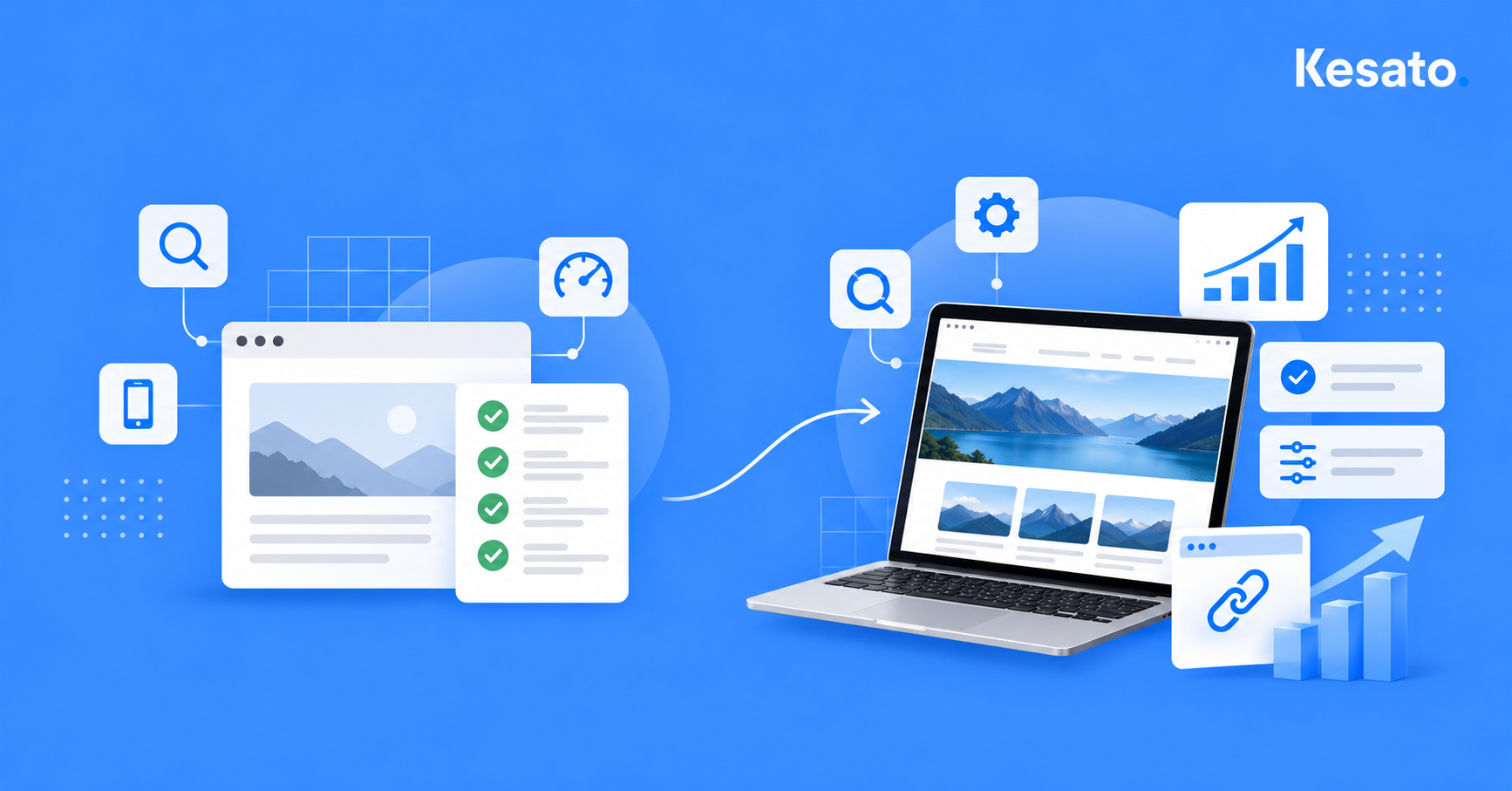
Different priorities, not the same checklist. A website under a year old needs to earn trust and build a technical foundation from scratch, while a website five years or older already has rankings and authority worth protecting, and should be growing its reach into newer territory like AI-powered search instead. Neither approach is more advanced than the other, they’re just solving different problems. If you’re not sure which stage your site is at, an experienced SEO agency in Bali can help you figure that out before you invest in the wrong priorities.
TL;DR
- New and established websites should not follow the same SEO checklist.
- New websites (under 1 year): focus on technical foundation, content, and building authority from scratch.
- Established websites (5+ years): focus on protecting rankings, refreshing content, and expanding into AI-driven search.
- Sites between 1 and 5 years usually blend both approaches.
- Both stages run on the same principle underneath: consistent, data-driven optimization, not a one-time fix.
About the author: Kesato is an SEO and GEO agency working with businesses in Bali and beyond, building search strategies matched to how established a website already is, rather than applying one generic playbook to every client.
What’s the Actual Difference Between SEO for New vs Established Websites?
The difference comes down to what you already have to work with. A new website is like an empty plot of land, before anything can grow, you need to prepare the soil: technical health, clear structure, and a first round of trustworthy content. An established website is more like a mature garden, the groundwork is already done, so the work shifts to pruning what’s overgrown, protecting what’s thriving, and planting new sections without disturbing what already works.
Neither stage is objectively harder. A new site has more ground to cover before results show up, but starts with a clean slate. An established site sees faster wins when work is targeted correctly, but risks losing existing traffic if changes are careless.
Verdict: if your site is new, prioritize foundation work first. If it’s established, prioritize protecting what already works before expanding further.
What Should New Websites Prioritize First?
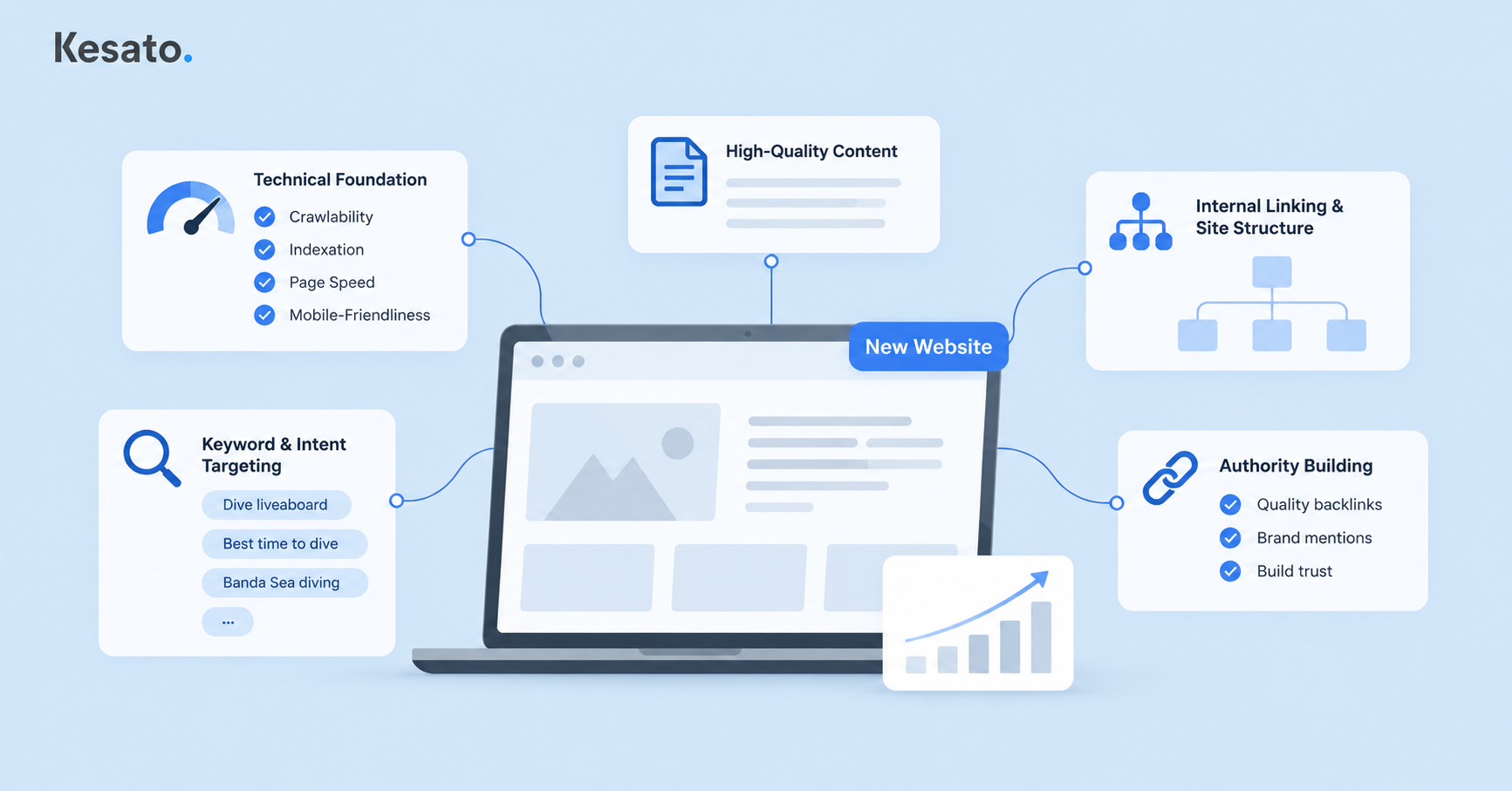
If your website is under a year old, the priority isn’t ranking #1 yet, it’s earning trust. Think of this as your SEO checklist for new website owners:
- Technical foundation: the basics that let search engines and AI crawlers actually find, read, and understand your site, crawlability, indexation, page speed (Core Web Vitals), and mobile-friendliness. This is the core of any solid technical SEO checklist.
- Keyword and intent targeting: build topic clusters around what your audience is actually trying to find, rather than chasing individual keywords one by one.
- High-quality content: helpful, unique content that actually answers what your audience is asking, this is what SEO for new websites should center on early.
- Internal linking and site structure: help search engines understand how your pages relate to each other and which ones matter most.
- Authority building: earn quality backlinks and mentions to build trust and relevance from day one.
Verdict: build authority, earn trust, and grow organic traffic that holds up long-term, not a quick spike that fades.
What Should Established Websites Prioritize Instead?
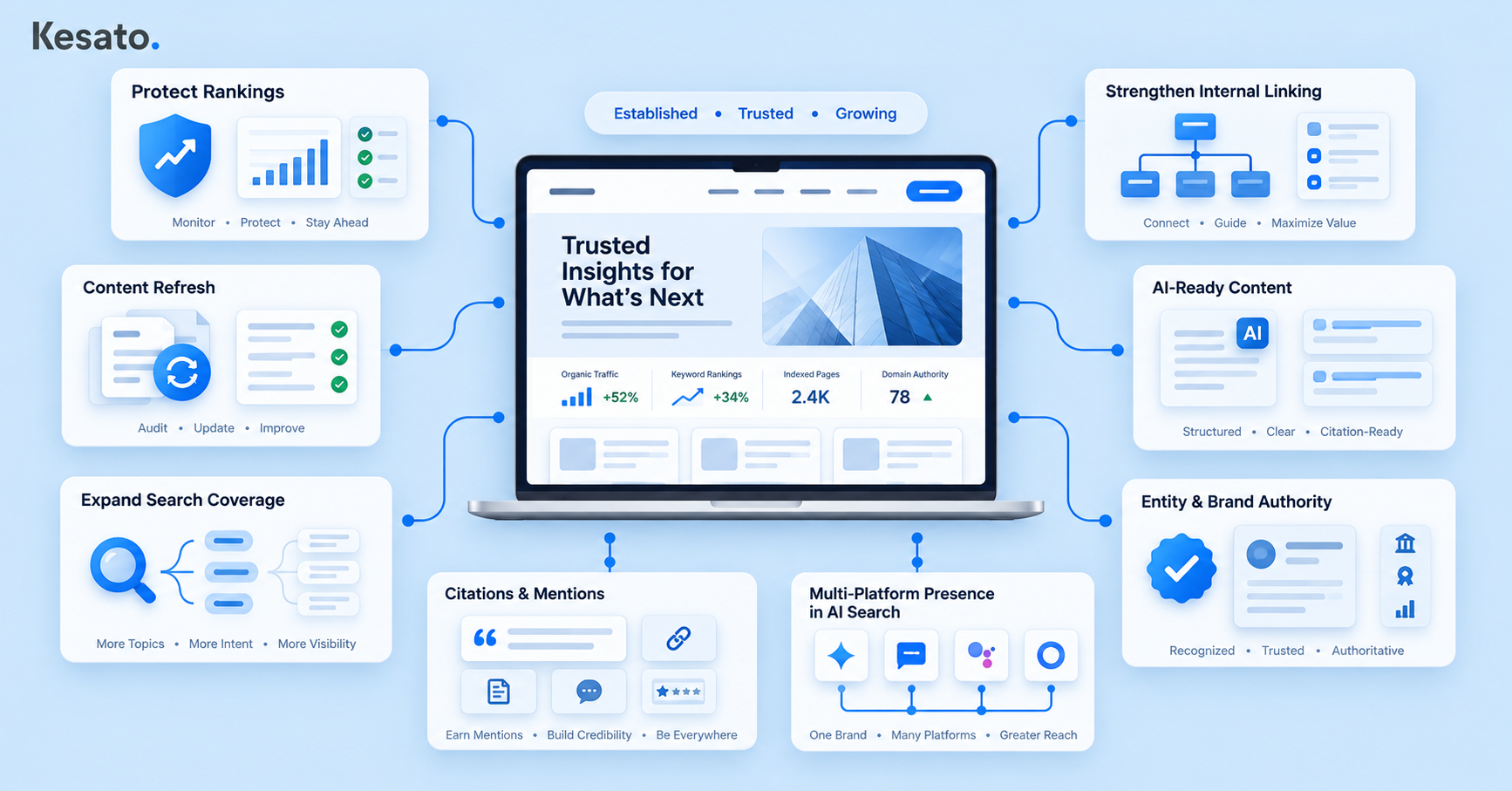
Once a website has been around for five years or more, the game changes. You already have rankings and trust built up, protecting that comes first, while the opportunity shifts toward expanding visibility across both traditional and AI-driven search.
On the SEO side:
- Protecting rankings: monitor and optimize the pages already performing well so they don’t quietly decline.
- Content refresh: update underperforming pages and improve relevance. Running a proper content audit for SEO first often makes this faster than writing new content from scratch, that’s the content refresh strategy in practice.
- Expanding search coverage: find content gaps and capture new keyword opportunities you haven’t targeted yet.
- Strengthening internal linking: help pages support each other and spread authority more evenly across the site.
On the GEO and AI side:
- AI-ready content: write clear, structured answers that AI tools can easily pull from and cite, just as important now as ranking on a traditional results page.
- Entity and brand authority: make sure your brand is consistently recognized across the web, on review sites, directories, and social platforms, this is the brand authority SEO work AI systems lean on to decide who’s trustworthy enough to cite.
- Citations and mentions: earn mentions on trusted sites, forums, and media, essentially learning how to get cited by AI so your brand shows up inside AI-generated answers.
- Multi-platform presence: increase visibility across AI Overviews, ChatGPT, Perplexity, Bing Copilot, and other platforms beyond Google, part of the bigger shift from traditional search to AI powered search we break down in a separate article.
Together, these pieces answer the bigger question most established brands are asking right now: how to rank in AI search as well as in traditional results.
Verdict: secure what’s already working first, then expand into AI-driven visibility. Chasing new ground before securing existing rankings usually backfires.
How Do I Know Which Approach Fits My Website?
Age is the simplest signal, but not the only one:
- Younger than 1 year, few backlinks, or unresolved technical issues: start with the new-website priorities above, regardless of how much content you’ve already published.
- 5 years or older, ranking for a reasonable set of keywords, some existing authority: shift to the established-website priorities instead.
- Between 1 and 5 years: usually blend both, some ongoing foundation work alongside early protection and expansion.
A quick side-by-side:
| New Website (Under 1 Year) | Established Website (5+ Years) | |
| Main goal | Build trust and authority | Protect and expand visibility |
| Content focus | First round of quality content | Refresh content and fill gaps |
| Technical priority | Full technical foundation | Ongoing technical health checks |
| AI/GEO focus | Structure content for future citation | Actively build entity authority and citations |
| Typical timeline to results | 6 months or more | A few months, since assets already have traction |
Why Does This Need Ongoing Work Instead of a One-Time Fix?
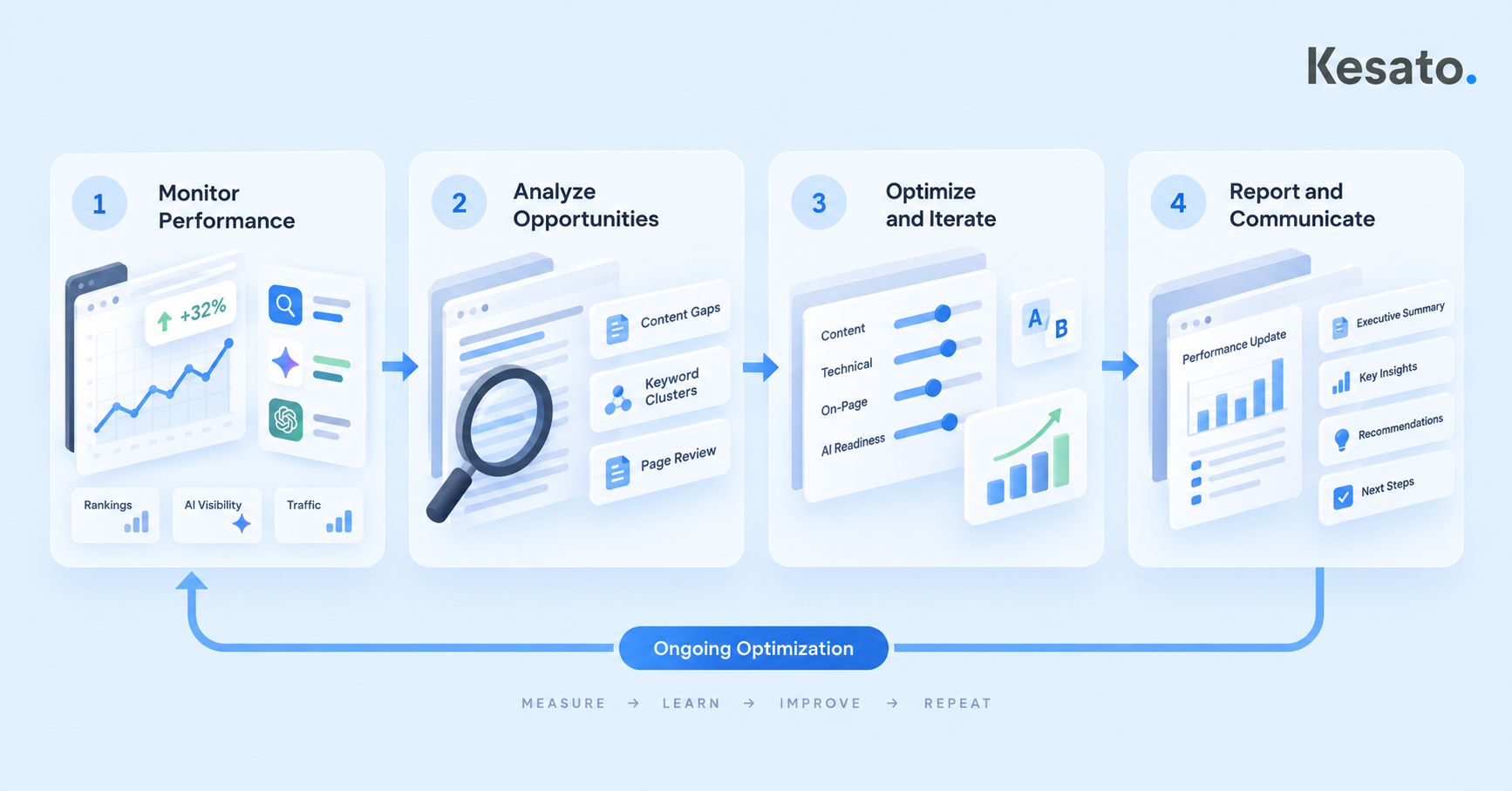
Both stages run on the same underlying principle: consistent, ongoing optimization, guided by real data.
- Monitor performance: use proper SEO monitoring tools to track rankings, traffic, and AI visibility regularly, rather than checking in once a quarter.
- Analyze opportunities: regularly look for gaps, whether that’s an untapped keyword or an underperforming page.
- Optimize and iterate: let the data guide your next move instead of gut feeling.
- Report and communicate: keep stakeholders aligned through clear SEO reporting on what’s working and what needs to shift next.
Verdict: SEO, and especially SEO in the age of AI, isn’t a project with an end date. Skipping this loop is how even a well-planned strategy goes stale.
How Do You Get Started With the Right SEO Strategy for Your Website?
Once you know your website’s stage, match it to the right execution: technical fixes and foundational content for new sites, or a content audit for SEO and citation-building push for established ones.
Working with a dedicated SEO agency in Bali makes this faster, since these priorities are easiest to execute correctly with an outside audit rather than guessing internally.
Frequently Asked Questions
Can a Website Move From One Stage to the Other?
Yes, and most do. A site that starts with new-website priorities naturally shifts toward established-website priorities as it matures, gains authority, and starts generating meaningful traffic worth protecting.
Do I Need to Choose Only One Approach?
No. Established websites often still run small new-website-style projects, like a new content hub, alongside their main protection and expansion work. Your stage describes where most of your effort should go, not a strict either-or rule.
How Long Does It Take to See Results?
New-website work usually takes six months or more, since it’s building from a lower baseline. Established-website work can show movement within a few months, since it’s optimizing assets that already have traction.
Does This Replace Regular SEO Audits?
No. Audits are how you figure out which stage actually fits your site right now. Think of this approach as the framework, and audits as the check-up that keeps it accurate.
About Kesato
Kesato is an SEO and GEO agency helping businesses build search strategies suited to where their website actually stands, not a one-size-fits-all checklist. The team works with both new websites building their first foundation and established brands defending years of rankings while growing their reach into AI-powered search.
Ready to find out which approach fits your website? Visit Kesato’s SEO and SEM services to get a strategy built around your site’s actual stage.