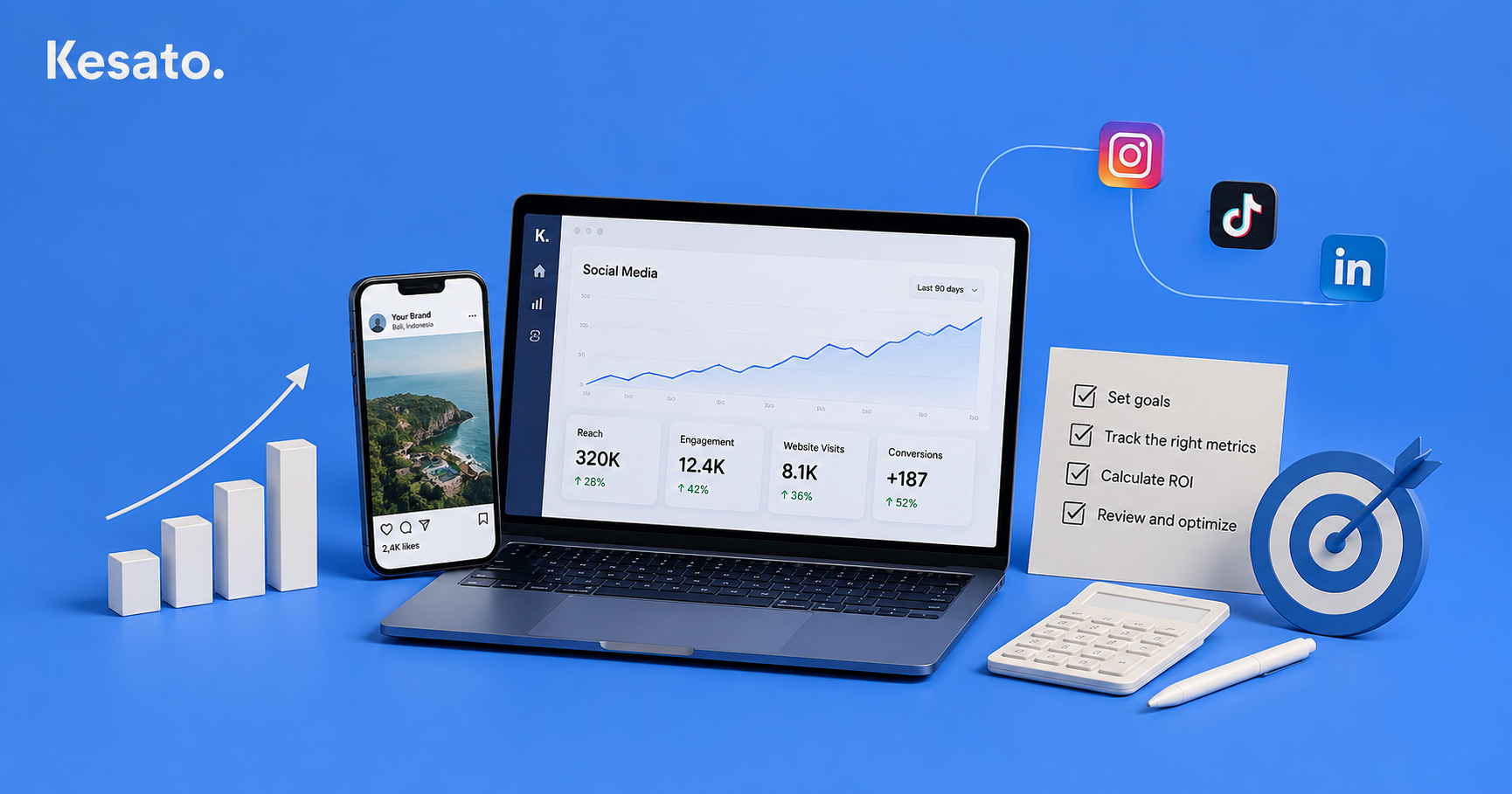
Social media ROI is measured by comparing the value your business gets from social media (revenue, leads, bookings, or brand awareness) against what you spend on it (time, ad budget, and content production). The basic formula is ((Value Generated minus Cost) divided by Cost) x 100.
If you run a hotel, villa, restaurant, or retail brand, chances are you’re already spending hours (and money) on Instagram and TikTok. But how do you know if it’s actually working? This guide breaks down exactly how to calculate and track social media ROI, without needing a data science degree.
What Is Social Media ROI?
Social media ROI (return on investment) measures how much value your business gets back compared to what you put into your social media efforts, whether that’s money, time, or resources. It helps answer one simple question: is this worth it?
Unlike a Google Ads campaign where a click directly leads to a sale, social media often works in the background. A guest might see a resort on Instagram three times before finally booking through the website. That’s why ROI on social media isn’t just about direct sales. It also includes value that isn’t purely financial, like brand awareness, engagement, and audience growth.
According to Sprout Social’s 2026 Social Media Content Strategy Report, most marketers point to Facebook and Instagram as the platforms delivering the strongest business impact, and only 40% of marketers currently use AI tools for performance reporting and analysis, which means a lot of ROI tracking is still done manually or inconsistently (source: Sprout Social). HubSpot’s State of Marketing research similarly found that Instagram is the platform marketers cite most often when asked which channel actually drives ROI (source: Thrive Agency, citing HubSpot).
The Social Media ROI Formula
The standard formula looks like this:
ROI = ((Value Generated minus Cost) divided by Cost) x 100
Here’s how to break it down:
- Value Generated: revenue from bookings, leads captured, or the estimated value of brand exposure (reach, impressions, engagement).
- Cost: ad spend, content creation (photography, videography), software tools, and staff or agency fees.
Example: A boutique hotel spends 15,000,000 IDR per month on social media (ads plus content creation) and generates 45,000,000 IDR in direct bookings traced back to Instagram.
ROI = ((45,000,000 minus 15,000,000) divided by 15,000,000) x 100 = 200%
That means for every rupiah spent, the hotel earned two rupiah back.
KPIs and Social Media Metrics That Matter
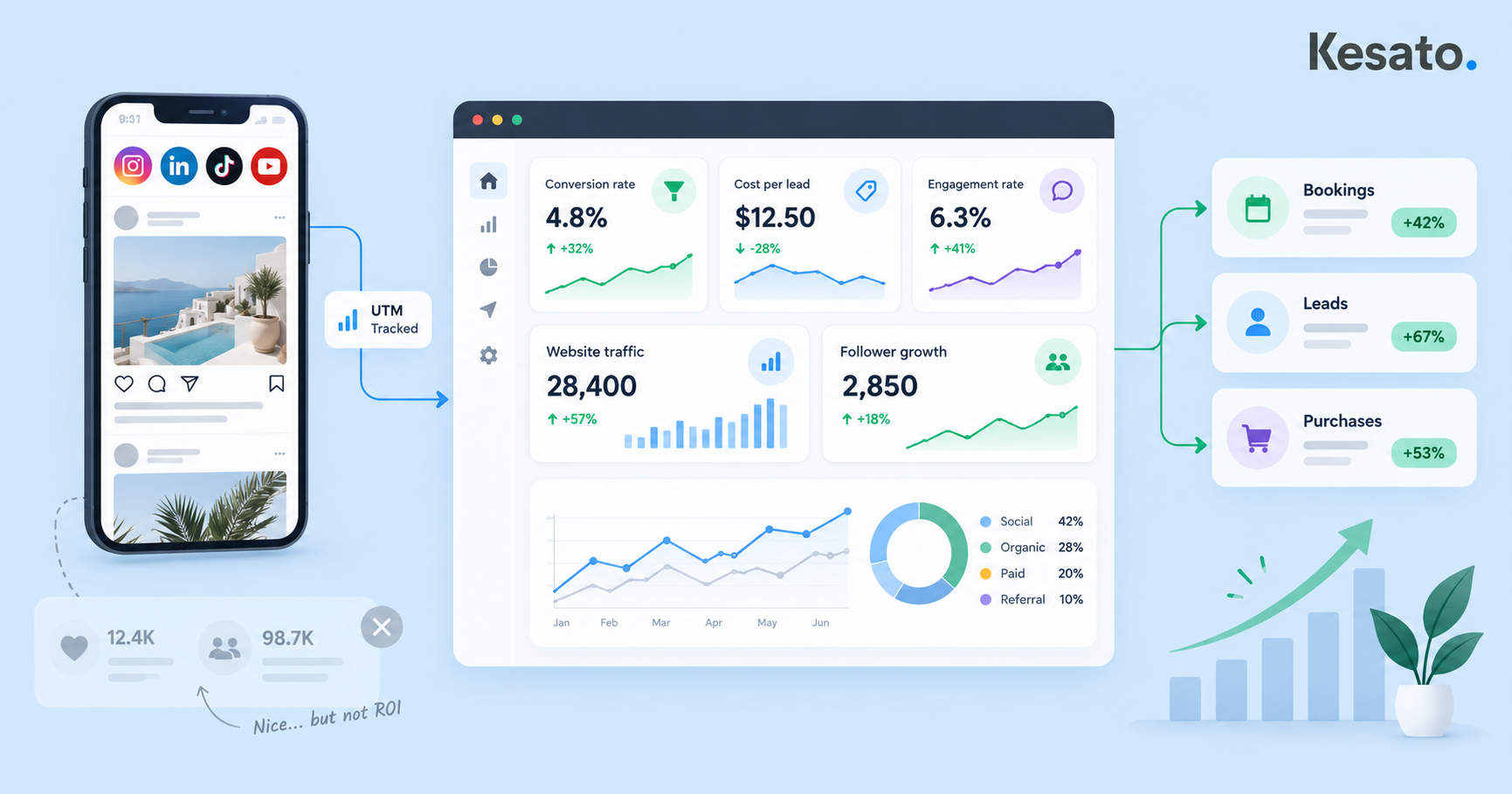
Not every metric deserves your attention. Focus on the ones tied to real business outcomes:
- Conversion rate: how many followers or viewers actually book, buy, or inquire.
- Cost per lead or cost per booking: how much you’re paying to get one real customer.
- Engagement rate: likes, comments, and shares relative to your audience size, which signals content quality.
- Website traffic from social: trackable through UTM links in Google Analytics.
- Follower growth rate: useful for brand awareness goals, less useful for sales goals.
The key mistake many businesses make is tracking vanity metrics such as likes or follower count without connecting them to leads or bookings. A post can go viral and still generate zero ROI if it doesn’t drive action.
The Process to Measure Social Media ROI
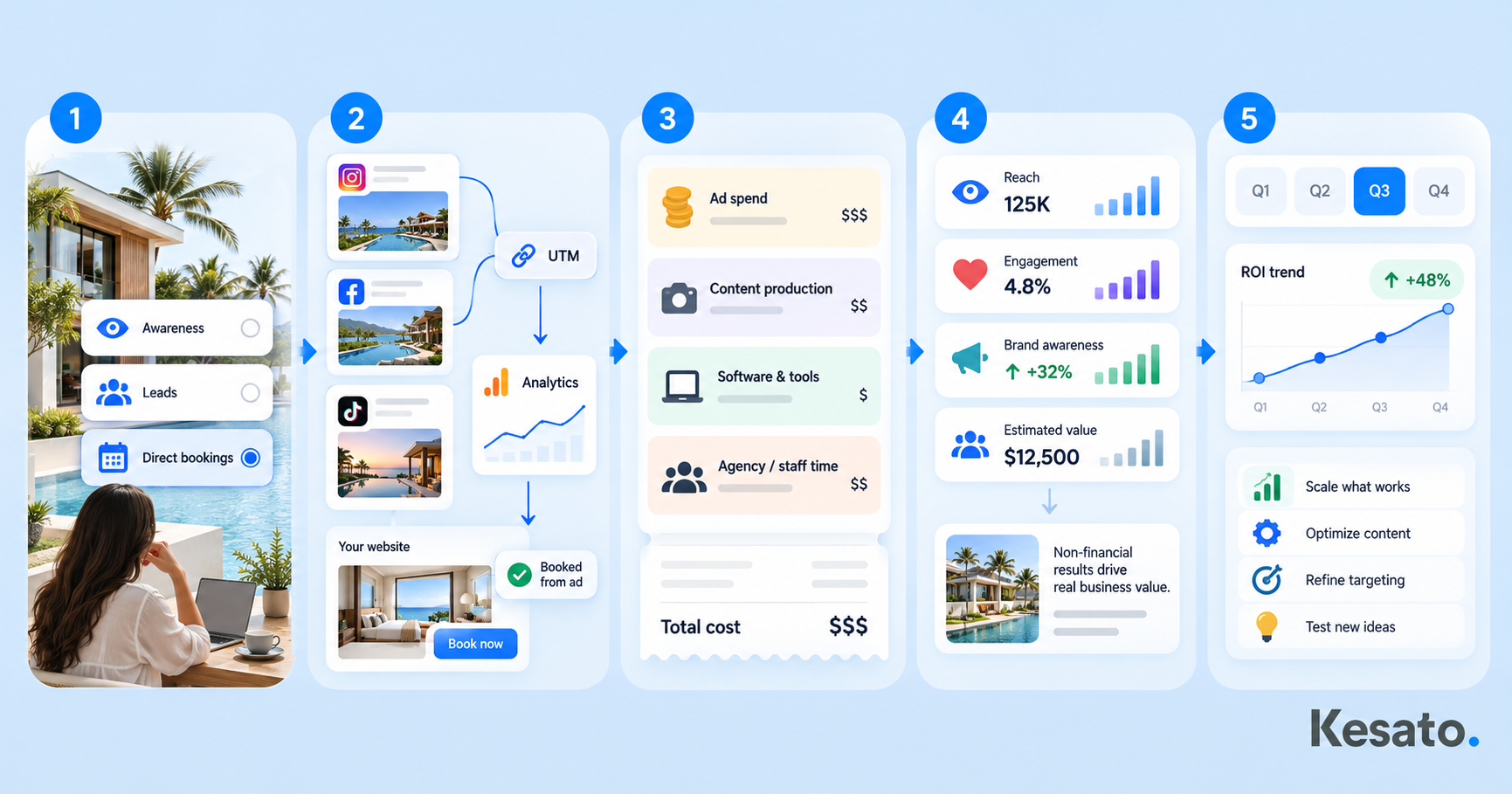
1: Define your goal first: ROI looks different depending on whether the objective is direct bookings, lead generation, or brand awareness. A resort launching in a new market may prioritize awareness, while an established villa brand may prioritize direct bookings.
2: Set a tracking system: Use UTM parameters on every link shared, and connect them to Google Analytics or a booking engine. This makes it possible to trace a booking back to the exact post or ad that drove it.
3: Calculate total costs: Include ad spend, content production, software subscriptions, and agency or staff time, not just what is spent on ads.
4: Assign value to results that aren’t purely financial: If the goal is brand awareness, estimate value using industry benchmarks for reach and impressions, or compare it to what an ad placement of similar size would cost.
5: Review and adjust quarterly: Social media trends and algorithms shift fast. A content format or posting time that worked last quarter may not work now, so goals and benchmarks should be revisited regularly instead of set once a year.
Common Challenges in Measuring Social Media ROI
- Attribution across touchpoints: a customer might see content five times across three platforms before converting, making it hard to credit just one post.
- Delayed conversions: someone might follow a resort on Instagram in June and book in December.
- Data silos: Instagram Insights, TikTok Analytics, and a booking system often don’t talk to each other, so manual reconciliation is usually required.
These challenges are exactly why many businesses choose to work with a social media agency in Bali, since an experienced team already has the tracking systems, benchmarks, and reporting tools in place instead of building them from scratch.
Start Turning Your Social Media Into Measurable Growth
Social media ROI isn’t just a vanity report for a boss to sign off on. It’s the clearest way to know whether a marketing budget is actually growing the business. Start with a clear goal, track the right KPIs, and review the numbers regularly.
If you’d rather have a team handle the tracking, content, and strategy, Kesato is a social media agency in Bali working with hotels, resorts, and lifestyle brands, and can help turn social media into a measurable growth channel instead of a guessing game.
Frequently Asked Questions
What is a good social media ROI?
There’s no universal number, but many businesses aim for at least 100% ROI, meaning they double their investment. Hospitality and retail businesses in competitive markets often see stronger returns when content and ad spend are managed by specialists.
How often should social media ROI be measured?
Monthly for ad performance, and quarterly for overall strategy review, since goals and platform algorithms change often.
Can ROI be measured without spending money on ads?
Yes. Organic ROI can be measured using time invested, content production costs, and outcomes like leads, website traffic, and direct messages or inquiries.