Ask any marketer how much does Google Ads cost and the honest answer is always the same two words. It depends. That answer is true, but useless for planning a budget. The real cost is shaped by your industry, location, competition, and how well your campaigns are built. This guide replaces the vague answer with real numbers and a breakdown of exactly what you are paying for, so you can plan knowing what to expect instead of guessing.
How Much Does Google Ads Cost on Average
According to WordStream’s 2026 Google Ads benchmarks, which analyzed over 13,000 search campaigns, the average cost per click across all industries is 5.42 USD. That figure has more than doubled since 2016, when it sat at 2.32 USD, driven by inflation and rising competition.
There is no fixed monthly fee. You set your own budget and Google spends it through an auction that runs every time someone searches, so two businesses can spend wildly different amounts on the same keyword depending on their competition and ad relevance.
Here is the quick version before we go deeper:
- Cost per click (CPC): what you pay each time someone clicks, averaging 5.42 USD in 2026
- Click-through rate (CTR): how often people click after seeing your ad, averaging 6.64 percent
- Conversion rate (CVR): how often a click becomes a lead or sale, averaging 8.18 percent
- Cost per lead (CPL): the total spent to get one lead, averaging 66.69 USD and the number that actually matters
Notably, WordStream’s data shows that in 2026 the average cost per lead dropped for the first time in five years, a sign that advertisers who adapt to Google’s automated tools get more efficient results.
Cost Varies Dramatically by Industry
The single biggest factor in Google Ads pricing is your industry. When one customer is worth thousands, advertisers bid aggressively and push the cost per click up. When margins are thin and purchases are quick, clicks stay cheap.
The table below shows real 2026 averages by industry from WordStream, for both cost per click and the more decisive cost per lead.
| Industry | Average CPC | Average CPL |
| Attorneys & Legal Services | 9.87 USD | 131.63 USD |
| Home & Home Improvement | 8.33 USD | 90.92 USD |
| Dentists & Dental Services | 8.00 USD | 72.97 USD |
| Personal Services | 7.17 USD | 54.60 USD |
| Health & Fitness | 6.17 USD | 67.36 USD |
| Business Services | 5.87 USD | 93.69 USD |
| Beauty & Personal Care | 4.62 USD | 39.25 USD |
| Real Estate | 3.22 USD | 102.51 USD |
| Restaurants & Food | 2.05 USD | 30.57 USD |
| Arts & Entertainment | 1.63 USD | 26.84 USD |
Notice that a low cost per click does not always mean a low cost per lead. Real Estate has a modest CPC of 3.22 USD but one of the highest costs per lead at 102.51 USD, because the path from click to closed deal is long. A higher cost per click is only a problem if the customer value does not justify it. A law firm paying nearly 10 USD per click is still profitable if one client is worth 5,000 USD.
How Does Google Actually Decide What You Pay
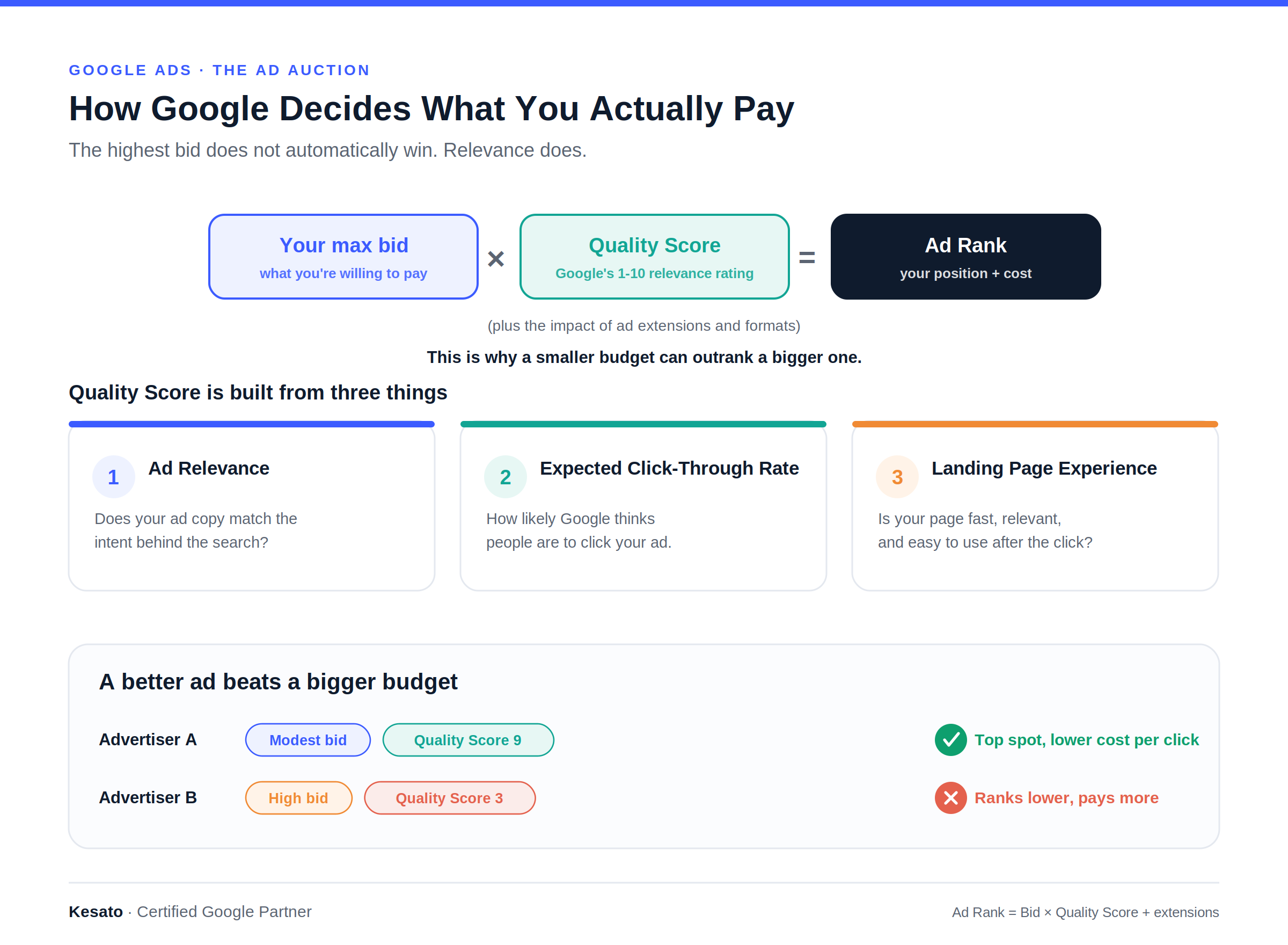
A common myth is that whoever bids the most wins. That is not how it works. Google uses an auction that rewards relevance, not just money. Two things decide your actual cost.
Quality Score
Quality Score is a rating from 1 to 10 that Google assigns to each keyword. It is the single biggest lever most advertisers can pull to lower their cost per click, built from three components.
- Ad Relevance : How closely your ad copy matches the intent behind the search. An ad that mirrors the words and needs of the query scores higher and costs less.
- Expected Click-Through Rate : How likely Google thinks people are to click your ad. A strong track record of clicks signals that your ad is useful, which pushes your score up.
- Landing Page Experience : How fast, relevant, and easy to use your landing page is once someone clicks. A slow or mismatched page drags the whole score down and quietly raises your cost.
Ad Rank
Ad Rank determines where your ad appears and is calculated by multiplying your bid by your Quality Score, plus the impact of ad extensions. This is why a competitor with a smaller budget can outrank you if their ads and landing pages are simply better. Improving relevance is often cheaper than raising your bid. A better ad beats a bigger budget.
Does a higher bid guarantee the top spot? No. Google multiplies your bid by your Quality Score to determine placement. A well-optimized ad with a modest bid can outrank a poorly built ad with a large bid. Relevance and landing page quality can matter more than the raw dollar amount you are willing to pay.
What a Realistic Monthly Budget Looks Like
Your monthly budget should be tied to your goals and your cost per lead, not pulled from thin air. The simple formula Google uses is your daily budget multiplied by 30.4 to get your maximum monthly spend.
Here is what different budget levels realistically achieve.
| Budget Level | Monthly Spend | What to Expect |
| Starter | 500 to 1,000 USD | Test one or two campaigns, gather early data |
| Growth | 1,000 to 5,000 USD | Multiple campaigns, steady lead flow, room to optimize |
| Scale | 5,000 USD and up | Aggressive expansion, multiple markets and formats |
A starter budget is enough to learn what works but rarely delivers dramatic results alone. Most businesses find the sweet spot in the growth tier, with enough spend to gather meaningful data and optimize toward a lower cost per lead over time.
Where the Real Costs Hide Beyond Ad Spend
The money you give Google is only part of the picture. When people ask about google ads budget, they often forget the surrounding costs that determine whether the whole thing is profitable.
Management Fees
If you work with an agency or freelancer, management fees apply. The three common models are:
- Percentage of ad spend, usually 10 to 20 percent of your monthly budget
- Flat monthly fee, a fixed cost regardless of spend
- Performance-based pricing, tied to leads, sales, or return on ad spend
Landing Page and Creative Costs
These are easy to overlook. Traffic sent to a slow or unconvincing page wastes money no matter how well the ads are tuned. Budget for design and copy, not just clicks.
Tools and Tracking
Analytics and reporting software add smaller recurring costs but are essential for knowing whether your spend is working.
Do you need an agency, or can you DIY? You can absolutely run Google Ads yourself, and many small businesses do. The trade-off is time and the learning curve. DIY makes sense when budgets are small. An agency becomes worthwhile once ad spend is high enough that efficiency gains outweigh the management fee, or when the account grows too complex to manage alongside running a business.
Practical Ways to Lower Your Cost Per Click
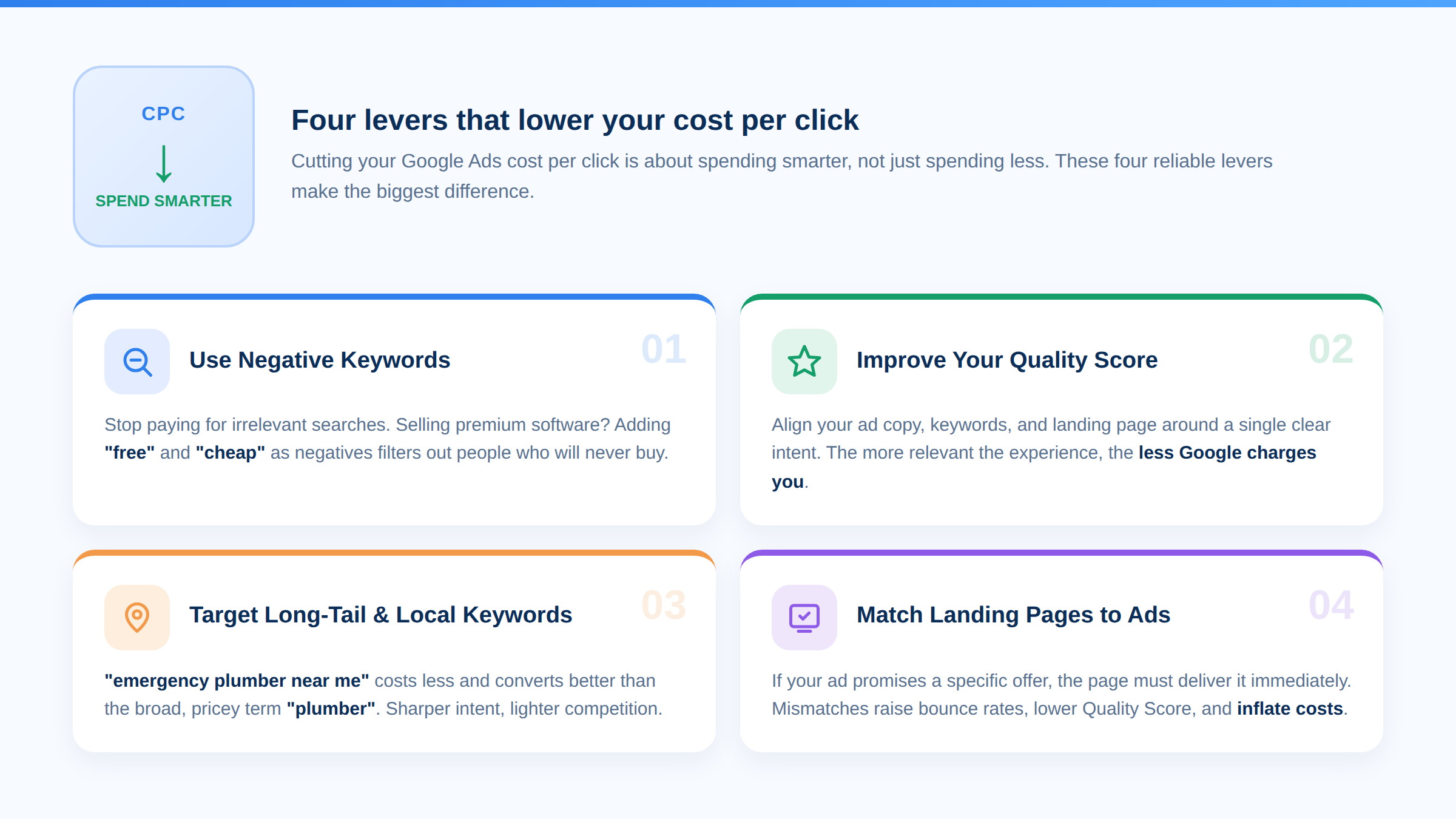
Cutting your cost per click google ads spend is about spending smarter, not just less. A few reliable levers make the biggest difference.
- Use Negative Keywords : Stop paying for irrelevant searches. If you sell premium software, adding “free” and “cheap” as negative keywords filters out people who will never buy.
- Improve Your Quality Score : Align your ad copy, keywords, and landing page around a single clear intent. The more relevant the experience, the less Google charges you.
- Target Long-Tail and Local Keywords : A search like “emergency plumber near me” costs less and converts better than the broad, expensive term “plumber” because the intent is sharper and the competition is lighter.
- Match Landing Pages to Ads : If your ad promises a specific offer, the landing page must deliver it immediately. Mismatches raise bounce rates, lower Quality Score, and quietly inflate your costs.
When It Makes Sense to Bring in Google Ads Specialists
Running a small campaign is manageable alone. But as spend grows and the account fills with multiple campaigns, ad groups, keyword lists, and bidding strategies, the difference between an average setup and an optimized one can be thousands of dollars a month.
This is where a dedicated SEO and SEM team earns its fee. A good google ads agency does not just launch campaigns. It continuously tests, prunes wasted spend, improves Quality Scores, and ties every dollar back to a real business outcome rather than a vanity metric like clicks.
So, is Google Ads worth it? For most businesses, yes, provided it is managed with clear goals and consistent optimization. Left unattended, it drains budget. Managed well, it is one of the most measurable and scalable growth channels available. If you would rather have specialists handle the technical side while you focus on your business, Kesato is a good place to start.
Frequently Asked Questions
Is 1,000 USD a month enough for Google Ads?
For a small business targeting local or niche keywords, yes. It runs one or two focused campaigns and gathers useful data. In competitive industries like legal or insurance, that budget stretches thin and is better spent on tightly targeted, high-intent keywords.
Why did my cost per click suddenly increase?
Usually competition. When more advertisers bid on your keywords, prices rise. Seasonal demand, a drop in Quality Score, or landing page changes can also push costs up.
Is Google Ads more expensive than Facebook Ads?
Google Ads usually has a higher cost per click because it targets active search intent. Facebook Ads often cost less per click but target interest rather than intent, so the two are rarely a direct comparison.
Can small businesses compete with big brands on Google Ads?
Yes. Because Google rewards relevance through Quality Score, a small business with sharp targeting and well-built ads can outrank larger competitors on specific, local, or long-tail keywords without matching their budget.