
Key takeaways
- Choose Google Ads or Meta Ads based on your hotel’s goals, not platform popularity.
- Google can reach active hotel searches; Meta can introduce properties and generate inquiries.
- Check your booking journey, creative assets and tracking before increasing ad spend.
- Compare verified bookings and qualified leads, not just clicks or reported conversions.
Your Bali hotel has a limited advertising budget. Should you invest in Google Ads to reach travelers already looking for accommodation, or use Meta Ads to introduce your property through Instagram and Facebook?
The answer depends on what your hotel needs to achieve.
A newly opened boutique villa may need to introduce its experience to potential guests. An established resort might already have people searching for its rooms. A wedding venue may need qualified inquiries rather than immediate online bookings.
Each situation calls for a different approach.
Choosing between Google Ads vs Meta Ads for hotels is not simply about which platform gets cheaper clicks. It is about guest demand, business objectives, booking readiness and measurable results.
This guide compares the platforms in a Bali hospitality context. It includes a practical decision matrix, a pre-launch checklist, a measurement framework and troubleshooting steps for campaigns that attract interest but fail to generate bookings.
Table of contents
- Google Ads or Meta Ads: Which Should Your Hotel Choose?
- How Google and Meta Fit Into the Hotel Guest Journey
- Which Google Ads Campaign Types Matter for Hotels?
- Where Meta Ads Can Support Hotel Marketing
- Before Spending: Is Your Hotel Ready to Advertise?
- Google Ads vs Meta Ads for Hotels: A Practical Decision Matrix
- How to Compare Google and Meta Ads Performance
- How Should a Bali Hotel Allocate Its Advertising Budget?
- What If Your Ads Get Clicks but Not Hotel Bookings?
- Final Takeaway: Choose Channels Around Business Goals
- Frequently Asked Questions
Google Ads or Meta Ads: Which Should Your Hotel Choose?
Start with Google Ads when relevant search demand is available and your hotel can turn that demand into measurable bookings. Evaluate Meta Ads when the priority is introducing an experience, reaching suitable audiences, or generating inquiries through compelling creative.
Some properties benefit from both. Others should fix their website or reservation process before spending on either platform.
Consider three situations:
- Established hotel: Potential guests already search for the property or accommodation options in its location. Relevant Google Search or Hotel Ads may deserve early evaluation.
- New boutique villa: Travellers may not yet know the property. Strong photography and videos can help Meta introduce the villa to a relevant audience.
- Resort with a seasonal package: Meta can communicate the experience while Google reaches people searching for suitable stays. Both roles should have distinct objectives.
These are starting hypotheses, not guaranteed winning strategies.
Google has visual and automated campaign formats beyond Search. Meta can support website conversions and booking-related actions, not only awareness. The right choice depends on the campaign setup and the quality of the hotel’s offer.
Before choosing a platform, answer this question: What specific business problem are we trying to solve?
If the answer is simply “we need more traffic,” the hotel may not yet have a clear enough objective.
How Google and Meta Fit Into the Hotel Guest Journey
Guests rarely make every travel decision in one session.
Someone planning a holiday in Bali might see a villa video on Instagram, browse reviews, search Google for the property and return later to check room availability.
Another traveller might begin with a search such as “family resort in Nusa Dua” and compare several properties without ever seeing their social media advertising.
These journeys are different. Neither is necessarily better.
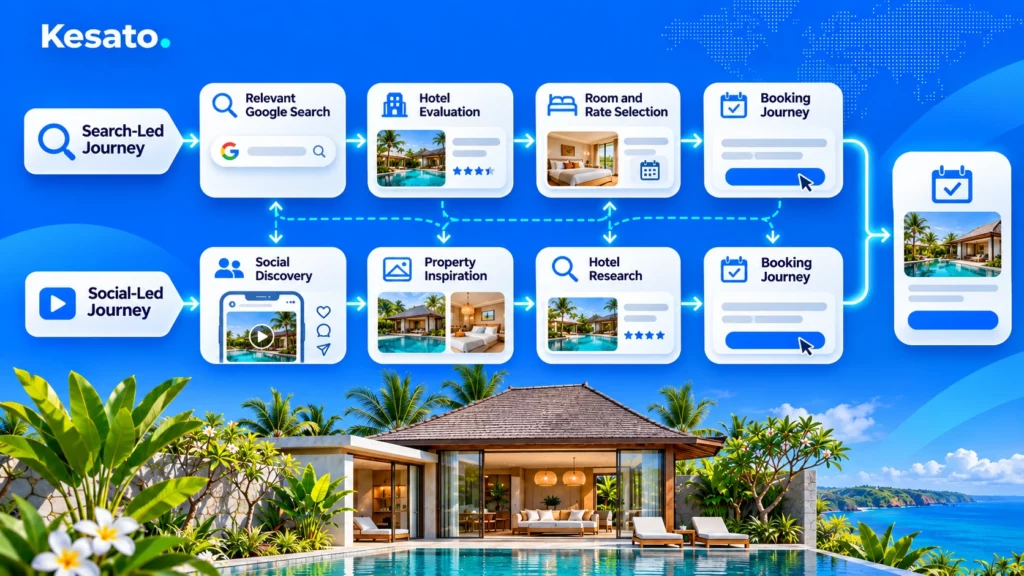
Existing Search Demand vs. Social Discovery
Google Search Ads can reach people when they enter relevant queries. This makes search intent particularly useful when someone is actively evaluating accommodation.
For example, a traveller searching for a private pool villa in Seminyak has expressed a specific need. A relevant ad can connect that search with an appropriate property page.
Meta Ads generally reaches people while they browse social platforms. A resort can introduce a wellness experience, highlight a distinctive villa design or communicate a stay package before someone searches for it by name.
However, the difference is not absolute.
Google also offers visual advertising through YouTube, Display and Performance Max. Meta campaigns can be optimised for lead or sales outcomes when appropriate conversion signals and destinations are available.
For a wider explanation of local and international audience behaviour, explore Kesato’s guide to digital marketing in Bali.
Why Travellers May Interact With Both Platforms
Hospitality decisions often involve several questions:
- Does the property match the type of holiday the guest wants?
- Are the rooms, location and facilities suitable?
- What do previous guests say?
- Is the rate competitive for the intended dates?
- Can the guest book easily and confidently?
Different channels may help answer different questions.
A Meta video could introduce the property’s atmosphere. Google Search might help the guest compare locations and room options. A hotel listing or review platform could provide reassurance.
That does not mean every guest follows this sequence.
When evaluating campaign performance, consider these possible interactions. Avoid assuming that the platform receiving the final conversion credit created all the demand.
Which Google Ads Campaign Types Matter for Hotels?
Google Ads is not a single advertising format.
For hospitality businesses, the distinction between Search campaigns, Hotel Ads and Performance Max for travel goals is important. Each has different inventory, requirements and levels of automation.
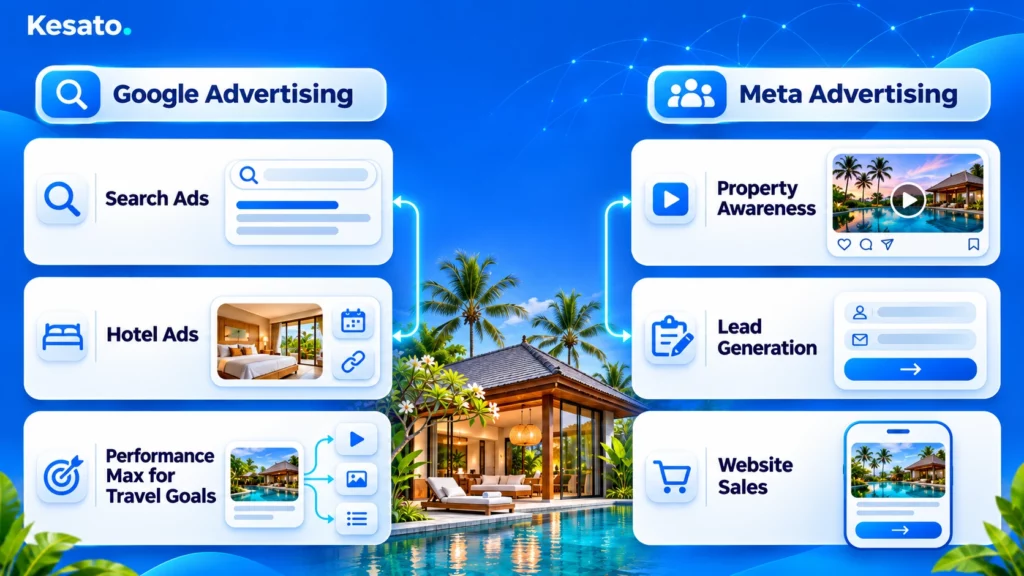
Search Ads for Relevant Hotel Searches
Search campaigns allow advertisers to reach users through relevant searches.
A Bali resort may evaluate queries related to its location, accommodation category or a specific experience. Campaign structure should distinguish search intent from irrelevant or overly broad traffic.
Before launching, examine:
- Whether relevant searches exist in the target market.
- Whether the hotel has a landing page that answers those searches.
- Whether the room or package being promoted is available.
- Whether a completed inquiry or booking can be tracked.
- Whether the hotel’s booking economics can support paid acquisition.
Brand searches require separate consideration. A traveller searching for the hotel’s exact name may already know the property, and paid brand conversions should not automatically be interpreted as entirely new demand.
Kesato’s existing guide to Google Ads and OTA brand bidding explores that issue in more detail.
Hotel Ads for Prices, Availability and Booking Links
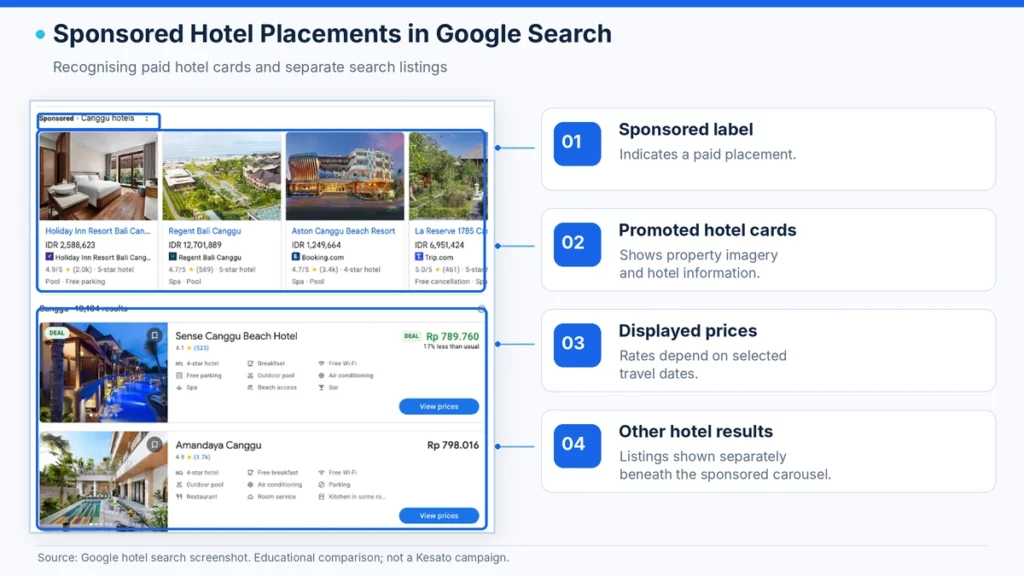
Google Hotel Ads can appear in hotel booking experiences associated with Search and Maps. They may display property information, room prices, availability and links to book.
This format differs from a standard keyword-based Search campaign.
Hotel campaigns require property information, current pricing, availability and appropriate booking landing pages. Hotels typically work with Hotel Center and an eligible booking or integration partner to provide that information.
Google explains these requirements in its hotel campaign documentation.
Important for 2026: Google discontinued Google-sourced third-party hotel rates after September 30, 2026. Affected advertisers need an appropriate direct price-feed setup through Hotel Center or an integration partner to continue serving on the affected Hotel Ads inventory. The relevant Google policy notice explains the change.
Before budgeting for Hotel Ads, confirm that the property, rate feed, booking links and campaign eligibility are ready. Do not assume every accommodation business has the same access or technical setup.
Performance Max for Travel Goals
Performance Max for travel goals helps eligible hotel advertisers reach users across multiple Google advertising surfaces.
Unlike Search campaigns that centre on search queries, Performance Max uses automated delivery across supported Google inventory. It can use property-specific assets and hotel information to support booking goals.
This creates an opportunity to reach guests at different stages. However, automation does not remove the need for accurate conversion signals, reliable booking data and suitable creative.
Google’s Performance Max for travel goals documentation explains its cross-channel scope and property-specific reporting.
Before evaluating it, confirm the property’s eligibility, hotel feed arrangements and measurement capabilities. The availability of Hotel Ads placements also depends on the applicable rate-feed requirements.
The practical choice: Evaluate Search for relevant queries, Hotel Ads for eligible hotel-booking inventory and Performance Max for broader automated reach when your property data and measurement are sufficiently prepared.
Where Meta Ads Can Support Hotel Marketing
Meta Ads can help hotels reach people through advertising experiences on Facebook, Instagram, and supported messaging environments.
Its value is not limited to likes or followers.
A hotel can use Meta to introduce a property, communicate a travel experience, generate qualified inquiries, or support website conversions. The appropriate campaign objective and conversion location depend on the business goal.
Meta’s official campaign objective training explains why you should align objectives with conversion locations and performance goals.
Introducing a Property Through Visual Discovery
Hotels sell experiences, not just rooms.
High-quality photography and video can help potential guests understand a private villa’s design, a resort’s beachfront location or the atmosphere of a wellness retreat.
For a property with limited brand awareness, this can be a useful way to begin building interest.
Creative should answer real guest questions:
- What makes this property different?
- Who is the experience designed for?
- What does the room or facility actually look like?
- Where is the property located?
- What should an interested guest do next?
Beautiful imagery alone is not a strategy. It needs an accurate offer, a suitable audience and a clear next step.
Generating Qualified Inquiries and Bookings
Meta can support different inquiry and conversion journeys.
A wedding venue may prefer to collect event requirements through a lead form. A villa may receive questions through messaging. Another hotel may send guests to a website booking engine.
These actions need different success definitions.
A submitted event inquiry is not the same as a qualified wedding opportunity. A click to WhatsApp does not prove that a conversation occurred. A website booking-button click is not a confirmed reservation.
Before selecting a conversion-focused objective, verify what the hotel can actually measure. Ensure the reservations or sales team can respond, qualify and record the outcome.
Kesato’s guide to running Meta Ads for Bali businesses covers objectives, campaign setup and tracking considerations in greater depth.
Retargeting and Audience Considerations
Retargeting can help a hotel reconnect with eligible audiences that previously interacted with its website or marketing content.
For example, someone who viewed a room category but did not complete a reservation might later encounter relevant advertising, where privacy settings, consent and audience eligibility allow it.
That does not guarantee a booking or prove the ad caused the reservation.
Consent choices, platform policies, and browser restrictions may also affect audience availability and tracking.
For Bali hospitality businesses, international and domestic source markets may have different travel planning patterns. Consider the guests you can realistically serve rather than assuming a broad audience is always better.
The key question is not how many people Meta can reach. It is whether the campaign reaches appropriate prospects and supports a measurable business objective.
Before Spending: Is Your Hotel Ready to Advertise?
Choosing a platform before checking the booking experience can be expensive.
If a guest cannot find availability, understand the offer or complete a reservation, more advertising may simply send more visitors into the same problem.
Check Demand, Booking Experience and Offer Clarity
Before launching, review the experience from the guest’s perspective.
- Target demand: Is there evidence of relevant search interest or a well-defined audience need?
- Offer clarity: Are the room type, dates, inclusions and relevant terms understandable?
- Mobile experience: Can visitors navigate and access the booking or inquiry route?
- Availability: Are promoted rooms or packages actually bookable?
- Booking handover: Does the website connect correctly to the booking engine?
- Direct-booking proposition: Is the value of booking directly clear, where relevant?
Do not assume a direct-booking strategy requires abandoning OTAs. The objective is to make the hotel’s own channels useful and competitive within its wider distribution mix.
Kesato’s article on increasing direct bookings for Bali villas explores the booking journey and the relationship with OTA distribution.
Check Creative Assets, Tracking and Lead Handling
Next, review the systems that support the campaign.
Hotel advertising readiness checklist:
- The hotel has one clear primary campaign objective.
- The target guest segment and source market are defined.
- The landing page or inquiry path works on mobile.
- Room descriptions, prices and availability are accurate.
- Creative assets match the actual property and offer.
- Conversion tracking distinguishes leads from confirmed bookings.
- The reservations team knows who will handle incoming inquiries.
- The hotel can review campaign costs against relevant business outcomes.
If several checks fail, address the most serious gaps before scaling advertising.
For example, a resort with strong Meta videos but no reliable response process may need to improve inquiry handling before buying more leads.
Likewise, a hotel considering Google Hotel Ads may need to resolve booking-feed or rate-accuracy issues first.
Google Ads vs Meta Ads for Hotels: A Practical Decision Matrix
Use the following matrix as a starting point for choosing which channel to evaluate.
It is a practical editorial decision aid, not a proprietary Kesato methodology or an official Google or Meta benchmark. It synthesises platform capabilities and common hospitality measurement principles with AI-assisted editorial support.
The recommended channel is a hypothesis to test. Actual results depend on the hotel, market, creative, booking systems and available data.
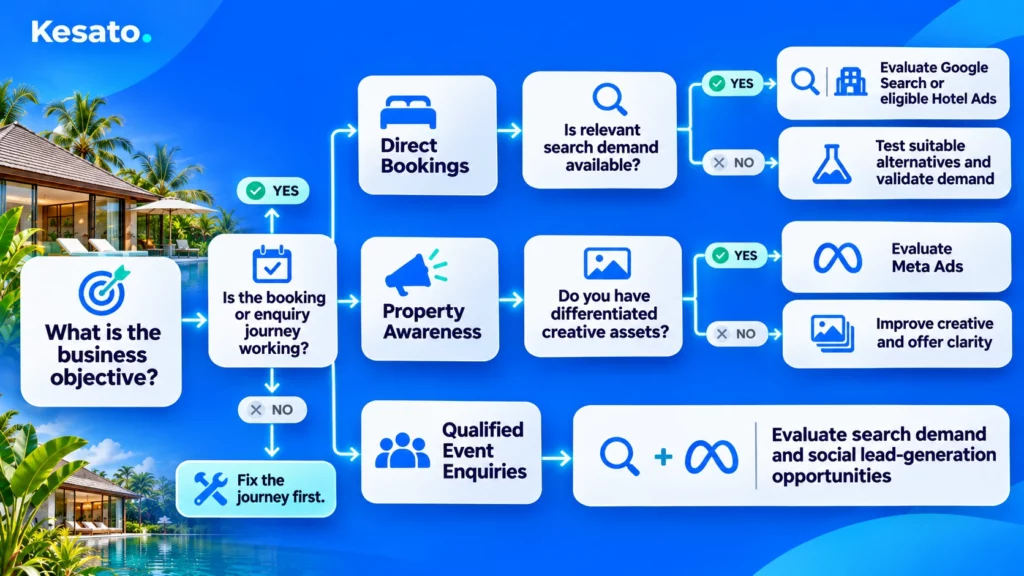
| Hotel situation | Channel to evaluate | Why | Check first |
|---|---|---|---|
| Established hotel with relevant searches | Google Search or eligible Hotel Ads | Reach existing search and hotel-shopping interest | Demand, rates, booking journey and tracking |
| New villa with strong visual assets | Meta Ads | Introduce the property and its experience | Audience, creative, offer and inquiry path |
| Resort promoting a seasonal package | Google and Meta | Combine relevant searches with visual promotion | Availability, demand, creative and measurement |
| Wedding or retreat venue | Google and/or Meta | Reach active venue searches and generate suitable inquiries | Qualification criteria and sales follow-up |
| Hotel with broken booking functionality | Fix the booking journey first | Changing platforms will not resolve the failure | Booking test and responsible technical owner |
| Property receiving traffic but few bookings | Diagnose before reallocating | The problem may involve traffic, offer, tracking or reservations | Verified funnel and booking outcomes |
Established Hotel With Relevant Search Demand
Imagine an established resort in Nusa Dua whose location and accommodation category already receive relevant searches.
Google Search may be worth evaluating because travellers are actively expressing what they need. Hotel Ads may also be relevant if the property has the required technical setup.
The team should review query relevance, competition, landing pages and the cost of acquiring a booking.
Meta can still contribute through property storytelling, package promotion or other suitable objectives. There is no reason to exclude it simply because the hotel already has search demand.
Newly Opened Villa or Boutique Hotel
Consider a new boutique villa in Ubud with limited brand recognition.
Professional photography and video may help introduce the villa’s architecture, atmosphere and guest experience through Meta.
At the same time, Google Search may still provide opportunities for non-branded accommodation queries.
The decision depends on whether the property has enough differentiated creative, a relevant audience and a clear booking proposition.
A new property should not automatically choose Meta. Search demand and competitive conditions still deserve investigation.
Resort Promoting a Seasonal Package
A resort promoting a wellness weekend or family stay package may have two different advertising opportunities.
Meta can communicate the experience visually. Google can reach people searching for relevant accommodation or travel arrangements.
Both campaigns should lead to information that matches the promotion.
Before launching, verify the package dates, room availability, inclusions and booking terms. If the offer is difficult to understand or unavailable, the advertising platform is unlikely to be the main problem.
Wedding, Retreat or Event Venue
A hotel selling wedding, corporate retreat or group event packages often needs qualified inquiries rather than immediate room purchases.
Google may reach people searching for a suitable venue. Meta may help prospective organizers imagine the event and submit an inquiry.
The key KPI should reflect inquiry quality.
For example, a qualified event lead could require a relevant date, estimated group size and event requirements. The hotel’s sales team, not a generic platform definition, should set these criteria.
Evaluate the cost of qualified opportunities and their progression to confirmed business, not just the number of forms submitted.
How to Compare Google and Meta Ads Performance
It is tempting to compare Google and Meta using cost per click or the return shown in each advertising dashboard.
Those numbers can be useful, but they do not necessarily measure the same outcome.
A fair comparison starts with a shared business objective and a documented definition of conversion.
Match Campaign Objectives to Business KPIs
Different hotel objectives require different measures of success.
| Business objective | Leading indicator | Business KPI | Verification |
|---|---|---|---|
| Build hotel awareness | Relevant reach and engagement | Measured discovery or consideration | Consistent audience research or suitable study |
| Increase direct bookings | Booking-page visits and booking starts | Confirmed reservations and acquisition cost | Booking engine and reservation records |
| Generate wedding inquiries | Completed lead forms and received inquiries | Qualified opportunities | CRM and sales qualification |
| Promote stay packages | Offer-page visits and booking intent | Confirmed package bookings | Reservation and package records |
| Re-engage interested visitors | Return visits and attributed actions | Verified bookings and incremental effect where measurable | Booking data and attribution review |
For direct bookings, cost per confirmed booking can be more meaningful than cost per click.
It is also important to consider the value of the reservation, relevant acquisition costs and the cost of delivering the stay.
A high reported return on ad spend does not necessarily mean high profit.
Track Inquiries, Booking Starts and Confirmed Reservations
A reliable measurement setup distinguishes each meaningful stage.
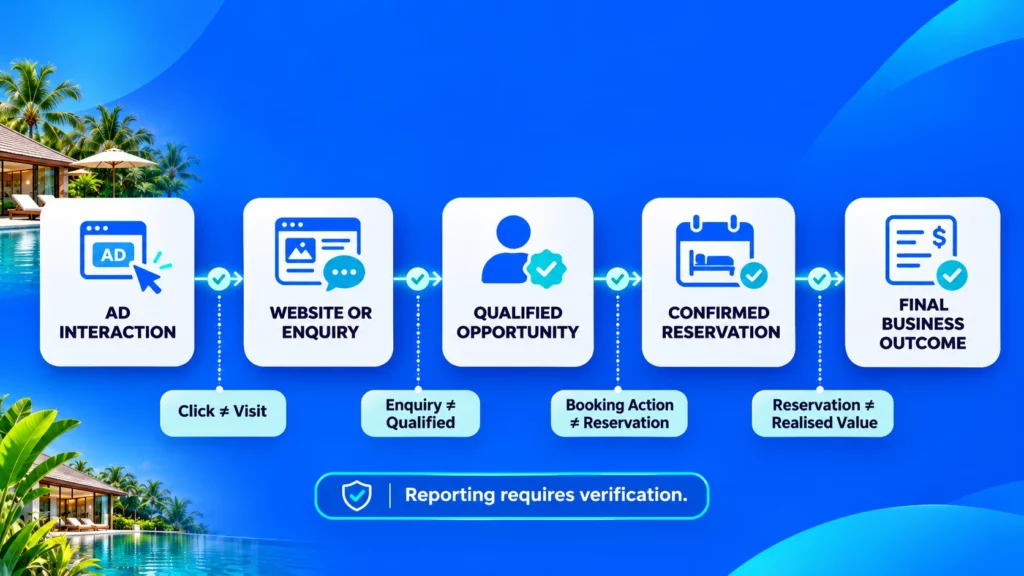
Use the following sequence:
- Ad interaction: A person clicks or otherwise interacts with an advertisement.
- Website or inquiry action: The person visits a page, submits a valid form, or starts a measurable inquiry.
- Qualified opportunity: The inquiry meets the property’s business criteria.
- Confirmed reservation: The booking is recorded in the hotel’s reservation system.
- Final commercial outcome: Booking changes, cancellations and realised value are reconciled where relevant.
Each stage requires appropriate measurement.
For Google Hotel Ads and travel campaigns, Google provides hotel conversion measurement guidance, including implementation on booking confirmation pages and the use of transaction identifiers to help prevent duplicate booking counts.
Meta website events and CRM data also require validation. Do not assume the Meta dashboard alone contains the hotel’s complete reservation history.
If the hotel receives bookings by phone, email or WhatsApp, it may need an additional approved process to document their outcomes.
Understand Attribution and Platform Reporting Differences
The same guest may interact with both advertising platforms before making a reservation.
Google Ads and Meta Ads can assign conversion credit under different reporting rules, attribution settings and observation windows.
As a result, the number of platform-reported conversions may not equal the number of unique confirmed reservations.
For a more useful comparison:
- Align the reporting periods where practical.
- Document each platform’s attribution settings.
- Use consistent definitions for qualified leads and bookings.
- Review website analytics alongside campaign reports.
- Reconcile actual reservations with booking or CRM records.
- Separate attributed results from proven incremental impact.
Incrementality asks whether the advertising created an outcome that would not otherwise have happened. Standard platform attribution reports do not fully answer that question.
Where the budget and data support it, appropriately designed experiments can provide stronger evidence about incremental contribution.
Until then, report platform-attributed conversions as attributed results, not guaranteed additional revenue.
How Should a Bali Hotel Allocate Its Advertising Budget?
There is no universal Google Ads versus Meta Ads budget split for Bali hotels.
A fixed percentage ignores the hotel’s demand, booking value, operating costs, seasonality and readiness.
Instead, establish a starting hypothesis and use a controlled evaluation process.
Choose a Starting Channel Based on Evidence
Begin by reviewing six factors:
- Business objective: Is the priority awareness, direct bookings, event leads or a specific package?
- Demand: Are there relevant searches, or does the property first need to communicate its value?
- Guest market: Which domestic or international audiences are realistically relevant?
- Operational readiness: Can the hotel receive and fulfill the resulting inquiries or bookings?
- Measurement: Can the hotel verify the outcome beyond clicks and impressions?
- Commercial economics: What can the hotel afford to spend to acquire a profitable booking or qualified customer?
For direct-booking campaigns, calculate the maximum acceptable acquisition cost from the hotel’s relevant contribution economics and financial goals.
Consider the expected booking value, variable servicing costs, transaction costs and the value of any other distribution costs being compared.
The result should come from the property’s records, not an assumed hospitality benchmark.
Then choose a test scope that fits your budget and the evidence you can realistically collect.
A smaller budget may require prioritising one objective and one channel rather than launching many fragmented campaigns at once.
Test, Review and Reallocate Without Guesswork
Once the campaign is live, evaluate whether the measurement system works before interpreting business performance.
Begin with delivery and technical checks. Confirm the correct destination, working links and expected conversion events.
As data accumulates, examine lead quality, booking outcomes and relevant acquisition costs.
Do not move the budget after one unusually good or bad day. Consider conversion delays, sample size, market conditions and campaign changes.
Reallocate when the evidence supports a decision, not because one platform appears to have a lower CPC.
If both platforms are running, keep objectives and measurement definitions clear. A useful test may compare whether each channel reaches a distinct audience, supports a different stage or contributes to a verified business outcome.
For more context on campaign evaluation and learning, read Kesato’s article on how long Google Ads takes to work. Treat any timeline as contextual rather than a universal guarantee.
What If Your Ads Get Clicks but Not Hotel Bookings?
Consider a hypothetical boutique villa running Meta Ads.
The campaign attracts clicks, but the owner cannot find corresponding confirmed reservations. The immediate reaction might be to stop Meta and move the budget to Google.
That could be the wrong diagnosis.
First, locate where the guest journey stops producing verifiable results.
Diagnose Traffic and Audience Problems
Start with the advertising and landing-page data.
- Clicks but few actual visits: Check page loading, link destinations and tracking definitions.
- Visits but little relevant engagement: Review audience fit, ad messaging and landing-page relevance.
- Interest in the offer but few booking starts: Check room clarity, rates, dates and availability.
- Many inquiries but few qualified leads: Review targeting, promises in the creative, and inquiry qualification.
The result of each check should guide the next action.
If the ad promises a private-pool experience that the landing page barely explains, the problem may involve messaging or page content rather than platform selection.
If the campaign reaches users outside the hotel’s practical target market, adjust the audience or campaign settings.
Diagnose Website, Inquiry and Tracking Problems
Next, investigate the technical and operational journey.
- Booking button works, but the engine fails: Reproduce the error and contact the relevant technical provider.
- Forms submit, but nobody follows up: Review notification delivery, ownership and reservation response processes.
- Platform reports bookings, but the PMS does not: Test conversion triggers, duplicates and attribution.
- Bookings exist, but channel attribution is unclear: Improve reporting while clearly acknowledging the remaining limitations.
Do not increase advertising spend until you resolve major booking failures.
Likewise, do not declare a platform unsuccessful because its dashboard reports fewer conversions without first checking what the conversion numbers represent.
Practical troubleshooting sequence:
- Confirm the business outcome you expected.
- Locate the last stage supported by reliable evidence.
- Check the next stage for technical, commercial or operational problems.
- Assign a responsible person and resolve the verified issue.
- Retest the journey before changing the campaign strategy.
This method helps distinguish advertising problems from booking-system, tracking and reservation-process problems.
Final Takeaway: Choose Channels Around Business Goals
Google Ads and Meta Ads can both support hospitality marketing in Bali. Their value depends on how they fit the property, its guests and the business outcome being pursued.
Google Search and Hotel Ads may be useful when relevant demand already exists. Meta can introduce a property’s experience and generate inquiries. Both can play a role when their objectives and measurement are clear.
However, neither platform can compensate for an unclear offer, a broken booking journey or unreliable reservation tracking.
Start with the business problem. Check the hotel’s readiness. Select the channel that fits the opportunity, then evaluate verified outcomes instead of relying on clicks alone.
For hotel teams reviewing broader campaign planning and execution, Kesato’s contact page provides a way to explore the agency’s services.
Frequently Asked Questions
Are Google Ads or Meta Ads Better for Hotel Bookings?
Neither is universally better. Google Search and eligible Hotel Ads may suit existing accommodation demand, while Meta can support property discovery, inquiries and website conversions. Compare them using booking readiness, relevant audiences, verified reservations and acquisition economics rather than click costs alone.
Can Meta Ads Generate Direct Hotel Reservations?
Yes, Meta can support direct-booking campaigns when an appropriate objective, website or booking destination and reliable conversion measurement are available. However, a link click, message opening or reported website event should not be treated as a confirmed reservation without verification.
Should a New Bali Hotel Start With Google or Meta?
Start by examining search demand, differentiation, creative assets and booking readiness. Meta may help introduce an unfamiliar property, while Google can reach relevant non-branded searches. A newly opened hotel should test the channel best aligned with its objective rather than choosing automatically.
Can Hotels Run Google and Meta Ads Together?
Yes. A hotel can use the platforms for complementary purposes, such as reaching relevant searches and introducing experiences visually. Establish distinct objectives, track important outcomes consistently and avoid adding together platform-reported conversions as if they were unique bookings.
How Much Should a Hotel Spend on Paid Ads?
There is no universal budget or Google-to-Meta percentage. Base spending on business goals, expected booking contribution, available demand, tracking quality and the ability to run a meaningful test. Review verified acquisition outcomes before increasing the investment.